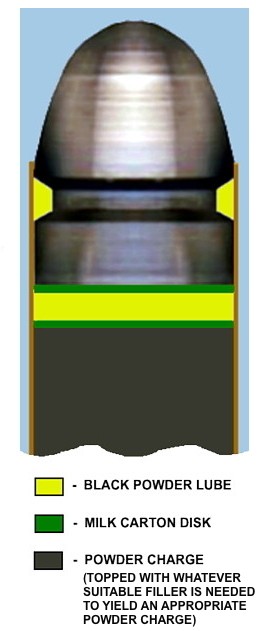
Here is my take on the subject:
1. One reason that under-bore-size expanding-base bullets like the Minié design do not work optimally when loaded in self contained cartridges in a breechloader is that, ideally, the expansion/flaring of the bullet skirt must commence at the instant that the powder charge goes off, while inertia is acting to try to keep the bullet stationary ... and such bullets work well in the muzzle-loaders they were designed for because that can happen. However, confinement of such a bullet in the mouth of a cartridge case prevents (or at least significantly retards) that skirt expansion until the base of the bullet has moved forward far enough to be clear of the case mouth. That is too late for the maximum skirt flaring to take place, and in my view this factor also likely results in somewhat inconsistent degrees of skirt expansion from shot to shot, thus affecting accuracy. This confinement factor was undoubtedly less of a problem in the coiled-brass Boxer cartridge cases back then, but is more pronounced in modern solid/drawn brass cases, which yield more consistent accuracy with solid-base bullets which start out as a tight fit in the bore.
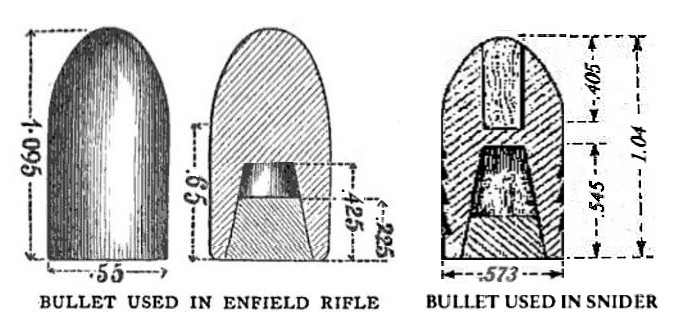
2. Note that both the original Pritchett bullet and the Snider bullet had an "expansion plug" seated in the base cavity (... the standard plug material which the British settled upon was baked/fired clay ...) which greatly improved the expansion of the bullet into the rifling. Modern Minié bullets lack this feature.
3. Also, the bullet design arrived at for the Snider breechloader differed significantly from the Pritchett-style bullets which had worked so well in the .577 Enfield muzzle-loading rifles and, despite some superficial similarities of appearance, they also differed significantly from the Minié-type bullets for which moulds are now available ...
Although the standard Pritchett bullet was well under bore size, it was effectively rammed down on the powder charge as a paper-patched projectile, still encased in the greased portion of the wrapping of the paper cartridge, and of course was effectively confined only by the bore of the rifle itself, so it could expand well into the rifling as soon as the propellant charge exploded (as mentioned above.)
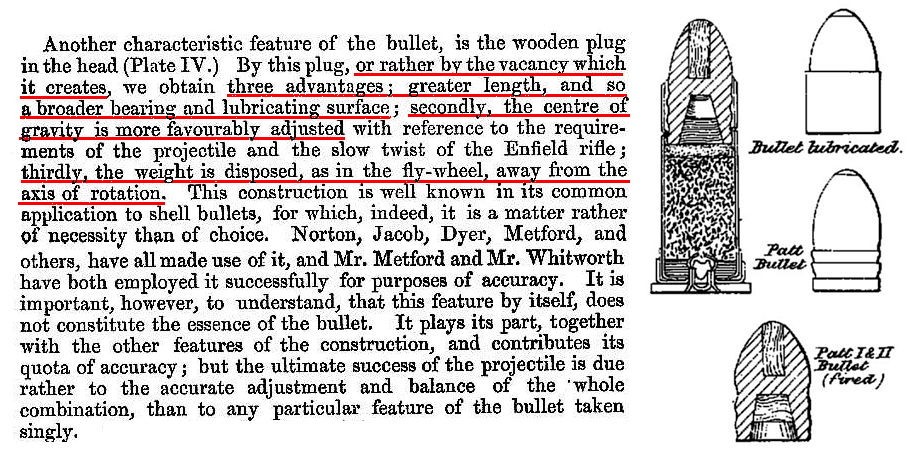
In contrast, the slightly shorter Snider bullet was almost .025" greater in diameter, and had a deeper base cavity as well as cannelures to carry some lubricant ... but the really significant design difference was the nose cavity which was present in every version of bullet used in Snider cartridges. This cavity (originally filled with a boxwood plug as seen in the above diagram, but later simply left as a void in the bullet nose with the lead spun over the opening so it was not visible) was incorporated to offset the sizeable base cavity, thus improving the ballistic stability of the bullet by moving the longitudinal center of gravity back toward the middle of the projectile. For some reason unknown to me, this feature had not been necessary with the Pritchett bullet (perhaps because of its smaller base cavity and different length) but without such a nose cavity Minié-type bullets may be prone to wobble, or even tumble, when loaded into a cartridge case and fired from Snider.

This passage is extracted from a period treatise on Snider ammunition:
By comparison, the bullets of about .60" diameter which so many of us have success with in the Snider tend to be relatively short and, because they are already of a sufficient diameter to engage the rifling, do not need a hollow base for expansion; accordingly, being solid-based, they do not suffer from the stability issues of hollow-base bullets dicussed above. Also, most of these designs have one or more quite deep and wide grease grooves, so they carry much more lubricant than the original design, to keep the fouling soft. I tend to shoot my Sniders under "field conditions" ... loading from the cartridge pouch ... so although I need effective lubricant to keep the fouling soft through multiple shots, dipping of the bullet nose in Udderly Smooth or a similar lube is not practical for me, although it works quit well shooting from the bench at a range. I have accordingly developed a load which uses a well-lubed solid-base bullet of the type I have just described, with a "grease cookie" (a fairly thick disk of the same soft lube, sandwiched between card wads punched from milk carton material) between the powder charge and the base of the bullet. For reduced powder charges, I ca top off the propellant with a filler such as corn meal (or an "active filler" of 50/50 corn meal/black powder.) With such loads I have no trouble maintaining accuracy through strings of ten to twenty shots without cleaning.