gunsmith a snider enfield

yes breech plug on a not so cared for muzzle loader ,wouldn't budge and before getting rammy and marking things up.Boiled it for about an hour or so with a tiger torch and 4 foot pipe capped at one end topping up water periodically .While still hot the plug removed and seemed almost hand tight ,very little force and before wouldn't budge.......then sprayed the barrel down with wd 40 to stop flash rusting
But the bonus was after it cooled off decided to clean up the outside of the barrel the brown rust and scale turned black from the boiling and used the fine wire carding wheel the barrel actually polished up blue

can't find pics of before and after
 
yes breech plug on a not so cared for muzzle loader ,wouldn't budge and before getting rammy and marking things up.Boiled it for about an hour or so with a tiger torch and 4 foot pipe capped at one end topping up water periodically .While still hot the plug removed and seemed almost hand tight ,very little force and before wouldn't budge.......then sprayed the barrel down with wd 40 to stop flash rusting
But the bonus was after it cooled off decided to clean up the outside of the barrel the brown rust and scale turned black from the boiling and used the fine wire carding wheel the barrel actually polished up blue

can't find pics of before and after

THANKS VERY VERY MUCH ! YOUR advice worked a1 first try !! NOW HAPPY !

been soaking THINGS since my last post ( 6 days ) got advise from a gent member pmatuk to try BOILING MY BREECH BLOCK in a pot ( boiling water with a dash or 2 of common dish soap.


i tried this ( about an hour, topping up the water as it boiled off. ) when still hot i put on work gloves and then did 3 or 4 good wraps on a wood block, AND OUT CAME THE LUG / BOLT easy as could be.


it was still quite gummed up AND DIRTY looking so im cleaning up the hole and this lug now so hopefully itll go ok.

FOLLOW UP QUESTION -----

how long should the spring located in the block, behind the lug be ? the one wich is now out is about 1/4 inch lenth un-compressed. is this sound correct ?
 
The boiling water and soap trick is somewhat surprising what it will loosen .
the spring length sounds about right as it doesn't have to push much to lock the bolt in place
 
/MY original SPRING MUST BE weak / worn/ took a set, , so i went to canadian / bulgarian tire found a spring for 1.70$ got home cut it about 3/4 inch long ( slightly to long , trimmed it slightly shorter and retried, now the lug sticks out enough to lock and retracts in when the level is pressed on the blocks side.
now have to wait for other bits to arrive .
thanks for the trick on boiling pmatuk , ive sharred it on other snider groups !
 
Some very knowledgeable guys in this thread.
So here is where I will ask my question.
I have 3 band Snider Enfield 1861. When I watched my friend slug my barrel it seemed that the last 8 to 10 inches toward the breech was considerably larger in diameter than the rest of the bore. Is there a schematic on the barrel/bore diameter available, or does someone know whats going on.
Thanks
 
if in the end all looks good and its shooting time try 10 grains 3f on the bottom with 40 gr pyrodex on top try to get bullet from a parker hale mould made for enfields ...shallo flat base recess lubed etc ,,good place to start good luck you could be heading into an addiction
 
Bore size was .577" from end to end. Groove size tapered from .012-.014" at breech to .007" at muzzle.
 
The information supplied by "green" is correct. The .577 family of Enfield muzzle-loading rifles had this "progressive depth rifling" to permit maxium expansion of the hollow-based bullets at the breech, with a "swaging effect as the projectile travelled down the bore with its progressively shallower grooves. This feature of course remained in the barrels of the muzzle-loading rifles which got converted into Mark I and II Snider-Enfield rifles, and was also duplicated in the steel barrels purpose-made for Mark III S-E rifles.
 
so since it seems quite a fw sniders shoot better with th .600 size bullets, and i do not doubt the above info theses gents know sniders better than i, then why now the 575 bullets dont shoot as well in a snider? or is it a test try and work out whats best situation?

i simply would like to avoid re inventing the wheel if the knowledge is available ....SEASONS BEST TO ALL OF COURSE!
 
NB.nagantsniper: For my Snider shooting I play with many different bullet options. After a few hundred test rounds I found I could get pretty good accuracy with .575 Lee minies as long as I didn't use anything compressible between powder and bullet. In short, I got acceptable groups with cream of wheat right up to base bullet or, in my new favorite approach, with thick cork gaskets taking up the excess case volume at the base (around the primer pocket). In the latter case I only need to put a tiny pinch of cotton fiber between powder and bullet- just as in original Boxer loads. With these I have approached the typical accuracy of .60's.

I also cast .59 and .60 bullets for my Snider but, like others, definitely see the need for extra lube beyond what can be carried in the grooves for top accuracy. Many dip the nose of the bullet in "udder creme" before chambering. This gets a bit messy and, of course, is not historically relevant. However, if shooting an excellent group with a Snider is your goal this appears to be the way to go. The minie loads are historically more relevant and allow you to shoot the same loads out of any Snider but be prepared for wild shooting as you get into it.

The British were well aware of the possibility of using groove fitting bullets when the Boxer Snider ammo was invented. One reason they chose to go with the sub-bore muzzle-loading type bullet was that they feared too much lube would be stripped off as the bullet was forced into the rifling (remember modern use of udder-creme!). The Boxer ammo was successful in that hundreds of rounds could be fired without cleaning and with no loss of accuracy. When the British finally did introduce a larger than bore bullet for the Martini (and it still wasn't groove size) it was lubricated by both wax covered paper patch on the bullet and a thick wax cooky below the bullet.

milsurpo
 
Here is my take on the subject:

1. One reason that under-bore-size expanding-base bullets like the Minié design do not work optimally when loaded in self contained cartridges in a breechloader is that, ideally, the expansion/flaring of the bullet skirt must commence at the instant that the powder charge goes off, while inertia is acting to try to keep the bullet stationary ... and such bullets work well in the muzzle-loaders they were designed for because that can happen. However, confinement of such a bullet in the mouth of a cartridge case prevents (or at least significantly retards) that skirt expansion until the base of the bullet has moved forward far enough to be clear of the case mouth. That is too late for the maximum skirt flaring to take place, and in my view this factor also likely results in somewhat inconsistent degrees of skirt expansion from shot to shot, thus affecting accuracy. This confinement factor was undoubtedly less of a problem in the coiled-brass Boxer cartridge cases back then, but is more pronounced in modern solid/drawn brass cases, which yield more consistent accuracy with solid-base bullets which start out as a tight fit in the bore.

2. Note that both the original Pritchett bullet and the Snider bullet had an "expansion plug" seated in the base cavity (... the standard plug material which the British settled upon was baked/fired clay ...) which greatly improved the expansion of the bullet into the rifling. Modern Minié bullets lack this feature.
EyQA4a.jpg

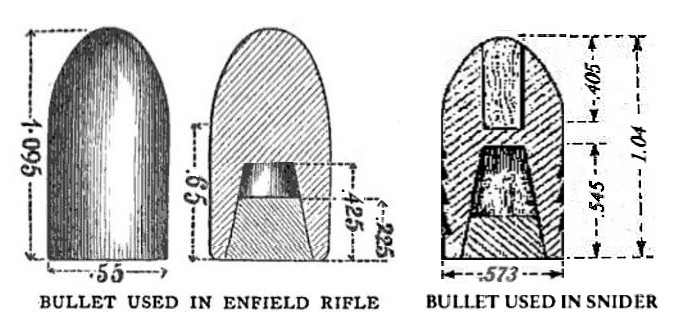
3. Also, the bullet design arrived at for the Snider breechloader differed significantly from the Pritchett-style bullets which had worked so well in the .577 Enfield muzzle-loading rifles and, despite some superficial similarities of appearance, they also differed significantly from the Minié-type bullets for which moulds are now available ...

Although the standard Pritchett bullet was well under bore size, it was effectively rammed down on the powder charge as a paper-patched projectile, still encased in the greased portion of the wrapping of the paper cartridge, and of course was effectively confined only by the bore of the rifle itself, so it could expand well into the rifling as soon as the propellant charge exploded (as mentioned above.)

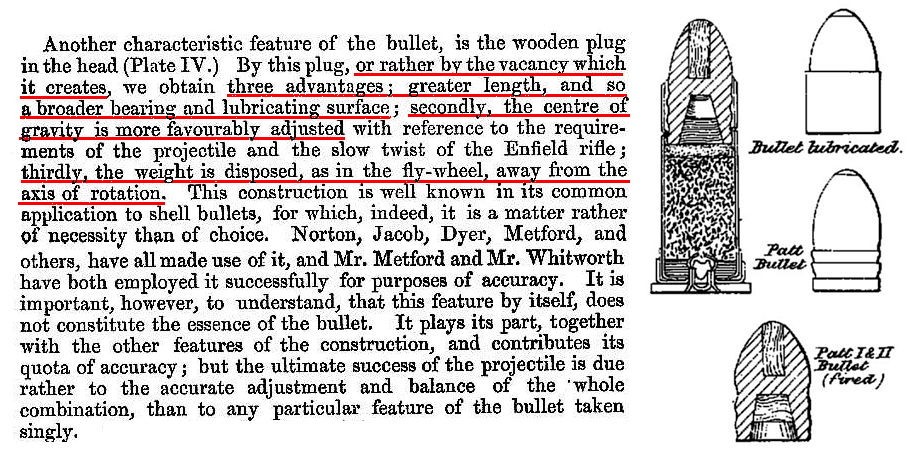
In contrast, the slightly shorter Snider bullet was almost .025" greater in diameter, and had a deeper base cavity as well as cannelures to carry some lubricant ... but the really significant design difference was the nose cavity which was present in every version of bullet used in Snider cartridges. This cavity (originally filled with a boxwood plug as seen in the above diagram, but later simply left as a void in the bullet nose with the lead spun over the opening so it was not visible) was incorporated to offset the sizeable base cavity, thus improving the ballistic stability of the bullet by moving the longitudinal center of gravity back toward the middle of the projectile. For some reason unknown to me, this feature had not been necessary with the Pritchett bullet (perhaps because of its smaller base cavity and different length) but without such a nose cavity Minié-type bullets may be prone to wobble, or even tumble, when loaded into a cartridge case and fired from Snider. :confused:

This passage is extracted from a period treatise on Snider ammunition:
I0BYVp.jpg


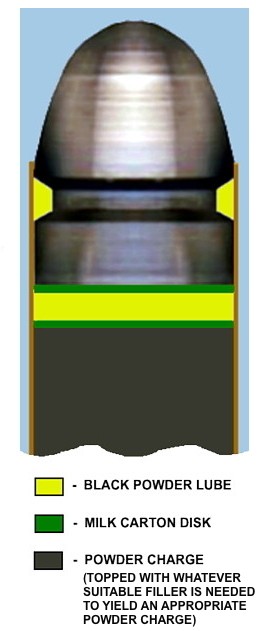
By comparison, the bullets of about .60" diameter which so many of us have success with in the Snider tend to be relatively short and, because they are already of a sufficient diameter to engage the rifling, do not need a hollow base for expansion; accordingly, being solid-based, they do not suffer from the stability issues of hollow-base bullets dicussed above. Also, most of these designs have one or more quite deep and wide grease grooves, so they carry much more lubricant than the original design, to keep the fouling soft. I tend to shoot my Sniders under "field conditions" ... loading from the cartridge pouch ... so although I need effective lubricant to keep the fouling soft through multiple shots, dipping of the bullet nose in Udderly Smooth or a similar lube is not practical for me, although it works quit well shooting from the bench at a range. I have accordingly developed a load which uses a well-lubed solid-base bullet of the type I have just described, with a "grease cookie" (a fairly thick disk of the same soft lube, sandwiched between card wads punched from milk carton material) between the powder charge and the base of the bullet. For reduced powder charges, I ca top off the propellant with a filler such as corn meal (or an "active filler" of 50/50 corn meal/black powder.) With such loads I have no trouble maintaining accuracy through strings of ten to twenty shots without cleaning.
dzT9E6.jpg
 
All excellent points made by GrantR. I would just add a couple of things:

1) If you use one of the available minie moulds you can put base plugs in. There are moulds available for forming them out of materials like "bondo", etc. I make mine out of wood.

2) If you study the history of the Boxer Snider ammunition it is baffling why Boxer went straight to the "carcass bullet" with nose cavity. The standard P53 bullet at the time was still the solid nose 530 grain variety (not actually the "Pritchett" bullet). In fact, the British had been testing the Metford "shell" bullet for some time and, in target shooting, it was superior to the standard service bullet. Boxer may have simply "borrowed" the idea as being state of the art. Unfortunately he went straight to a 525 grain version which was rapidly found to shoot "wildly" from the slow twist 3-band rifles. The day was saved by dropping bullet weight to 480 grains (Mk 3 to 9 ammo) which shows how close these bullets are to the edge of the stability field at Snider velocities.

3) The original Boxer ammo was actually very successful and period target shooting results show results that are right there with what today's best shooters can do with .60 solids (at the short ranges we currently shoot at). As GrantR points out, currently available minie moulds don't replicate the originals very well. The bullets they cast are actually more like what a P53 "service bullet" modified with grease grooves might have been like. There is no practical way to cast a nose cavity but a fellow in the US makes base plugs for the Lee moulds that extend the base cavity up toward the nose and may replicate the ballistics of the Boxer bullet. I've bought one but have yet to try it.

I also haven't tried a grease cooky under the bullet with my .60's but I think I'll have to give that a shot as an alternative to the udder creme dunk- Thanks for the idea Grant!

milsurpo
 
NB: If you're referring to the lengthened base plug for the bullet mould, it is being made by a guy named Robert Bradley in the US. Apparently he has a facebook page where he can be contacted. He calls it the plug for making Japanese style Snider bullets. The mould for making base plugs out of bondo, etc is sold by "NOE".

milsurpo
 
so far my project is going slow but forward. got my new to me nepal 3 bander stock, wich i will TRY to alter into a ersatz 2 bander stock.

currently am dremelling out the area that the shoe / the action sits in to fit my mk111. found out the mk111 is a larger action width/ chubby-r than the mk2 sniders.

lock fits in ok, ANYONE EVER DONE SIMILAR stock FITTING ?? any idea / advise most welcomed.
 
Back
Top Bottom