Halger280HVMag
CGN Ultra frequent flyer
- Location
- B.C. XMU Local .454
For a pistol destined to accompany a bush-pilot into wilderness areas.
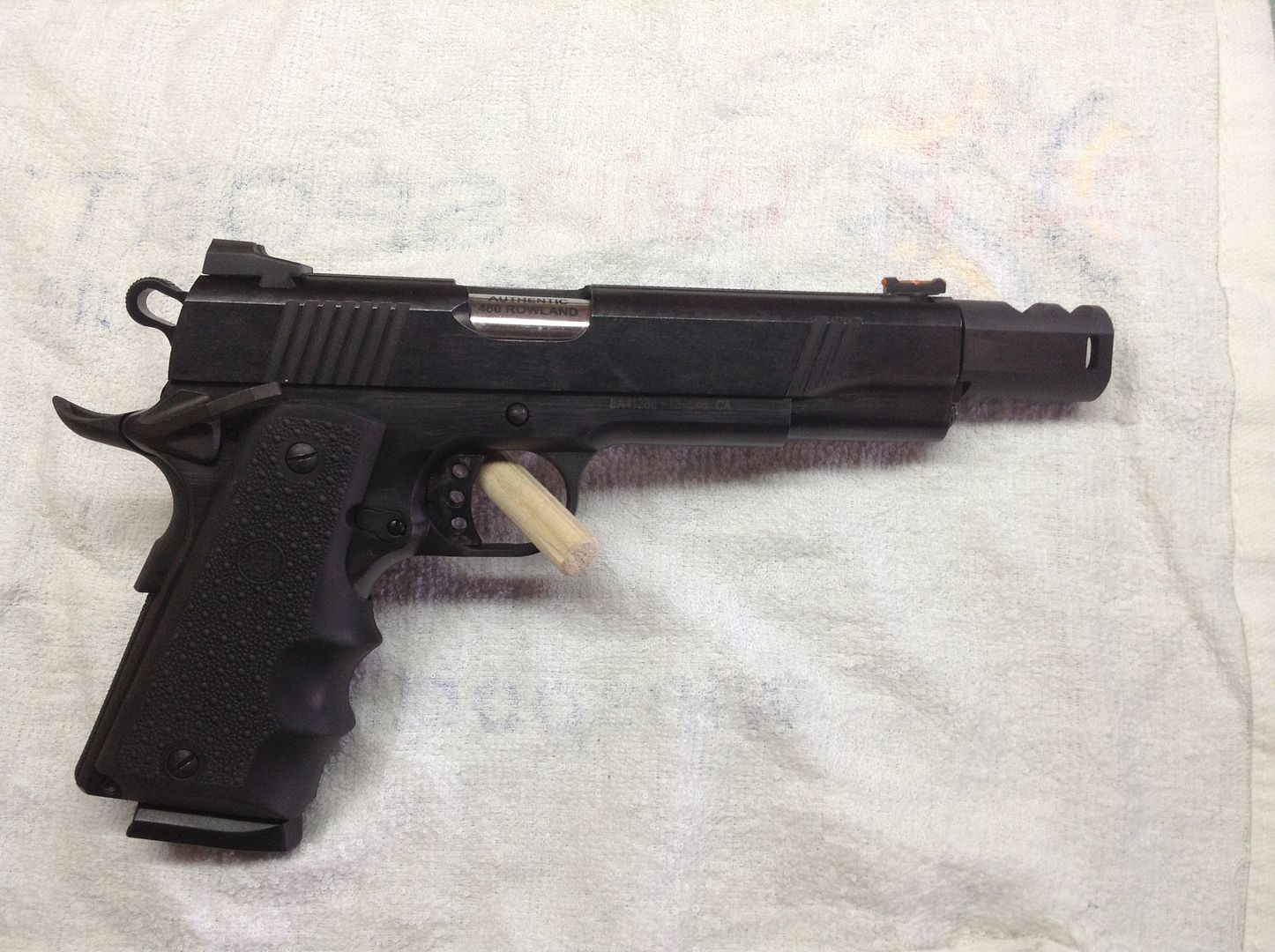
Here's what I have come up with.
Basically, a carefully tuned and smoothed Norinco NP-30.
Using a compensated barrel and 20# recoil spring and blue buffer.
Grip plates are very thin to make the big double stacker more user friendly.
they are also aluminum to afford some protection, in the event of a blown case.
Combined with a flat MSH, the pistol is not a lot thicker in the handle than a stock 1911.

The bullets are Lee 200 grain, cast very hard.
Powder longshot.
The cases.
Do not even think about using .45ACP cases.
.WW 45ACP cases weigh about 80 Grains on the powder scale.
.WW45-08 cases weigh an average 105 grains.
Wall thickness at the case mouth is about the same at about 10 Thousandths of an inch for both cases.
At the lower part of the case wall above the extractor groove.
The .45-08 case measures 75 Thou. in thickness.
The .45ACP case measures 35 Thou. in thickness.
That's a LARGE difference in case head strength.
I have no trouble obtaining 1500 fps with the 200 grain pills.
The extra weight of the NP-30, plus the compensator. Makes this gun very shootable.
The other plus, is ten rounds in the handle.
The following is an excerpt from the originator of the .45-08 cartridge.
So there you go!
Have fun Eh!
Here's what I have come up with.
Basically, a carefully tuned and smoothed Norinco NP-30.
Using a compensated barrel and 20# recoil spring and blue buffer.
Grip plates are very thin to make the big double stacker more user friendly.
they are also aluminum to afford some protection, in the event of a blown case.
Combined with a flat MSH, the pistol is not a lot thicker in the handle than a stock 1911.
The bullets are Lee 200 grain, cast very hard.
Powder longshot.
The cases.
Do not even think about using .45ACP cases.
.WW 45ACP cases weigh about 80 Grains on the powder scale.
.WW45-08 cases weigh an average 105 grains.
Wall thickness at the case mouth is about the same at about 10 Thousandths of an inch for both cases.
At the lower part of the case wall above the extractor groove.
The .45-08 case measures 75 Thou. in thickness.
The .45ACP case measures 35 Thou. in thickness.
That's a LARGE difference in case head strength.
I have no trouble obtaining 1500 fps with the 200 grain pills.
The extra weight of the NP-30, plus the compensator. Makes this gun very shootable.
The other plus, is ten rounds in the handle.
The following is an excerpt from the originator of the .45-08 cartridge.
The Armco 45-08 BD
What is it?
This is actually nothing new. Enterprising shooters have been creating stronger .45ACP cases for over 80 years, using first 30-06 cases, and recently .308. The mechanism by which this is achieved has varied, with more or less usable results.
Three things were needed and have recently come to pass:
1. First, a workable, professional way to prepare the cases, as opposed to the old methods of hacksawing and trimming the cases to length and then reaming the necks by hand. This resulted in uneven case wall thickness and poor cases (and worse accuracy). We have developed a die that holds the .308 case perfectly concentric to the reamer which then bottoms in the web of the case, ensuring a consistent depth of cut and identical case volumes. This is of course necessary in order to ensure consistent, safe, accurate loads. The cutting to length is achieved at the same time, with the case locked in place in the lathe. Repeatable and achieving a reasonable cost per case.
2. The second need was a good powder. Until a couple of years ago, shooters were experimenting with Unique, Blue Dot, even very good powders like Vihtavuori N105, the one I had the highest hopes for. The pressure was not a problem for the cases, but we hit the wall with primers. Even magnum rifle ones flowed and perforated, indicating pressures well above the 60,000 psi range. Mind you, we were getting a LOT of speed! Hodgdon brought out their new “Longshot” powder, and boy did it work! All of a sudden, another hundred plus FPS was attainable, with PISTOL PRIMERS!
3. The third need was for an understanding of how to keep a 1911 running under brutal conditions. That came from the experience of pistolsmiths such as myself with the knowledge of how to keep these guns running for a hundred thousand rounds or more of full power ammo. A few hundred rounds – even a couple thousand - of this stuff is no problem for a strong gun.
How does the gun survive 200 grain bullets at 1400+ fps? Contrary to the guys touting the .45 Super (a pretty anemic round compared to this), and even the .460 Rowland (which also uses a comp to control the slide speed), we do NOT need a 28 lb recoil spring. These brutal springs introduce new problems (we’ve tried them) such as harsh feeding and bullet setback and feed failures. Ejection really didn’t seem to be any less violent. A 20 or 22 lb spring works really well, especially if coupled with the excellent .200” Red Buff by Chuck Hiett. A necessity (because of the slide speed) is good, stiff magazine springs. New ones work, especially Para Ordnance ones, but worn out mag springs WILL cause nose-up feed failures. I recommend HD Wolff ones. The rest of the gun needs no modification, except that it needs to be a good strong, tight gun, with sufficient barrel lug engagement in order to avoid barrel and slide lug battering. No AMT’s or Auto Ordnance guns need apply. No surprise to me, we have a lot of Norinco’s in the woods with these loads, and they seem to last well. Not pretty but strong as hell. Sometimes a slightly longer link is beneficial if your barrel lock-up is less than optimal. A full length guide rod is nice, but not essential.
How about the shooter? One modification that REALLY helps is a good (not a drop-in) beavertail. Recoil gets quite noticeable. I have a guy running this stuff in a stock Commander, but it KICKS! And he’s not running max. loads… All that aside, these guns really don’t hurt like a Casull, or even a .44 Magnum. Pretty similar to a REALLY hot .38 Super. Everyone who shoots one asks for another magazine…
Now, as to loads. You can run almost whatever you like because of the tremendously strong cases, but for the HOT loads, try Longshot. We start at 10 grains of Longshot and a 200 grain hard cast SWC bullet. Large pistol primer. I know it seats a little below flush, but it works great. I’ve used Winchester and CCI with good results. For some guns with small firing pins – a couple of Springfield models, for instance – we have experienced pierced primers and have gone to rifle primers. If you use rifle primers in yours, loads stay the same and they go off just great. For 230’s, start at 9.0 grains. MY maximum (I suggest you stop before that) is 12.5 grains with the 200 for over 1500 fps, and 11.0 grains with a 230 grain Jacketed flat nose bullet. My suggestion is a MAXIMUM of 11.5 and 10.5 grains for these two weights. I have not played with lighter bullets because our need here is for a bear defense load, and we need penetration above all. This is the reason for the 200 grain hard cast bullet. The flat nose cuts through clean and at 1400 fps (the 11.5 grain load), it goes a long ways through muscle and bone. At 1500 it REALLY hits hard! The 230 grain Noslers I tested at about 1300 generated more slide speed and ejection (and pressure). I like the 200’s as the energy numbers (yes, I know, I know…) are substantially higher. My own loads generate a half ton of energy, and that’s exactly what my 4” 629 does for me. And the revolver – much as I dearly love it - is a noticeably bigger gun, slower to shoot (EXACTLY half the split times between aimed shots), and holds 6 rounds compared to 11 for my Para Ordnance. AND not nearly as nice to carry as a 5” 1911, even a “wide-body”.
Shootability? We have played a lot with these guns and my best time for four A-Zone hits on an IPSC target at 12 yards was .8 seconds. That’s from the first to fourth shot for just over a quarter of a second per shot. Not a pretty group but all four were center hits. Pretty slow by IPSC standards, but my best with the revolver is double that. That’s where we justify a load and gun combination like this in Bear Country. A bear at 12 yards starts a charge. You basically have time for 8 aimed shots with the auto and 4 shots with the revolver – If you have it out and ready. Given a shooter thoroughly familiar with the 1911, he has a hell of a lot better chance of walking away.
As a point of interest, my initial testing almost two years ago was with a commander-length barrel in a Springfield Defender. It ran a 2 port compensator, and was a sweet gun to shoot with these loads. It was when I switched to a non-compensated gun that the slide speed gremlins caught up with me and I had to pop new HD springs into my old Shooting Star magazines. I don’t need to mention that the gun should have a good well adjusted extractor in it to pull these empties out reliably, but we have never had a problem getting empties out!!
To date, the threshold is caused not by pressure or gun battering, but by recoil and slide speed, as well as primer flow and blowby. Not that we need to push past that particular threshold at all. I think we have what we need. A gun that will never match a .454 Casull, but is a very viable alternative to a short, carryable .44 Magnum with more firepower, similar power, and better ergonomics.
Going further? 6” slide guns, 5 ½” barreled compensated carry guns, etc. all would make sense for Bear Carry, and would raise the bar of performance. 1600 fps with 200’s is easily attainable with the right barrel length and a comp, but do we need it?
What’s this NEED stuff, anyway J??
In conclusion, please realize that I don’t know your gun or reloading practices, and I urge you to start low and be careful. Use your chronograph. You ARE on your own. And I really appreciate feedback. I have a couple of neat videos of these loads being fired, and more would be great.
Gunnar Christensen
So there you go!
Have fun Eh!