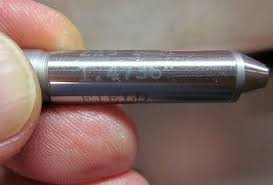
Below is a Colt AR15 NO-GO gauge 1.4736
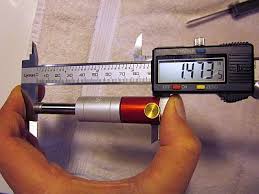
Below is the same NO-GO gauge in my "calibrated" Hornady cartridge case headspace gauge
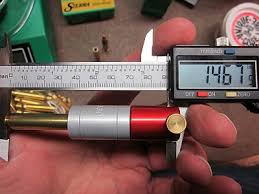
Below is a "FIRED" Lake City 5.56 case in my Hornady gauge
When you measure the case after firing you need to remember and factor in brass spring back from the chamber walls. And if you neck size only the shoulder will continue to move forward with each firing. The amount the case shoulder keeps moving forward until it conforms to chamber dimensions depends on annealing and work hardening of the brass.
Bottom line the photo above of my "fired" 5.56 case is "shorter" than the chamber. But its measurement is close enough to give it .003 shoulder bump for my AR15 rifles.
I full length resize all my cases except for my .303 British Enfield rifles and have the case body have "less" effect on bullet alignment with the bore. This is because if the case wall thickness is not uniform the thin side of the case will expand more and the case will warp and become banana shaped. And when this happens it can effect bullet alignment with the bore and accuracy.
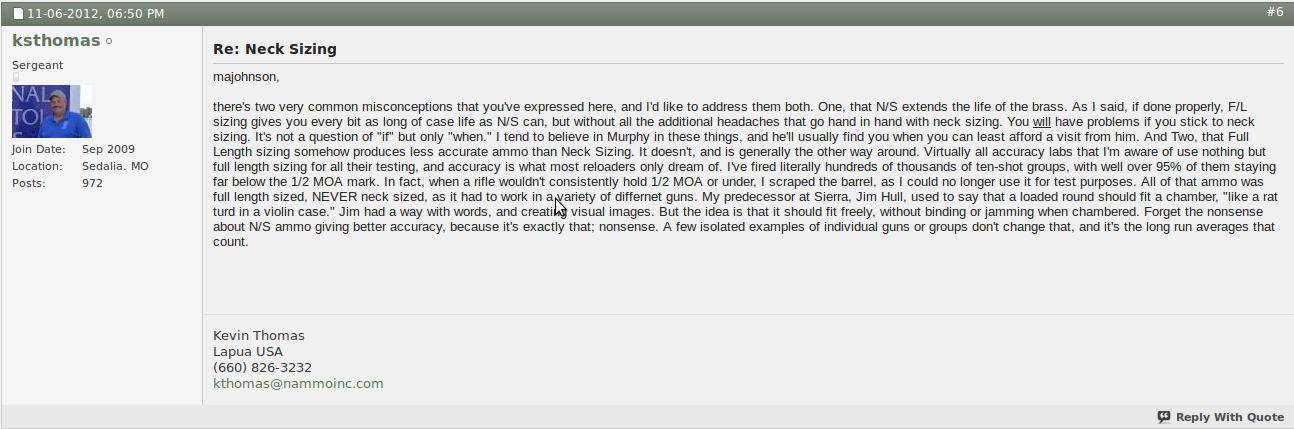
Your cartridge case should fit the chamber like a rat turd in a violin case. 
Meaning give the case wiggle room to let the bullet be self aligning with the bore. When you full length resize your cases the rear of the case is supported by the recessed bolt face and by the bullet in the throat. And the body and neck of the case does not touch the chamber walls and only the case shoulder contacts the chamber. Meaning if you have any warped cases they will have little to no effect on bullet alignment with the bore.
Below Kevin Thomas of "Team Lapua USA" who also worked in the Sierra Ballistic Testing Laboratory.
Below Erik Cortina of Team Lapua USA.