Headspace newbie

Lead hammer

CGN Ultra frequent flyer
Rating - 100%
3   0   0
Location
Saskatoon
Hey guys, I just got a Hornady headspace kit the other day. My 6.5 creedmoor brass is still only once fired. From what I have read so far, .002 would be a good place to bump back when it's required??
I checked a virgin, sized and prepped brass (Hornady) and after one firing, I see a .005 difference. It will be interesting to see how far it gets before it won't chamber. What is a normal amount of "stretch" one can see??? ( realize all chambers are different )
 
The way i was taught, was to resize every firing.
My 308 chamber is headspaced at 1.630’’
So when i shoot the empty casing measures 1.630’’ of headspace
When processing brass, i resize to 1.628’’ using a redding body die (doesn’t touch the neck)
So every firing goes through a 2 thou stretch and 2 thou bump
Speaking bolt action here
 
Last edited:
So once the brass stops growing, or bolt becomes stiff, then you will need to bump each and every time you reload?? That was kinda what I was imagining. My 270 after 5 x's, only needed a length trim.
 
Each single firing always
My lapua brass was 1.628’’ brand new
Stretched to 1.630’’
Bumped back to 1.628’’ as it was 1x fired
Repeat

I think the idea behind this, is to use brass that’s always reset to same parameters from one firing to another.
All my reloading process is always repeated every firings

Edit : another tidbit of info
Compared to a full lenght size die, the redding body die doesn’t resize the body as much.
It does a little though. The main focus of this die is pushing shoulders back
 
Last edited:
I have no experience skipping the part of bumping shoulders.
What i can tell, in 308, my first casings when i started reloading rifle we're bumped back 3 thous (so they we're at 1.627'').
Once fired, they would stretch 3 thous back to 1.630''.
At the time, this was using 42,1gr varget with 178gr bullet, considered a mild load, and would still stretch the full 3 thous.
 
I also do what Marty does. I want my ammo to be the same every time. With neck sizing only you eventually have to full length size then your loads are different then they were on the last firing. Keep everything the same all the time for consistency.
 
My experience with a Tikka .243 is that 1.627" is nice and smooth, 1.628" is starting to bind very slightly, and 1.630" chambers tightly.
My die (RCBS full length) will shorten the case to 1.625" or less if adjusted all the way down, so I start with a case at 1.630" and slowly turn the die down a fraction at a time til I get consistent 1.627".

The fired cases come out of the rifle at right around 1.627", generally speaking. So, how do I get cases at 1.630? By raising the die slightly and full length sizing, that stretches them to 1.630" or more. Then when you adjust the die down, you know you have positive contact between the die and the case shoulder.
 
Is .243 headspace same as 308?
As in GO@1.630?

If it’s the case, funny that a fired case comes out at 1.627’’
Either your chamber is 1.627’’ or your brass doesn’t strech from 627 to 630 (very unlikely?)
 
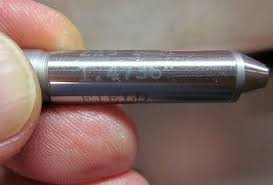
Below is a Colt AR15 NO-GO gauge 1.4736

F81aB6g.jpg


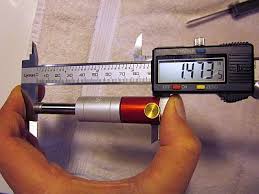
Below is the same NO-GO gauge in my "calibrated" Hornady cartridge case headspace gauge

kkoU6og.jpg


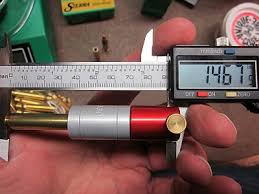
Below is a "FIRED" Lake City 5.56 case in my Hornady gauge

H0SXHH8.jpg


When you measure the case after firing you need to remember and factor in brass spring back from the chamber walls. And if you neck size only the shoulder will continue to move forward with each firing. The amount the case shoulder keeps moving forward until it conforms to chamber dimensions depends on annealing and work hardening of the brass.

Bottom line the photo above of my "fired" 5.56 case is "shorter" than the chamber. But its measurement is close enough to give it .003 shoulder bump for my AR15 rifles.

I full length resize all my cases except for my .303 British Enfield rifles and have the case body have "less" effect on bullet alignment with the bore. This is because if the case wall thickness is not uniform the thin side of the case will expand more and the case will warp and become banana shaped. And when this happens it can effect bullet alignment with the bore and accuracy.

Your cartridge case should fit the chamber like a rat turd in a violin case. ;) Meaning give the case wiggle room to let the bullet be self aligning with the bore. When you full length resize your cases the rear of the case is supported by the recessed bolt face and by the bullet in the throat. And the body and neck of the case does not touch the chamber walls and only the case shoulder contacts the chamber. Meaning if you have any warped cases they will have little to no effect on bullet alignment with the bore.

Below Kevin Thomas of "Team Lapua USA" who also worked in the Sierra Ballistic Testing Laboratory.

Y3IiYL5.jpg


Below Erik Cortina of Team Lapua USA.

 
I also size the case and the neck every time to make sure consistency. I use a Redding body die, a Lee collet die for the necks and a Forster BR seating die. This produces very straight ammo that chambers consistently and I don’t have to mess with lubing and cleaning the inside of the necks. I also anneal frequently; minimum every 3rd firing. This process works good for me.

 
Is .243 headspace same as 308?
As in GO@1.630?

If it’s the case, funny that a fired case comes out at 1.627’’
Either your chamber is 1.627’’ or your brass doesn’t strech from 627 to 630 (very unlikely?)

Yes, same headspace go/no-go gauge for both calibers. As Ed points out below, brass spring back plays a role.
My rifle has been re- barreled from .308 to .243, both are OEM Tikka barrels. My gun smith commented that the .243 barrel had a "nice, tight chamber", with the go gauge in place the action closes with very slight resistance.
My gauges are Manson, I don't think I've ever measured them. I expect I'd find the go gauge to be just a shade under 1.630".
The only time I get a measurement of 1.630" on resized brass is if my sizing die backs out a bit.
Next time you're sizing brass with a FL die, measure an unsized fired case, then size it, but stop the press stroke maybe 1/4" from the end of the stroke.
I'm willing to bet your case dimension from head to shoulder will "grow" from 0.003"-0.005" for example. That's because the die has not touched the case shoulder to bump it back.
 
Back
Top Bottom