Hot 357 magnum load

Balance

CGN Regular
Rating - 100%
26   0   0
Hey, So I was looking around for some hot 357 magnum loads and stumbled by a load in a speer manual back in the 80s. It showed data for a 158gr jacketed bullet with H110: 15.8 - 17.8 grains. Current Hodgdon load data says 15.0 - 16.7 grains.

Im shooting these hot loads out of a Ruger GP100 4.2" with magnum primers of course. I slowly worked my way up to 17.8gr of H110. I've had no issues regarding flattened primers or sticky extraction out of the cylinder.

I actually have some factory 158gr Federal American Eagle JSP ammunition that I compared the feel to, and they felt very similar. I currently don't have a chronograph, so I couldn't test the velocities.

Have any of you played around with this combo?
 
Hottest I've used so far is per that same Hodgdon's data at 16.7 grains H110 for a jacketed 158 bullet. And as mentioned, very accurate too.
 
I can't wait to do some testing once I get back home.

Will the use of regular small primer diminish performance for the load? I'm asking because this is all I have right now, sadly.
 
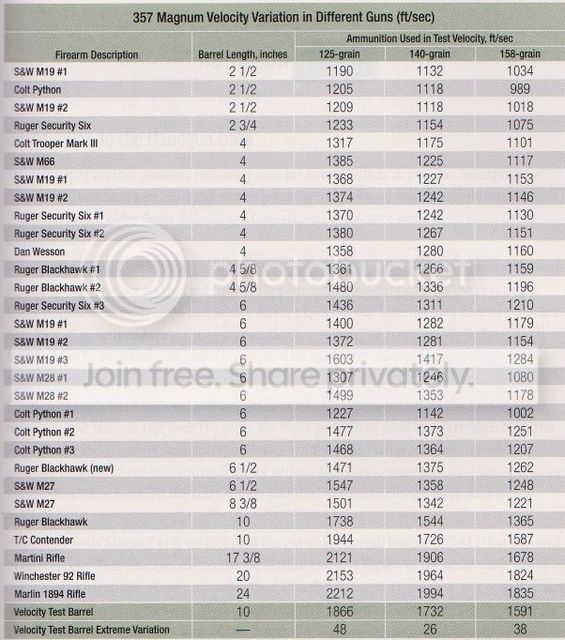
I have gone up to 17grns H-110 with a 158 TC bullet. Only gets me to 1165fps. No matter what powder I use I can't break 1200fps consistently through my 4.2" 686. Those federal 158 JSP rounds you mentioned are doing 1247fps average out of my gun.
 
I have gone up to 17grns H-110 with a 158 TC bullet. Only gets me to 1165fps. No matter what powder I use I can't break 1200fps consistently through my 4.2" 686. Those federal 158 JSP rounds you mentioned are doing 1247fps average out of my gun.

In a revolver the gap between the cylinder and the forcing cone has more to do with velocity loss than does barrel length.
You likely have quite a large gap in your 686.
 
Below Speer reloading manual No. 14, page 769, "Why Ballisticians get Gray" and Hodgdon's loading data is conservative.

.357%20pressures%20001_zpsnchpaa1o.jpg


As a side note I have a factory Savage .223 bolt action and the throat is longer than either of my AR15 rifles. Meaning the chamber is big enough for both a 5.56 cartridge and also the company Lawyer to fit in. ;)

There is a reason why the reloading manuals tell you to start low and work up looking for signs of excess pressure.
 
Looking at some of my old records. On Nov. 23, 1990 I was checking loads from a 6.5 inch S&W 27, with the Oehler chronograph. I was using the Keith type bullet, which is too long to crimp in the proper crimping groove, so I was using either 357 brass and crimped on the shoulder, or 38 Special brass crimped in the proper crimping groove. The powder room bellow the bullet is about identical, so there is no difference in performance between the two types of brass. Here are some results.

168 grain flat base bullet.
12 grains of H110 in 357 brass crimped on the shoulder, five shots.
Average 1124, with ES of 60.
I didn't record what primer, but if it was a magnum I usually stated it, so likely was a standard primer.

13 grains of H110, av. 1152 with ES of 68.

12 grains of Hercules 2400, average 1277, with ES of 48.

And here is Keith Bullet #358156, a gas checked bullet weighing 157 grains.
14 grains of H110, standard primer, five shots average 1329, with ES of only 19!

And on Jan. 2, 1991, 13 grains of H2400, average 1335, with ES of 59, using 168 grain bullet.

Here it is--
Standard primer, 157 gr. gas check, 15 grains of H110, av. 1140 with ES of 62

and same . with mag primer.

1198, with ES of 76.

In that case it got 50 fps faster with a mag primer.
 
Back
Top Bottom