HeavyTread
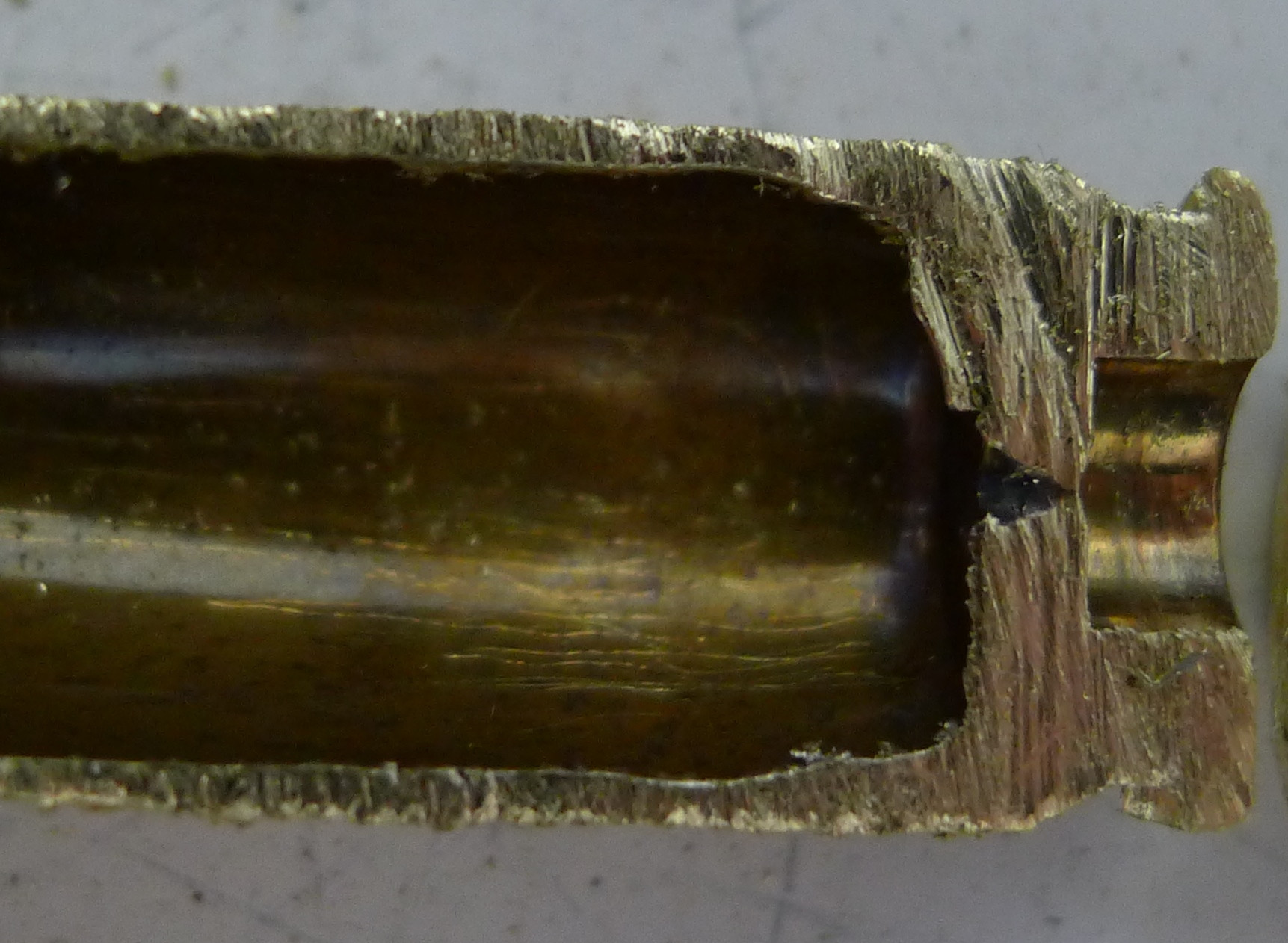
Below is a once fired factory loaded Winchester British .303 case, it stretched and thinned .009 on its first firing. I thought I felt something with a bent paper clip and I wanted more "accurate" information so I bought the RCBS case mastering gauge to check my cases for thinning, runout etc.
Below is the once fired and never reloaded .303 case, the Enfield rifle this case was fired in had the headspace set just below .067 meaning between SAAMI GO and NO-GO and well below military maximum of .074.
Unlike that commie pinko pervert LUTNIT I actually have the RCBS gauge
and not just a photo of it.

NOTE: Knock on wood, in over 46 years of reloading I have never had a case head seperation, this is from being lucky and "NOT" over resizing my cases, meaning minimum shoulder bump.
Below is what causes the case to stretch and thin in the base web area, "HEAD CLEARANCE" or the distance from the rear of the case to the bolt face. Without any gauges you can use a fired spent primer just started into the primer pocket and then seated with the bolt fully closed. The amount the primer is protruding from the rear of the case will be your "head clearance" which is the amount of shoulder bump on a resized case.
Below is a animated image of a case being fired, the thumb rule for shoulder bump and longer case life is .001 to .002 on a bolt action and .003 to .004 on a semi-auto. Brass is elastic when fired it has the ability to stretch a "little" when fired and then spring back and not stretch and thin with minimum head clearance. When you exceed the elastic limits of the cartridge case, meaning excessive head clearance is when the case starts to thin and stretch.
To control head clearance you need the Hornady cartridge case headspace gauge to measure your fired cases and adjust your sizing die for the correct shoulder bump.
We live in a plus and minus manufacturing world and no two resizing dies are the same, I have one full length resizing die that if adjusted by the directions with the die making hard contact with the shell holder the case will end up .009 shorter than the GO gauge. Meaning in my rifle the case would end up with .013 head clearance if the die is not adjusted for proper head clearance-shoulder bump.
My dies have rubber o-rings under the lock ring which allows the die to be self centering in the press and minimize neck runout. I use competition shell holders (five each) that are taller than standard shell holder in .002 increments.
Below is a +.004 shell holder that allows me to still make hard contact with the shell holder and not over resize the case. These shell holder sets come in plus .002, .004, .006, .008 and .010 heights. You can also use feeler gauges between the shell holder and die to adjust your die and corresponding shoulder bump during die setup.
Below is from Reloader Magazine, these .308 cases were fired in a new Savage rifle and the dies adjusted per the instructions, meaning no adjustments for proper shoulder bump. YOUR rifles headspace and the dies adjustment for shoulder bump will determine how long your cases last and the "quality of the brass and case construction play a big part in this.
Below the rifle that taught me more about headspace than any other rifle and the worlds best beer from the oldest brewery in North America.