How do you measure case thinning?

HeavyTread

Regular
EE Expired
Rating - 100%
5   0   0
Location
Over the rainbow
As you repeatedly size brass, the case wall will begin to thin just above the case head. Eventually the case wall will be thin enough that the case should be discarded to prevent case head separation.

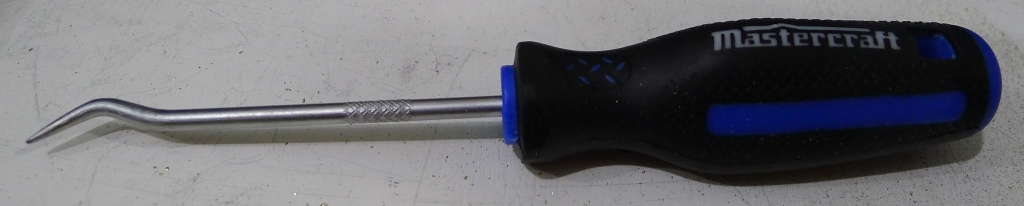
How do you measure that thinning? I know about the trick of using a paper clip or pick to feel inside the case for a shallow spot, and I actually have a great little curved pick I picked up from Canadian Tire to help with that.

But surely there's a more accurate way to actually measure the thickness of the case, and guidance for how much thinning is too much. (e.g.: *this* much thinning means you should toss the case).

Some kind of gauge or something? I've search all over the place and found nothing but neck thickness gauges.
 
As you repeatedly size brass, the case wall will begin to thin just above the case head. Eventually the case wall will be thin enough that the case should be discarded to prevent case head separation.

How do you measure that thinning? I know about the trick of using a paper clip or pick to feel inside the case for a shallow spot, and I actually have a great little curved pick I picked up from Canadian Tire to help with that.

But surely there's a more accurate way to actually measure the thickness of the case, and guidance for how much thinning is too much. (e.g.: *this* much thinning means you should toss the case).

Some kind of gauge or something? I've search all over the place and found nothing but neck thickness gauges.

If you can feel anything abnormal with that canadian tire pick, it's time to cull the case.

I had a 6BR case crack (not fully seperate) so I checked my supply and ended up just culling all 400 Lapua cases and getting new ones because too many had a definite hollow in them.
 
You can get an RCBS case master. There are some other companies that make them but most are only setup to measure neck thickness.

They look like this:
fancy_crack_finder.jpg
 
If you can feel anything abnormal with that canadian tire pick, it's time to cull the case.

I had a 6BR case crack (not fully seperate) so I checked my supply and ended up just culling all 400 Lapua cases and getting new ones because too many had a definite hollow in them.

I definitely felt something with the pick, although to be fair it's actually extremely sharp and I think it's actually pretty good for the application.

I'm working up a big post on some headspace issues I've been working through, but the pick looks like this:

62PNLIQ.jpg


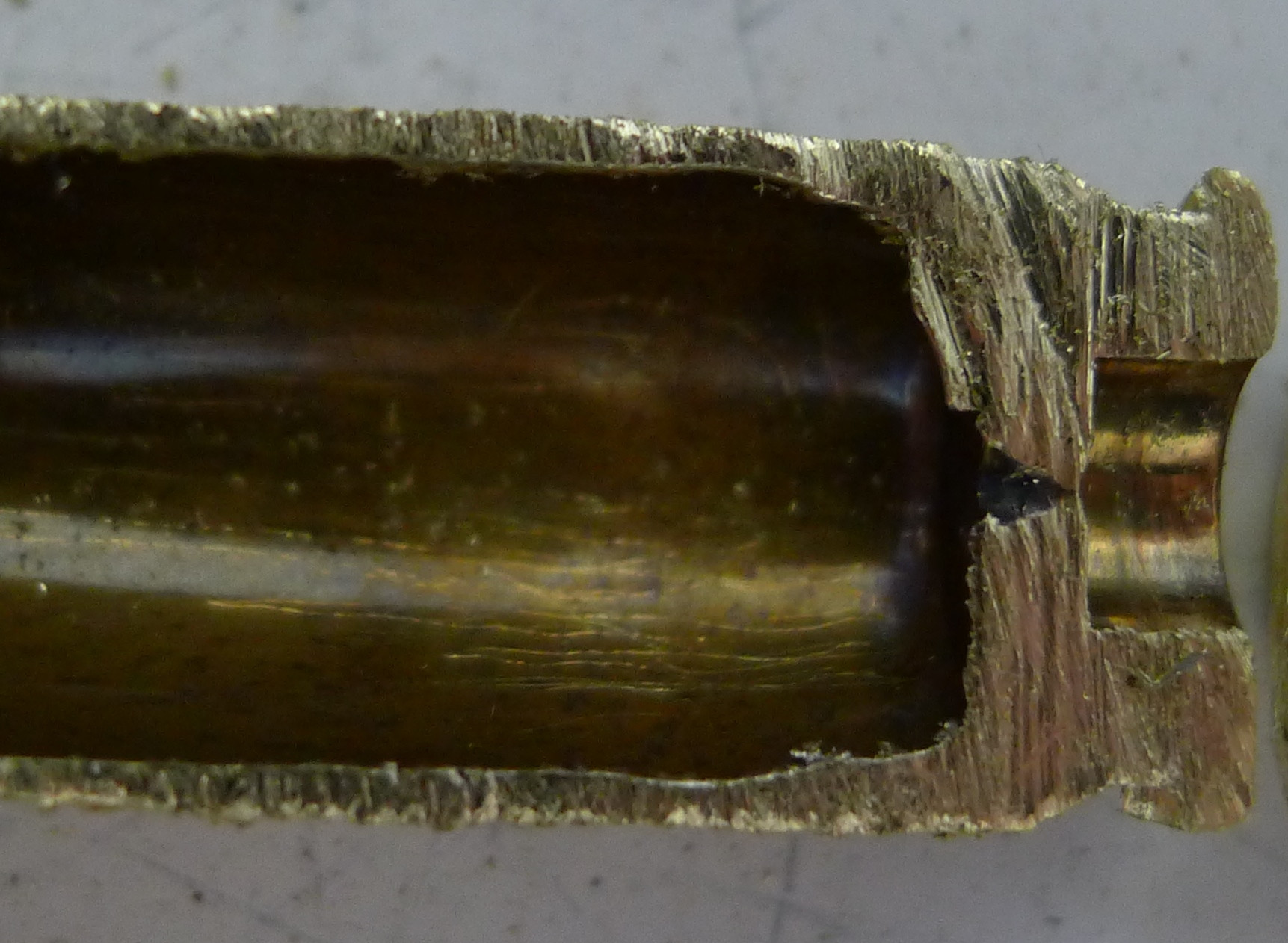
I was able to detect a case that had this much thinning:

1ItwNKV.jpg


Would you have discarded that? I literally don't know how much thinning is 'too much' and this is a Federal Champion case that's only been fired three times (twice by me).
 
HeavyTread

Below is a once fired factory loaded Winchester British .303 case, it stretched and thinned .009 on its first firing. I thought I felt something with a bent paper clip and I wanted more "accurate" information so I bought the RCBS case mastering gauge to check my cases for thinning, runout etc.

Below is the once fired and never reloaded .303 case, the Enfield rifle this case was fired in had the headspace set just below .067 meaning between SAAMI GO and NO-GO and well below military maximum of .074.

IMGP4521-1_zpsa603b8a2.jpg


Unlike that commie pinko pervert LUTNIT I actually have the RCBS gauge
facepalm_zpsf5c6ea89.gif
and not just a photo of it. :evil:

NOTE: Knock on wood, in over 46 years of reloading I have never had a case head seperation, this is from being lucky and "NOT" over resizing my cases, meaning minimum shoulder bump.

IMGP5204-1_zps5590eee6.jpg


runout003_zpsd19b7cc3.jpg


Below is what causes the case to stretch and thin in the base web area, "HEAD CLEARANCE" or the distance from the rear of the case to the bolt face. Without any gauges you can use a fired spent primer just started into the primer pocket and then seated with the bolt fully closed. The amount the primer is protruding from the rear of the case will be your "head clearance" which is the amount of shoulder bump on a resized case.

hedspace-b_zpsce06e3e4.gif


HEADCLEARANCE-a_zps1a9a1011.jpg


Below is a animated image of a case being fired, the thumb rule for shoulder bump and longer case life is .001 to .002 on a bolt action and .003 to .004 on a semi-auto. Brass is elastic when fired it has the ability to stretch a "little" when fired and then spring back and not stretch and thin with minimum head clearance. When you exceed the elastic limits of the cartridge case, meaning excessive head clearance is when the case starts to thin and stretch.

HeadClearance_zpsf30a3af1.gif


To control head clearance you need the Hornady cartridge case headspace gauge to measure your fired cases and adjust your sizing die for the correct shoulder bump.

headspacegauge002_zpscc227fb8.jpg


We live in a plus and minus manufacturing world and no two resizing dies are the same, I have one full length resizing die that if adjusted by the directions with the die making hard contact with the shell holder the case will end up .009 shorter than the GO gauge. Meaning in my rifle the case would end up with .013 head clearance if the die is not adjusted for proper head clearance-shoulder bump.

My dies have rubber o-rings under the lock ring which allows the die to be self centering in the press and minimize neck runout. I use competition shell holders (five each) that are taller than standard shell holder in .002 increments.
Below is a +.004 shell holder that allows me to still make hard contact with the shell holder and not over resize the case. These shell holder sets come in plus .002, .004, .006, .008 and .010 heights. You can also use feeler gauges between the shell holder and die to adjust your die and corresponding shoulder bump during die setup.

shellholders_zps0f9bb695.jpg


reddingshellholders_zpsa84fa472.jpg


Below is from Reloader Magazine, these .308 cases were fired in a new Savage rifle and the dies adjusted per the instructions, meaning no adjustments for proper shoulder bump. YOUR rifles headspace and the dies adjustment for shoulder bump will determine how long your cases last and the "quality of the brass and case construction play a big part in this.

308fail-1_zps30d387ab.jpg


308fail2-1_zps3ca31f6b.jpg


Below the rifle that taught me more about headspace than any other rifle and the worlds best beer from the oldest brewery in North America. :cheers:

yingyang_zps26e31994.jpg
 
*shakes fist*

I actually only know about them existing because of your posts. It's been on my wishlist for a while now but just never seems to be a priority :(

LUTNIT

I hope everyone understands it was meant as humor, so just remember I wasn't serious and I didn't call you a (expletive deleted) commie pinko pervert. Laugh2

My problem is I'm retired with too much time on my hands and it was simpler and less costly before I retired and had all these gauges.
Before the gauges if I shot a large group at the range I could blame it on drinking too much coffee or bad sand in the sand bag rests. f:P:2:
 
Bad sand in the sand bag... I'll have to remember that one. I usually just blame the wind, the sun in my eyes, or a random friend who isn't there that day.
 
Below is a once fired factory loaded Winchester British .303 case, it stretched and thinned .009 on its first firing. I thought I felt something with a bent paper clip and I wanted more "accurate" information so I bought the RCBS case mastering gauge to check my cases for thinning, runout etc.

So a case can wind up with thinning on the very first firing. That's encouraging.. :(

To control head clearance you need the Hornady cartridge case headspace gauge to measure your fired cases and adjust your sizing die for the correct shoulder bump.

I actually have this thing and am starting to use it to just bump the shoulder by a .002". Unfortunately I have about 500 cases that were sized according to the die instructions and are probably .011" short of the ideal (bumped back .002") shoulder measurement.

Below is from Reloader Magazine, these .308 cases were fired in a new Savage rifle and the dies adjusted per the instructions, meaning no adjustments for proper shoulder bump. YOUR rifles headspace and the dies adjustment for shoulder bump will determine how long your cases last and the "quality of the brass and case construction play a big part in this.

Thanks bigedp51.

Things I learned from this thread:

1) Setting up your sizing die as described in the directions can lead to oversized brass
2) Any amount of thinning that's detectable by hand with a paperclip or pick is probably grounds to toss out the case
3) Thinning can occur on even the first firing
4) I need to spend some money on that RCBS case gauge for additional peace of mind on each trigger pull
 
Lot of science and pictures for something you won't do and don't need to worry about. The case will have other issues long before it gets too thin.
 
Wouldn't you consider the picture I posted to be too much thinning?
It's kind of rough with a lot of burrs so it's hard to see exactly where the edge is. In general it doesn't look too bad at all to me.
Excluding .303 British I've never had a case head separation happen before the neck or shoulder splits even with annealing every 3-5 firings.
If you are annealing every 1-2 firings with a match chamber you could get head separations before a neck split but I have no experience with that (I don't anneal me brass that often).

The excessive case wall thinning on first firing bigedp51 mentioned was with .303 British in loose military chambers which are known for case head separations. I've had separations from the first reload/second firing on WW brass before. Reloading for a .303B without a broken case extractor is a quick way to end your shooting day short. Case head separations on 4th or even 3rd firing if you're full length sizing each time is quite common. Before I learned the tricks to .303B reloading I would sometimes have 3-5 head separations out of a box of 100 reloads every time.
 
Wouldn't you consider the picture I posted to be too much thinning?

It might only stretch on the first firing and with proper shoulder bump never stretch again.

I have 30-30 cases over 30 years old and they only die from split necks and they do not stretch because of the low chamber pressure of the 30-30.

If your going to reload and use new brass then don't load the first firing to hot and stretch the brass.

I fire form my .303 British with a reduced load and .312 pistol bullets.

It also helps to have the Hornady cartridge case gauge to find out your fired length for resizing with the correct shoulder bump.

Pick one brand of brass for each rifle if you can and get to know your brass and your rifle by shooting and measuring your cases. This way you will know the limits of your cases and simply stay below there pressure limits for long case life.

As long as you have a "normal" civilian SAAMI chamber that is within normal headspace limits your cases should not stretch on the first firing. (and if you don't have any defective cases)

And now some good advice...........NEVER ask sunray a single question and skip over all of his post and NEVER read them. There are midgets who sit at their computers pretending to be giants posting in forums. My favorite is at castboolits forum and he goes by the screen name of Mutigunner, the problem is Mutigunner doesn't cast bullets or even have a reloading press. Mutigunner simply reads other peoples postings and then passes this information off as his own in other forums.

So pretend these forums are like the X-Files TV program.

trust-no-one_zps4697a28f.jpg


Until you get to know the posters because...................

The_Truth_Is_Out_There_tagline_zps74d89e15.jpg


So guess who sunray really is............and remember he was abducted by little grey aliens and he is the only living brain donor in the universe)

Fumon2_zps03fd7a59.jpg
 
Last edited:
Of all the info presented in this thread so far, I consider Sunray's the best (wonders never cease!!).

The original poster's understanding of the issue was poor. I trust he understands the mechanism better now, it's one of headspace, not the number of times a case was resized. Regardless, in the majority of rifles the case will fail for other reasons, head separations are simply not an issue.

For those guns that tend to cause separations, it's just a fact of life. My Savage 99 needs to have the cases fully resized, or they won't chamber easily. Then they develop head separations in 4-5 firings. C'est la vie. I shoot them until the back ends fall off. I dont' get you guys acting like a case head separation is the end of the world and throwing out hundreds of cases because a separation might happen one day.
 
Of all the info presented in this thread so far, I consider Sunray's the best (wonders never cease!!).

The original poster's understanding of the issue was poor. I trust he understands the mechanism better now, it's one of headspace, not the number of times a case was resized. Regardless, in the majority of rifles the case will fail for other reasons, head separations are simply not an issue.

For those guns that tend to cause separations, it's just a fact of life. My Savage 99 needs to have the cases fully resized, or they won't chamber easily. Then they develop head separations in 4-5 firings. C'est la vie. I shoot them until the back ends fall off. I dont' get you guys acting like a case head separation is the end of the world and throwing out hundreds of cases because a separation might happen one day.

There is a difference between your rifles headspace and resizing your cases and bumping the shoulder back too far and creating excess head clearance. If YOU are having case head separations in 4 to 5 firings YOU are over resizing your cases.

YOU and many other people need to look at the illustration below and LOOK at the blue, red and green dotted lines and then look at the word in the center of the illustration. This word is "SHOULDER SETBACK". When full length resizing the general thumb rule is .001 to .002 shoulder bump for bolt actions and .003 to .004 for semi-auto rifles. I have full length dies that push the shoulder back .009 shorter than the GO headspace gauge and when you add this to the rifles actual headspace you could have over .011 head clearance if the die is not properly adjusted.

shouldersetback_zps59bf1b04.jpg


YOU are over resizing your cases and causing them to fail far to soon and the reason is simple, YOU are bumping the shoulder back too far and are giving the case too much room to stretch and meet the bolt face.

Head clearance is the distance the case has to stretch to meet the bolt face, when you over resize your cases meaning bumping the case shoulder back too far you will exceed the elastic limits of the brass and it will then stretch and thin.

HEADCLEARANCE-a_zps1a9a1011.jpg


When you resize with minimum shoulder bump the brass is elastic and it will stretch to meet the bolt face and then spring back and NOT stretch.

HeadClearance_zpsf30a3af1.gif


All of this is in the front part of your reloading manuals and all you need to do is read them.
facepalm_zpsf5c6ea89.gif

Now how many sunrays do we have in here? And how many are just visually impaired and don't understand what you see and read?
doh_zpsa2e8f099.gif
 
If you can feel anything abnormal with that canadian tire pick, it's time to cull the case.

I had a 6BR case crack (not fully seperate) so I checked my supply and ended up just culling all 400 Lapua cases and getting new ones because too many had a definite hollow in them.

What a horrendous waste of good brass!
You could have gotten at least several more firings with each case, had you properly handled head space.
 
Back
Top Bottom