












































You are using an out of date browser. It may not display this or other websites correctly.
You should upgrade or use an alternative browser.
You should upgrade or use an alternative browser.
I can now stop purchasing slug rounds !
- Thread starter sendmorebrains
- Start date


I tend to remelt slugs that have those horizontal lines through them. It's a sign your lead and/or mould wasn't hot enough; it started to harden as it was poured in. I have had slugs that look like that leave two holes in one target (also through the backboard so it wasn't the wad). Only thing I can think of is that they broke up in flight.
I don't know of any progressive press that can load slugs or buckshot
I have fired around 500 Lee keydrive 1oz slugs and am anticipating the new mould I ordered. A full bore 900gr (2.06oz) slug for rifled barrels. Some of the data I have found for them are pretty nuts; up to 220gr of magnum rifle powder. I'm limited to 3" hulls though so can't go that crazy.
Assuming free hulls and if the lead was free my 1oz slug loads or 8 pellet (1oz) buckshot loads would come out to about $0.39 each. I have seen factory rifled slugs for as low as $0.75 each.
I don't know of any progressive press that can load slugs or buckshot
I have fired around 500 Lee keydrive 1oz slugs and am anticipating the new mould I ordered. A full bore 900gr (2.06oz) slug for rifled barrels. Some of the data I have found for them are pretty nuts; up to 220gr of magnum rifle powder. I'm limited to 3" hulls though so can't go that crazy.
Assuming free hulls and if the lead was free my 1oz slug loads or 8 pellet (1oz) buckshot loads would come out to about $0.39 each. I have seen factory rifled slugs for as low as $0.75 each.

Love the dedication you obviously have there! however do you have some emotional attachment to that Lee Loader? It must take hours. I have a MEC 600jr and I have it down to 45 min/25 regular shot shells - I can only imagine how long it takes with the slugs. BTW if you're interested in a progressive I know a guy...
2nd - do you know of anyone that makes slugs? Hummason maybe?
3rd - should the slugs be smooth or have rifling on them - unless you have a rifled barrel
4th - is it necessary to do the drill press thing? I know it looks more professional, but does it have any bearing on the ballistics? I'm thinking that you could use your stash of red AA for the slugs and the greys for the shot.
5th - have you ever tried Buckshot - I know a guy that has - but says it's very labour intensive..
2nd - do you know of anyone that makes slugs? Hummason maybe?
3rd - should the slugs be smooth or have rifling on them - unless you have a rifled barrel
4th - is it necessary to do the drill press thing? I know it looks more professional, but does it have any bearing on the ballistics? I'm thinking that you could use your stash of red AA for the slugs and the greys for the shot.
5th - have you ever tried Buckshot - I know a guy that has - but says it's very labour intensive..


- Location
- The Conservative part of Ontario
Slugs do not need rifling. The commercial variety do, but it's a sales gimmick. It serves no purpose.3rd - should the slugs be smooth or have rifling on them - unless you have a rifled barrel
slugs are of a weight forward design that's what keeps the round end forward.

Slugs do not need rifling. The commercial variety do, but it's a sales gimmick. It serves no purpose.
slugs are of a weight forward design that's what keeps the round end forward.
lee markets the slugs for rifled barrels, if the slugs were rifled they wouldnt work that well
the rifled slugs, are (I think) for squeezing through full chokes, not for any stability reasons.
not sure I would shoot the lee slugs thought a full choke

sendmorebrains
Regular
I see you also buy your tool boxes Dollarama to store ammo in.
LOL - Busted. only $3 bux per box ! The money I saved on the cheep tool boxes I purchased a used Brother label maker....

What do you use slugs for ?
I find this cool but i had to ask myself what i would do with that many slugs ? Targets ?
You can cast harder slugs for better penetration.
Check the bear defense threads

Love the dedication you obviously have there! however do you have some emotional attachment to that Lee Loader? It must take hours. I have a MEC 600jr and I have it down to 45 min/25 regular shot shells - I can only imagine how long it takes with the slugs. BTW if you're interested in a progressive I know a guy...
2nd - do you know of anyone that makes slugs? Hummason maybe?
3rd - should the slugs be smooth or have rifling on them - unless you have a rifled barrel
4th - is it necessary to do the drill press thing? I know it looks more professional, but does it have any bearing on the ballistics? I'm thinking that you could use your stash of red AA for the slugs and the greys for the shot.
5th - have you ever tried Buckshot - I know a guy that has - but says it's very labour intensive..
Not OP but from my experience...
1. I have a MEC600JR and a Lee LA2; neither is any faster for slugs or buckshot since it still has to be hand placed. Even for birdshot the MEC will only be a little faster. The big advantage of the MEC is that it is so much better built and will last longer.
2. Several US companies make them, often with special wads specifically for them, but they are expensive and can't be exported from the US personally. Ballistic Products has a good selection and a Canadian distributor but it isn't much cheaper (if at all) than factory slugs. Finding someone who casts and is willing to sell you slugs is probably your best bet.
3. As said above the rifling is so they can swage through a choke. The pressure cone on the front of a super sonic slug (1100+ fps) will cause a low pressure area around the body with greatly reduced drag so even if the rifling is curved it wont cause much spin. Once the slug slows down it can cause very slight spin but this usually means doughnut patterns on target.
4. I have read that a roll crimp (which is what is done on the drill press) is superior to a star crimp but I've never noticed any difference. I use a normal star crimp on my slugs and can group just as good as factory roll crimped slugs out of a smooth bore.
5. I have loaded around 500 slugs and maybe 700 buckshot shells with cast 1oz Lee slugs and 00 buckshot. It's slightly more labour intensive to load buckshot than slugs. I can do a box of 25 shells in about an hour including buffer (powder mixed with the shot to prevent deformation; I use cream of wheat from Bulk Barn). Handloading buckshot also opens up a lot of options for your loads. I can load 8, 9, or 12 00 size pellets with or without buffer. My tests produced the best results with 8 pellets and buffer (pellets stacked by 2's in a shot cup). The pattern was about .8" per yard. With the pellets stacked by 3's (9 or 12 pellet loads) the pattern is about 1" per yard.
lee markets the slugs for rifled barrels
In my experience they work like crap in rifled barrels. I have tried all kinds of loads and things and have never gotten Lee key drive slugs to group even close to decent through a rifled 870. My guess is they just aren't big enough. Rifled 12ga barrels usually have a groove diameter of .730" and normal 12ga wads which Lee slugs are designed to go into only measure .705" to .710" so don't engage the rifling properly. Even if the base expands a little to engage, the part of the wad between the slug and barrel doesn't. At least that is my guess.
Most people who reload for rifled barrels use oversized single balls, full bore slugs, or buy plastic sabots that take jacketed bullets (usually large pistol bullets like .44 or .45). After trying everything I can think of and have found through hours of searching online and reading I just ordered a full bore slug mould. Only cost me USD$75 and shipping to Canada was all of USD$5 from Accurate Molds (handles extra, like all mould makers except Lee).
Last edited:

Brutus
CGN Ultra frequent flyer
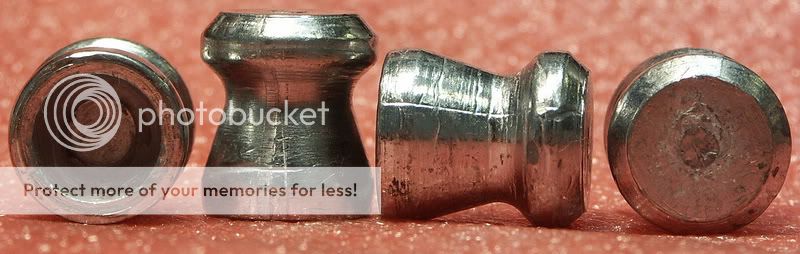
These little 350 grain slugs shot very well in my fully rifled Ithaca shotgun barrel. (20 gauge)
They also have a ring to them when they bump up against each other, so maybe some linotype is present?
It is said by others that they are also successfully used in smoothbore barrels.
I sourced them from gardner, but the mould is hard to find in stock with suppliers.
Last edited:

When you can do better, then you can brag all you want.
Till that day arrive's,...........................
Who's bragging?
For the record, I meant "pussy bird-shot" in the way of weak recoil, non-shoulder hurting shells that you can shoot all day, as opposed to non-pussy slugs which thump.
So...
I see that there is apparently no difference between the two. The internets once told me that the high brass was for slugs/buckshot and magnum loads. I guess the internets was wrong.
There's no functional difference between high and low. It's a myth perpetuated to make you think high brass shells are better and you should pay more. They do look prettier though.
When the round fires the pressure presses the brass against the walls of the chamber, transferring some of the rearward force to the walls of the chamber and barrel, rather than the bolt. The shorter brass does not have as much surface area, and therefore doesn't do this as well, which results in more force being applied to the bolt. Over time or with very high pressure loads, this can result in damage to the gun and/or shooter.
Cheers
When the round fires the pressure presses the brass against the walls of the chamber, transferring some of the rearward force to the walls of the chamber and barrel, rather than the bolt. The shorter brass does not have as much surface area, and therefore doesn't do this as well, which results in more force being applied to the bolt. Over time or with very high pressure loads, this can result in damage to the gun and/or shooter.
Cheers
+1;-)
sendmorebrains
Regular
there is a fellow on Youtube who loads slugs progressivly on a Hornady 366.
Nice ! Link please.

Nice ! Link please.
[youtube]6ygC4RrPP6Y[/youtube]
and
[youtube]Cwspyx3eS8Q[/youtube]






















