Info on annealing.

WhelanLad

CGN Ultra frequent flyer
Rating - 0%
0   0   0
Location
Australia AU
First off. Does crimping eliminate the need to Anneal?

I guess I'm now up to the point of needing to anneal cases for longevity of the accuracy?!

I witnessed this a few years ago now when my "Woodleigh" load, all of a sudden went to sccit..

Turns out, that FC brass had proberly been reloading in the 6-7 times bracket.
An no doubt the neck tension was gone.

Seating the projectile , I felt difference in 'effort' to seat.

Not wanting to go thru brass as often, means I need to anneal the cases.
Il be doing Her .308 brass and my .7-08 brass.

Is the little Gas torch the 'easiest' way, stand up in a tray. Torch them an tip them to quench.

Will follow some YouTube info , but first ask legends Here

Cheers
 
I don't believe crimping will eliminate the need for annealing, unless someone can explain how crimping stops the brass from stretching or growing. I don't crimp at all, but I do resize and bump shoulder back 0.002.

Regarding your gas torch question, that's all I do and it seems to work. I bought one of those motorized display units from Amazon. I place an aluminum pie plate on top with a bit of water in it, then place the brass cartridge in the middle and hold a torch on the shoulder area for 6 seconds (your time may vary) using a metronome (BPM) It's inexpensive and works like a charm.
 
Crimping to eliminate annealing? That is an interesting question!
As most of us know,one of the advantages of annealing is case life , for sure, when annealing, the brass is brought back to as close as it original condition as possible as gar as hardness and elasticity goes.
This is to ensure a consistent bullet tension.
Crimping is done by many ( pistol shooters especially) to stop bullet movement on cycling and recoil , but it also has the advantage of giving a consistant - if not extreme bullet tension .
In theory, crimping (especially the factory crimp that Lee offers ) should mitigate the issue of brass hardening and inconsistent neck tension, but I doubt if it will increase case life, it may in fact lower it.
The only way to tell would be be an in depth test.
I would be far more inclined to anneal , and yes, the gas torch is an easy way to do it.
Cat
 
I guess I'm now up to the point of needing to anneal cases for longevity of the accuracy?!

Annealing questions always tend to stir a bit of controversy.

Firstly, know that the only proven benefit of annealing is elimination of cracked cases by the mechanism of stress-corrosion cracking. This is the sole reason any factory anneals their brass cases, which are of course brand new and (so far as they are concerned) intended for one time use. Annealing reduces the residual, internal stresses within the case that makes it susceptible to this damage. Stress relief is the first stage of annealing, so it is possible to achieve satisfactory stress relief without significant drop in hardness or recrystallization of the material (2nd and 3rd stages of annealing, respectively).

Despite the absence of definitive proof, lots of people believe that annealing can help accuracy. Because it has not had the same level of research devoted to it, precisely how much benefit can be had, the mechanism behind any improvements, and the parameters that have to be controlled are much less well understood. The topic is driven much more by anecdotes and folklore rather than science and testing. Since your question seems to be on the accuracy side of the issue, expect less consensus in the responses you receive.

My own thoughts are that the old approach of standing them up in a pan and holding a torch to them by hand lacks sufficient control to be beneficial. Temperature variations can be significant even within the case; variations from case to case are likely to be hundreds of degrees. A student working on a master's degree in the UK analyzed some cases annealed this way by a match shooter over there, he found temperature was so poorly controlled that some cases had recrystallized brass on one side of the neck, and not on the other. He concluded that it was probably better to not anneal that to anneal in such a fashion.

Virtually any automated annealing process that keeps exposure to the flame consistent in terms of time and flame position should be a substantial improvement over the torch and pan technique, and is probably good enough for the vast majority of shooters.
 
I am not going to comment on anything mentioned earlier, I am still new to reloading.
But I have an engineering thought about consistency, in this case including every little step in reloading process.

My case is a Lapua W308.
All started from a story, that within a year time I gave my multiple batches brass for annealing (and I had no history all these brass were inherited) to three different sources. All three people claiming there were doing annealing with AMP's.

When I started neck sizing and mandrell, also pressing the bullets .................... just by muscle memory I noticed huge differences in friction between parts. I marked my reloaded ammo, and my Labradar show me the ES/SD numbers, also I made pictures of the groups @ 200-300.

From this point on I wanted to investigate from the inconsistencies coming.

I ordered some parts and made my testing equipment. Nothing fancy but only to give me numbers for comparison and statistics. Pictures from early days, in my garage sorry for a messy table.

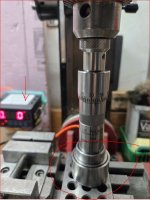
This one for a neck sizing press, measuring a torque deviations between samples to size both the OD / ID.

torque meter.JPG

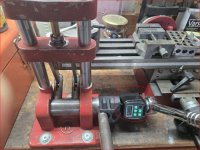
This one for sitting the bullet, measuring the deviation in press force between samples.

press force meter.JPG

Starting from seeing the numbers fluctuations I came to a conclusion the multiple batches brass had a material history effect and was not annealed equally comparing the three sources.
I numbered the ammo, shoot them at 200-300, record the SD/ES and the groups pictures.

I made corrections in my own reloading process to bring the friction between parts to minimum and consistent.

Just to end my story, I built my own annealer as well.
The Temp for annealing my own Lapua 308 the best consistency I got about 500-550 Celsius.
 
Iron cat?
Yes, I tightened the consistency in my reloading steps and the 10 group sizes shrink (usually under ten shots I don't really like to call as a group).
I tested at 200 also at 300 as well, and documented with pictures.

The annealing consistency is a key, also the sizing the brass neck ID with a same force.
I managed so so the ID with lubed mandrel multiple stokes, the feel in muscles is immediate but the result is not controlled doing it only by hand.
But to point out, whatever is along the process, the key important is to sit the bullet with closest smallest deviation possible.
I don't have the press force numbers here with me, my learning curve - notes are somewhere downstairs in my cave.

Now, this my story is a bit long I was working on it for several weeks.

When I started collecting parts I was focusing to keep my costs low as possible, the two measuring units also the press force sensor I got from aliexpress.
Later I contacted a seller if I could extract the data from my digital display units, and they show me another another controller display for $120, vs $45 how much I spent on this what I have currently. The 20 Kg press force sensor is a same (about $40 if my memory serves me well).
The other unit can plot a graph in excel spreadsheet (compatible with PC also droid tablets), and if I speculate that would be great for collecting data and comparing automatically, let say 20-30 or more samples in a row.
Right now I can only read one of each from a digital display, and I need to write down the numbers manually.

I may build one motorized bullet sitter, if this winter lasts long enough. I have seen those gizmos pros using, running North of a $ grand on the internet.
I think I can build one from chinese 3d printer parts for fractions.
 
Does crimping eliminate the need to Anneal?
Thats an interesting question. The crimp would certainly have the effect of normalizing neck tension.


Turns out, that FC brass had proberly been reloading in the 6-7 times bracket.
An no doubt the neck tension was gone.
Brass work hardens, which would have the effect of increasing neck tension. The first thing you notice when working with old brass is a wide variation in bullet seating force, which is basically neck tension. After annealing, bullet seating force becomes much more consistent.


Is the little Gas torch the 'easiest' way, stand up in a tray. Torch them an tip them to quench.
NO, it is not. Think of the time and effort required to stand all those cases in a water filled tray and then remove them from the tray. Not to mention hand holding a gas torch over a tray full of precariously balanced rifle cases and the impossibility of hitting all sides of the necks with the torch. This method is by far the worst way of annealing. Get yourself some form of automated gas torch annealer and do it properly.

I have an Annealeze machine which was reasonably priced and is WAY faster and easier to use than the rotary system I started with.


I don't believe crimping will eliminate the need for annealing, unless someone can explain how crimping stops the brass from stretching or growing. I don't crimp at all, but I do resize and bump shoulder back 0.002.
Can you explain how annealing the neck stops the case body from stretching?

Annealing has nothing to do with case body stretch. Annealing is all about preventing neck splits and uniforming neck tension on the bullet.
 
That's great! By how much did your groups shrink at 300 ?
Cat
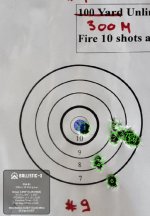
This was before my investigation somewhere in early summer, started with cold barrel.
I am looking now for latest (in Sep.2025) cannot locate in my tablet the app is not working after some stupid update. I remember only something like 0.35 MOA @ 2961 fps AV.

image_cropper_1745100156811.jpg
 
Annealing re-softens the brass that has been work hardened by being manipulated by sizing. Crimping is more brass manipulation and would increase the need for annealing not lessened it.
 
First off. Does crimping eliminate the need to Anneal?
No.
I guess I'm now up to the point of needing to anneal cases for longevity of the accuracy?!
Annealing will restore normal neck tension. It may help accuracy, but you would need to be a very good shooter with a good barrel, bullet, and trigger to shoot the difference.
Is the little Gas torch the 'easiest' way, stand up in a tray. Torch them an tip them to quench.
It's the least expensive way. You don't need the water, brass doesn't "quench". Air-cooling is fine. If you are concerned about over-annealing and softening the head of the case, then the water will help you.

Another inexpensive method is putting a socket in you electric screwdriver / drill, putting the brass in the socket and hitting it with a torch while spinning the socket.
 
I use to crimp work hardened brass as a workaround to ensure the bullets stay in place once brass workhardening/springback had gotten bad enough that seating bullets was noticably easier & bullets could be moved in/out by pushing pulling by hand. Once I started annealing I stopped crimping rifle cartridges that arent going in a tube mag. I dont think crimping eliminates the need to anneal but can be used as a workaround to ensure the bullets stay in place & there is more consistent ignition of the powder in the event that you realise the case necks need annealing too late, ie cases are primed & charged and ready to load and you dont want to dump the powder and decap and start over with anealing, If ive gotten to that point ill just reach for a lee factory crimp die and just put a decent crimp on em, I really cant tell much difference in the groups if I crimp rather than anneal & no crimp but im not doing any precision shooting.
I just use a propane torch set on a bench, hold a casing in each hand about halfway up the case in my fingers, hold the neck of the cases near the end of the flame while turning the cases back and fourth in my fingers watching for the colour of the neck to turn once the colour looks right the case is getting too hot to hold in the fingers I drop them in a bucket of water. Takes a little practice but you can do it fairly consistently & doing 2 at a time speeds up the process, Ill anneal about evey 3 firings.
 
I anneal every few firing, propane torch, holding the brass between my fingers turning it back and forth to the count of 6-8 Mississippis, then I place them in a pie plate to cool down. Easy cheap fast! I like the idea of the “turn table” from amazon, I might get one!
 
Can you explain how annealing the neck stops the case body from stretching?

Annealing has nothing to do with case body stretch. Annealing is all about preventing neck splits and uniforming neck tension on the bullet.
The OP's very first question is whether or not crimping eliminates the need for annealing. Crimping does not eliminate the necessary job of case trimming - a step necessary to perform due to case stretch which has zero to do with crimping.
 
I anneal every few firing, propane torch, holding the brass between my fingers turning it back and forth to the count of 6-8 Mississippis, then I place them in a pie plate to cool down. Easy cheap fast! I like the idea of the “turn table” from amazon, I might get one!
Pretty much my system as well, although the count depends on the size of the casing. I find it helps to do it in a darker room with a touch of light coming through a window (or a lamp 4-5 feet away, depends on your eyes). You can see the color change easier. I drop mine into a shallow pan of water immediately with an old rag or t-shirt in it for ease of handling, and then a little ride in the oven at 210F to dry them off and worry about them later. It's not perfect but it works well if you're consistent about it.
 
  • Like
Reactions: DGY
The OP's very first question is whether or not crimping eliminates the need for annealing. Crimping does not eliminate the necessary job of case trimming - a step necessary to perform due to case stretch which has zero to do with crimping.
Pretty sure you missed the entire point here. NOBODY ever mentioned case trimming. The point is, does crimping normalize neck tension and thus eliminate the need to anneal .... for consistent neck tension.


AMP is the easiest way.
Well except for the need to pay for the fricken thing. Also AMP is very slow and labour intensive in comparison to a flame annealing machine. I'd buy that AMP is the best way to anneal but not the easiest nor quickest.
 
Well except for the need to pay for the fricken thing. Also AMP is very slow and labour intensive in comparison to a flame annealing machine. I'd buy that AMP is the best way to anneal but not the easiest nor quickest.
I found that the AMP is very easyt to set up as far as setting the temperature, etc. As most of the flame style types , and works quickly for each case.
Cat
 
Back
Top Bottom