Interesting 303 ammo ....

jibjedi

CGN Regular
Rating - 100%
178   0   0
Location
on short final
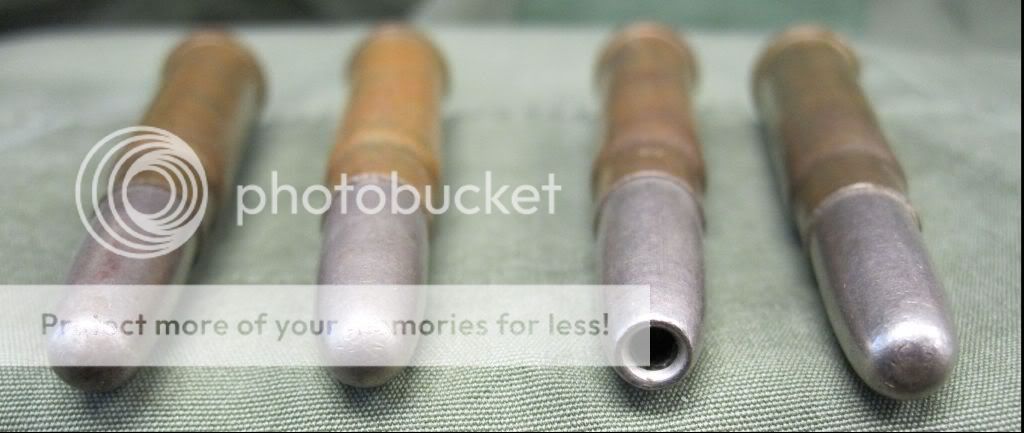
Found these at a local antique and collectables store. Is there anything significant about them? Or are they just some old surplus ammo? The one with the round nose looks like its dated '1912' ....but I can't tell for sure. And one looks like it has some sort of hollow point? I'd like to know more about them :)

IMG_1778.jpg

IMG_1781.jpg
 
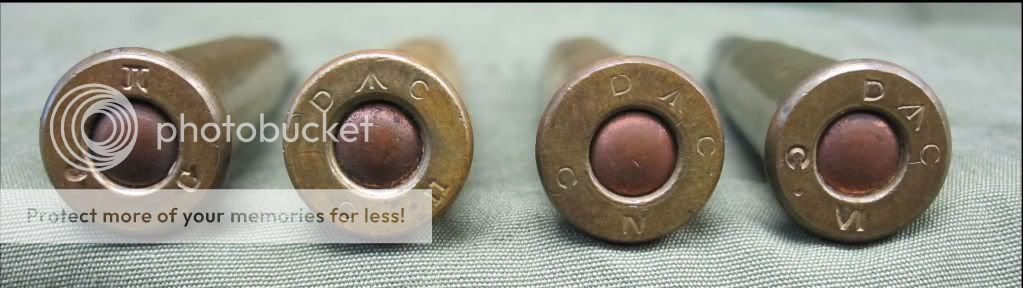
Dominion Arsenal Mark 6 1912 (212g flat base round nose)
Dominion Arsenal Mark 7 1941 (175g flat base spitzer)
another 1941 Mark 7 round
and a Dominion Industries Mk 7 1944 thats had the nose cut off to make hunting ammo
be careful shooting those, some times the lead core will shoot out leaving the jacket behind
the DI round is boxer primed and make great cases for reloading

Nothing overly rare, you don't see alot of ww1 dated ammo around, but it should shoot fine, i picked up 75 rounds of the same stuff in a loose 303 box at a gun show last summer. they are cordite instead of powder too, when you shoot you'll see some confeti fly out the barrel from the paper placed between the cordite strands and the bullet
 
The round-nose 1912 is one of the final batch of Mark VI ammo, made in Canada because the rifles had not yet been re-sighted for the new Mark VII round. This has a 215-grain RNFB bullet with a cupro-nickel jacket and is loaded with Cordite. The primer is the same Berdan type as was used on British ammunition of the period. MV was 2060 at 78 ft from the muzzle. This stuff was superbly accurate 98 years ago, but I wouldn't vouch for it today. This was the last Mark VI ammo manufactured in Canada; Mark VII manufacture had actually started here a year earlier.

The DAC 1941 Mark VII Ball round is also Cordite loaded and Berdan primed, made in canada for the Second World War. This DA or Dominion Arsenal was the Government plant and should not be confused with the private company Dominion Cartridge Company which also was making .303 ammo at the same time. This one has the 174-grain 3-piece composite bullet with the internal 3-grain aluminum tip and the flat base; again, this is a cupronickel-jacketed bullet. MV is 2440 ft/sec. This is the standard loading for which all .303 rifles have been sighted-in from the factory since 1910.

The WRA 1941 is Winchester-made Lend-Lease ammunition for Britain. The bullet jacket is gilding-metal instead of cupronickel (less fouling with GM) and it is loaded with standard American powders and primers. The 4 staking indents are because the British wanted their primers staked so that they wouldn't come loose and foul Brens and Vickers Guns. Performance was exactly the same as British ammunition: 2440 ft/sec MV.

Your FOURTH round is interesting for a number of reasons. For one thing, it is a 1944 Defence Industries, made in Canada, loaded with Type Z powder (basically a copy of Nobel Neonite, just a little slower than 3031) and a nonmercuric-noncorrosive Dominion primer. Dominion Cartridge Company supplied the primers and most of the supervisory staff for this huge Government-owned plant. During WW2, Canada cranked out more than 4 BILLION rounds of .303 and this is the best of the lot. This is truly FINE reloading brass if you can find some, so be sure to pick up after the guys who throw it away! Likely, the DI production was some of the BEST .303 ammunition ever made. These had the proper 3-piece composite bullet but with gilding-metal-plated mild steel jackets. This one has been altered just a bit and now is a home-made 'Dum-Dum' bullet. The nose-point has been clipped and it has been hollowpointed likely with a small drill. It is highly unlikely that this was done while this cartridge was in Canadian Service: our Army would court-martial you for possessing it, the Germans would shoot you for having it.... and do it legally, too! Likely this one was hollowpointed for deer-hunting after the war; a lot of guys used to do that in the years before hunting ammo became available again. It is NOT a safe practice at all: too much danger of a shoot-through, leaving the jacket in your barrel. Next shot gives you a beautiful BULGED barrel.

So that's what you have. Pretty good start on a .303 collection, I would call it!

Have fun!
 
Last edited:
Well, I'm certainly learning more and more about the good old .303 British here!

I actually have a few rounds that I would just love to know more about.

Before the war, my Old Man was in the Three Rivers Regiment way back when it was a militia M.G. regiment (before they were retasked Armoured) ... and he handled a LOT of 303 ammo.

So he "collected" a few examples of the more interesting ones ( yes a bad lad, no wonder he ended up in Bomber Command) and I ended up with them eventually.

Now, he told me that the hollow point "dum-dums" were actually a legit round before being deemed "illegal" during the Great War, and that although they were never used in the Vickers MG belts, they did fire quite a few of them in their LE rifles.

He said during the depression the militia would shoot just about anything available, and they got a dog's breakfast of cartridges sent to them in those lean years. Certainly by 37-38 they were getting better supplied...all Mk7 stuff ( by that time they were Armoured) ... because by then everyone knew there was a war coming.

Anyways...he also told me ( and I really think he was bull####ting me) that they even fired old Boer War black powder 303 ... and that cleaning their rifles was a #####. Now, seriously, I think he was pulling my johnson but who knows.

Well, that's about it... any ideas on what these are?

IMG_0066.jpg


IMG_0064.jpg


IMG_0062.jpg
 
The mk III, the mk IV and V were hollow pointed (introduced after using a limited qty of "Dum-Dum" bullets in North-west India theater in 1897-98). The hollow pointed (expanding) bullets were prohibited after the Hague Convention in 1899.

After 1899 the mk IV and V were made obsolete and were ONLY (and extensively -they had more than 45 million of "surplused" rounds - officially, at least see http://hansard.millbanksystems.com/commons/1901/mar/21/rejected-mark-iv-bullets#S4V0091P0-01962) used for target shooting (practice) by the military. It was replaced by the mk VI, wich was similar to the mk II.

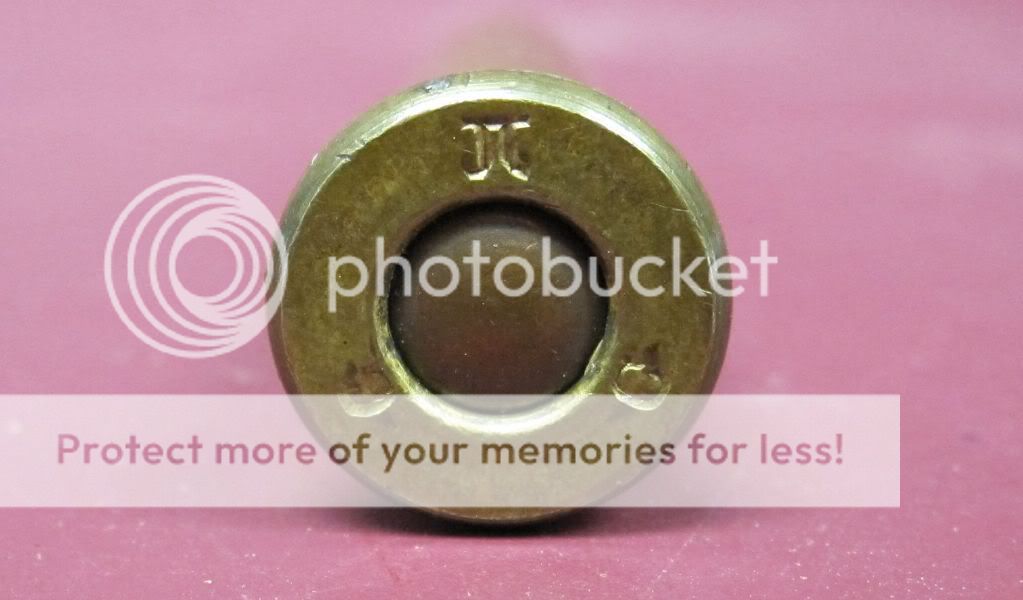
I have some difficulty to make the first one clear - can you post better pictures of the headstamp or describe it ?

That's also a nice start for a collection....
 
It is a II but shaped like the Greek letter "pi". I have never saw an explanation for it but it is a MkII Cordite ctg.
 
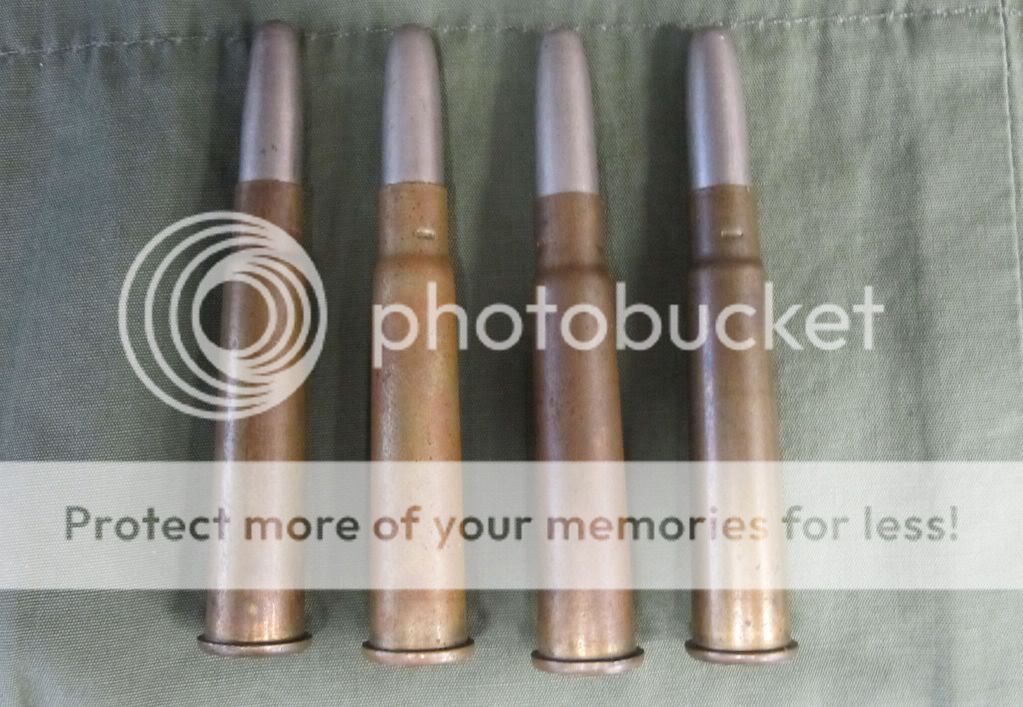
The fourth round in the first batch looks more like a replaced bullet than a modded one, judging by the rolled over jacket, and the serated looking tip. Cant quite place the bullet though.
 
dosing, I think you're right on that one. ... and I missed it, completely! Must be getting old or something. The stab-crimps on the case-neck have been ironed out, so it is entirely likely the bullet was replaced. They used to make a .312" Open Point Expanding as a part of the old CIL line. You could buy them in boxes of 50. They also had a Copper Point Expanding which looked like Remington's premium Bronze Point and they also had Core Lokt which had big stabs going right through the jacket below the cannelure. I'll have to dig some out and take pictures.

The SECOND batch of ammo here has me guessing.
First round is definitely a Cordite Mark II, but that's all I can say.

Second round is also Cordite Mark II by Dominion Cartridge Company on contract for the Canadian Government. This is definitely Boer War stuff.

Third round is a bit of a treasure, a Canadian-made 'Dum-Dum' bullet, completely correct. Cordite Mark IV. All THREE versions of the Dum-Dum bullet were made in Canada, BTW, but this is the only one you generally see. Mark III was made only in very small numbers; I just have the headstamp on a Blank. Mark V was end-of-the-program and all were banned by the Hague Convention of 1899. These generally sell for several bucks a shot and they are rarities today.

Final round is the replacement for the Dum-Dum series, the Cordite Mark VI. This was made to the SAME specification as the Mark II (which had been declared obsolete and thus would not resume manufacture) and was nothing more than the Mark II back in production with a new headstamp. When the Convention banned ALL of Britain's current-issue rifle cartridges, they had to do something to save 'face', so they said that they didn't need the Dum-Dums any more because they had something better.... and introduced the Mark VI. THEN they got to work and MADE something 'better': the impact-unstable high-velocity Mark VII which went into production in 1910 and still is the standard .303 today, 100 years later. But all Mark VI was between 1900 and 1912, with Mark VII production starting in 1910, so there is a bit of an overlap. This one is very early, as Canada started dating ammo in 1906, so this one is in the 1900-1906 window.

Once again, a very nice start on a .303 collection. Sometimes a guy just gets right lucky!

BTW, I don't think your Dad was pulling your leg about the black-powder rounds. I hauled one out of a junk-box of old .303s at a gun show and there was lots of wartime stuff in the box. It is my one-and-only black powder .303 Mark II cartridge for the earliest Lee-Metfords.

Lots of strange things go on in wartime. As another example, I was given a handful of fired Cordite .450 Gardner & Gatling cases at one time. They had been shot off in the earliest Maxim Guns, training air gunners in the RFC in 1915/16! They had been part of an old fellow's treasures until his passing, about 30 years ago. He lived just a few houses from me in Joe Batt's Arm and I didn't even know it until it was too late. Sometimes a guy gets right UNlucky, too!

Sure hope somebody can clear up that real early Mark II. It's NOT a Black-powder because they had a SMALL Boxer primer. The big Berdan primer came in with Cordite.

Enjoy!
 
I remember reading that britian did not sign the hague convention until they had developed the MkVII round. This was because they were having trouble on the NorthWest frontier and the tribesamen there were unimpressed with the current , nonexpanding, rounds.
 
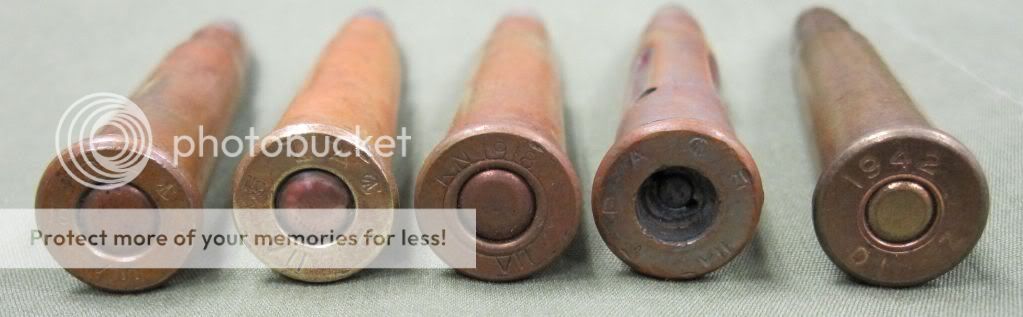
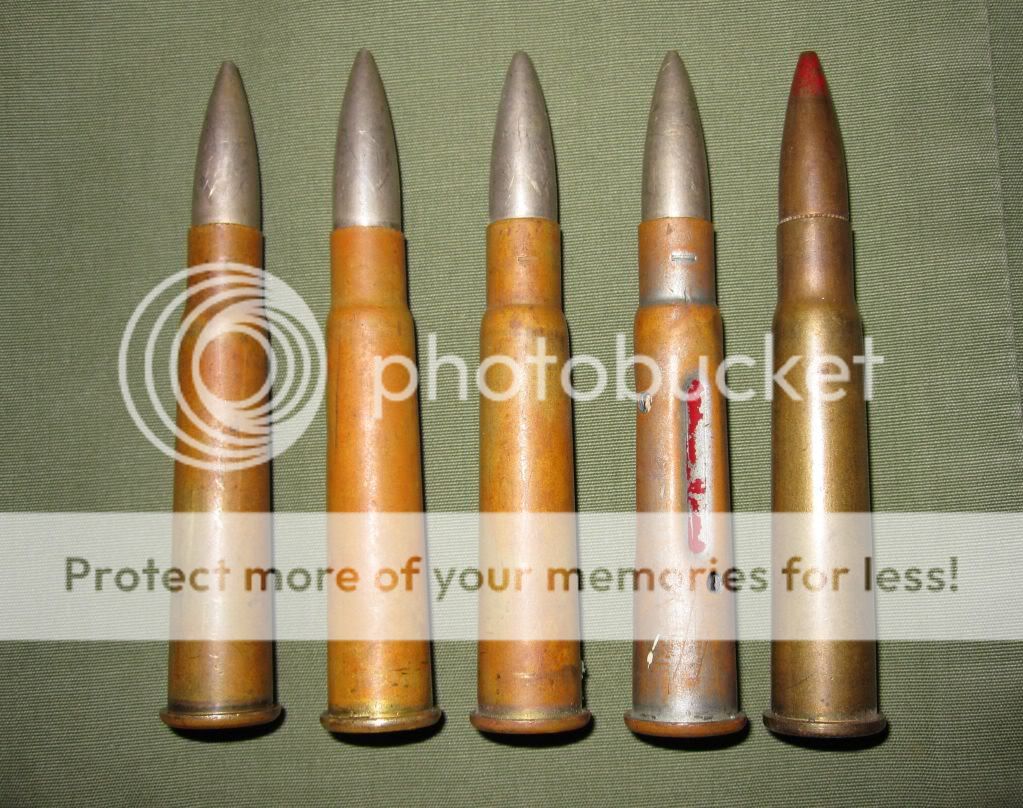
I'm fascinated by this. I went through my box of cartridges and found a few more different ones... one is a tracer, and a blank, but the other two are from a different company, the headstamps are DA and LA ... both Canadian, but from where?

IMG_0069.jpg


IMG_0071.jpg


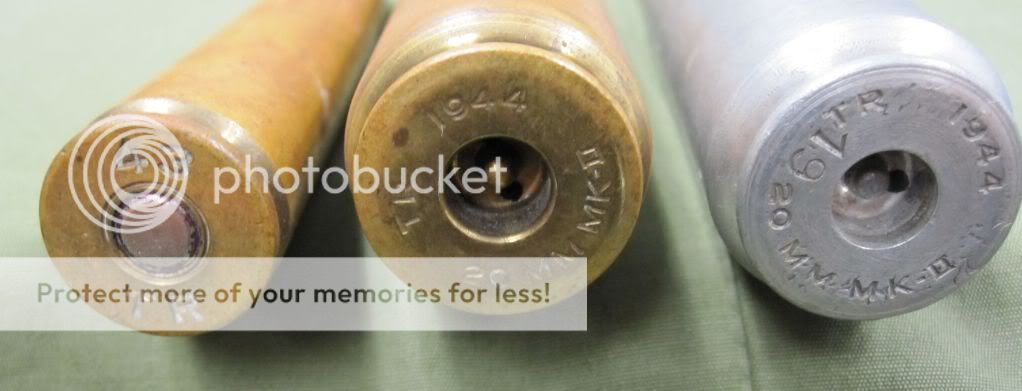
After the war he met my Mom, also from Three Rivers, and she had worked at the Dominion Rubber plant across the river at Cap de la Madelaine. She made these types of ammo...

IMG_0075.jpg


IMG_0073.jpg


Apparently the aluminum 20mm are quite rare... she told me they only made a few of them. They would jam the guns like crazy so they just stopped trying to make it work.
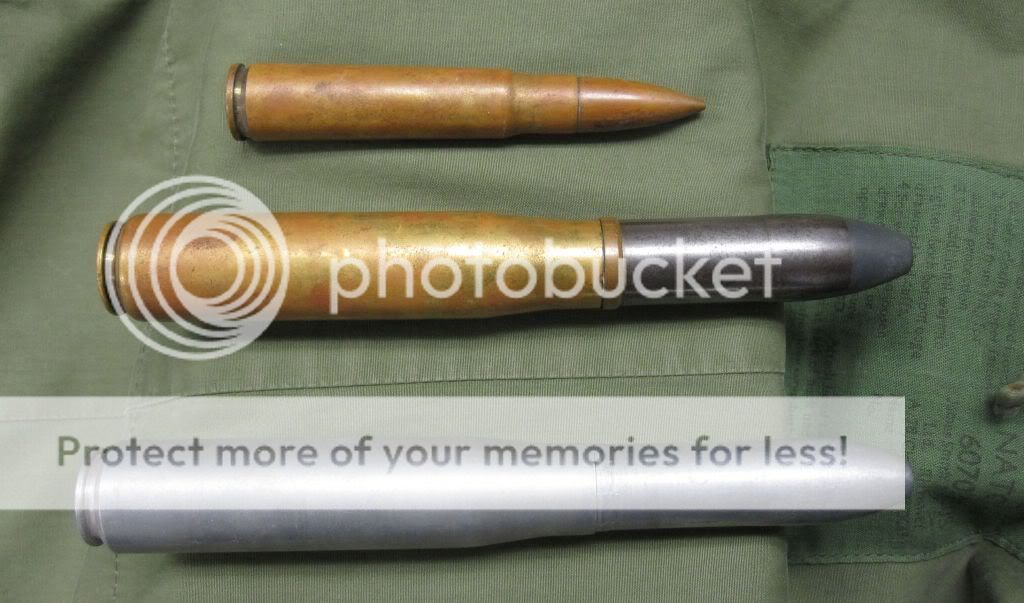
The other is a standard 20mm Oerlikon , HE I think, maybe Incendiary? Not sure.

Last one is what I always thought was a .50 BMG ... right up till I joined the Camerons and actually SAW a .50 up close. I then started to wonder WTF this weirdo was.

Simple enough, it seems, it turns out to be a .5 Vickers shell that I was told the RCN used in a quad mount on their ships.

Anyways... that's about it... just really wondering what DA and LA are.

The DC rounds... Dominion Cartridge... were they made at the old C-I-L plant in Brownsburg, Quebec?

And ( I know, geezus what a pest...) what were the muzzle velocities of the various marks of .303?

Thanks to all for the informative post ! Maybe cartridge collecting next ...

 
DA Dominion Arsenal , Quebec City
LA Lindsay Arsenal, Lindsay ON, just a cooincidence an ammo plant was built in the riding of Sam Hughes the Militia Minister.
KN KIngs Norton Metal Co, Britain.
 
Muzzle velocities:
The old Black Powder stuff was down around 1850 ft/sec and pressures were through the roof. They used 71 grains of Black compressed down in a pellet to about the space you would put half that if it were loose powder.

Early Cordite rounds, Mark II included, were about 1960 ft/sec. This would have included the three 'Dum-Dum' variants, all of which had 215-grain slugs.

With the Mark VI, they raised the MV to 2060 with the 215-grain slug, now with its nose intact.

The Mark VII and Mark VIIz hustled along at 2440 ft/sec and its 174-grain bullet.

In War Two, they brought out the HV loading for MGs, but quite a lot of Number 4 Rifles were adapted to it also. This was the Mark VIII, Mark VIIIz, Mark 8, Mark 8z, which had that really odd 174-grain bullet, sort of halfway between a boat-tail and a rebated tail, call it a RBT for nothing better. It went along at 2550 but that is pretty typical of the obsolete old .303. If you want something MUCH better, you get a .308.... which has a 173-grain BT at 2550 ft/sec and ONLY 8,000 psi higher pressure! Is somebody pulling our legs? Nope, that's what the official figures are!

BTW, I find that the longer barrel of the Mark III Ross rifle gives you almost exactly an extra 100 ft/sec, so the old-timers' tales of the Ross "hitting harder" are true! An extra 110 ft/sec raises the Mark VII from 2300 ft/lbs to 2513 ft/lbs, an extra 100 to 2493 ft/lbs.

Hope this helps.
 
I'm fascinated by this. I went through my box of cartridges and found a few more different ones... one is a tracer, and a blank, but the other two are from a different company, the headstamps are DA and LA ... both Canadian, but from where?

IMG_0069.jpg


IMG_0071.jpg


After the war he met my Mom, also from Three Rivers, and she had worked at the Dominion Rubber plant across the river at Cap de la Madelaine. She made these types of ammo...

IMG_0075.jpg


IMG_0073.jpg


Apparently the aluminum 20mm are quite rare... she told me they only made a few of them. They would jam the guns like crazy so they just stopped trying to make it work.
The other is a standard 20mm Oerlikon , HE I think, maybe Incendiary? Not sure.

Last one is what I always thought was a .50 BMG ... right up till I joined the Camerons and actually SAW a .50 up close. I then started to wonder WTF this weirdo was.

Simple enough, it seems, it turns out to be a .5 Vickers shell that I was told the RCN used in a quad mount on their ships.

Anyways... that's about it... just really wondering what DA and LA are.

The DC rounds... Dominion Cartridge... were they made at the old C-I-L plant in Brownsburg, Quebec?

And ( I know, geezus what a pest...) what were the muzzle velocities of the various marks of .303?

Thanks to all for the informative post ! Maybe cartridge collecting next ...

imo the .5 vickers was a better round then the bmg, being a bit smaller/lighter, youd save 5 pounds per 100 round belt with minimal loss of performance, and it was shorter, which made the action shorter, think 308 vs 30-06
 
smellie and green seem to be true afficianados of the .303 ... many thanks for the info!

I know it's off-topic... but was wondering what ARE the MV of the .5 Vickers and the 20mm Oerlikon? 50 BMG was around 3,000 fps if I remember right... almost exactly like the C7 rifle.



 
Now THERE is a question and a half!

I'm working from memory right now, but I do believe that the .5 for the Vickers was about 2500 ft/sec. The action was just the same toggle-lock as the .303 Vickers gun, just improved a bit and made larger. It was used in Tanks and aircraft and was a good, solid, reliable gun, even if it did cost a lot to build. It was overshadowed in War Two by the sheer numbers of .50 Brownings manufactured: well over half a million.

The Oerlikon was down about 1950 or 2000, but they had a completely-unlocked action: just a super-magnum Sten Gun, basically! Oh, yes, the manuals referred to them as 'inertia-locked' with 'advance primer ignition', but all that really meant was that the firing-pin hit the primer while the bolt still was moving forward: same as a Sten, when you get right down to it!

Re: Lindsay Arsenal. Lindsay Arsenal only used the LAC headstamp in 1917. For 1918 and 1919 production they used DAL with a C-Broad-Arrow off to one side. There are rumours of a very small clean-up batch headstamped 1921, turned out just before the factory was sold off at auction, but I have never seen one. I am told that the building is still there, but live too far away to confirm such.

Note the colour-coding on the Defence Industries Tracer round. ALL DI ammo used the same brass, same headstamps. 'Specials' (Tracers, AP, API and other fun stuff) were loaded into regular cases and bullet-tip marked as in American practice, but with a uniquely-Canadian code. Reason for this was very simple: faster production. There were daylight tracers, night tracers, AP and incendiaries as far as I know, although I have never seen DI Incendiary. To keep in Commonwealth coding, it should have had a blue tip. I have some old photos around here, so will try to figure out how to post them. I am still not very computer-literate in some ways, really can't see what's wrong with punch-cards.

Some very nice stuff here.

AFAIK, the largest collection of .303 ever was assembled by Mr. Bert Woodend, the former Keeper of the Pattern Room when it was at Enfield. His collection, much of it assembled as tiny sample lots hit the garbage-bins, numbered 3600 specimens. When Major Peter Labbett wrote the book on the .303 cartridge, he used his own collection (1850 specimens, of which I am proud to have contributed 2 Canadian rarities) but also had access to Mr. Woodend's collection for measurement and photographic purposes. I really think that his book will stand for all time as the 'last word' in military .303 collecting.

Perhaps we need a forum for military ammunition. There are certainly enough strange cats hiding in the lilac-bushes for us to do this and have a pack of fun while we are at it.

Have fun!
 
Ummm... okay smellie... you got me hooked now ...

I GOTTA HAVE THAT .303 BOOK !!!

If you could possibly get me a title, or ISBN number or something I'll try and find one. Hopefully it's still in print, if not, I can almost walk to the National Archives building in Ottawa and I'm sure they'll have a copy. ( They have a copy of almost every crack-pot magazine or tin-hat author in Canadian history so why not an obscure book on cartridges???).

And yes... an ammunition forum might be very interesting for the milsurp crowd.
 
Back
Top Bottom