Interesting and dangerous barrel failure. Mystery Solved!, sort of. (last page)

Steppenwolf

Moderator
Moderator
Rating - 100%
77   0   0
I found this on another forum and thought it may be of interest to fellow BP folks. I have some doubts about some of the "facts" stated. Below is the information supplied with the photos. I don't believe it was a Loyalist Bess because their India Pattern Bess has the beaver tail around the tang.

"Well, it's happened, an Indian repro musket has gone boom in most dramatic fashion. At a recent reenactment, one let go at the breech, split up the side and blew its stock apart. Two injured--shooter suffered cuts and two broken fingers, his mate to his right suffered a perforated eardrum.

This happened with a single load of 110 grains of BP."

"I mentioned that it looked like the breech had blown first, and the split had propagated down the weakest part of the barrel--the piece between the breech and the vent, and then on past the vent, like ripping a piece of cloth by clipping it at the edge. I couldn't figure out for the life of me how they got the powder contained enough to build up that much pressure. Your info about powder getting into the breech plug threads is quite pertinent there, and speaks to poor quality of manufacture more than anything. As I understand it, this gun had only fired a few dozen rounds before it blew."

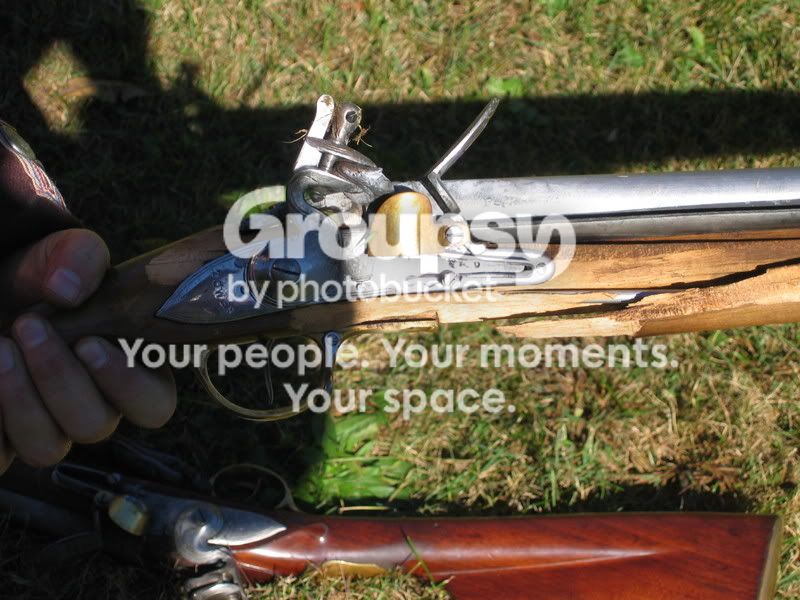
100-0074_IMG.jpg


IMG_2999.jpg


IMG_3000.jpg


IMG_3001.jpg
 
Last edited:

It does indeed look like an opened seam.
Interesting the way the tang and a collar are made separately from the actual threaded part of the plug.
 
Seems unusual for it to have split without a projectile. I'm thinking maybe after a flash in the pan the (shooter?) loaded another 100 grains.
Anyway, stay away from the Indian crap.
 
Arnt you supose to shake the mice outa the barrels before ya shoot :D

That couldnt of been done on purpose to scare people could it ?

Like plug the barrel and fire with a string from a distance.

Anyone here blowin up a BP Gun like that?
looks over Blowin up to me.
 
I don't know all the facts but I think it would take more than 110grs. of BP to cause that much damage. From what I have gathered, there was no ball in the rifle just 110grs. of BP and it have only been fired a dozen times with blanks, just paper and powder.

Arnt you supose to shake the mice outa the barrels before ya shoot :D

That couldnt of been done on purpose to scare people could it ?

Like plug the barrel and fire with a string from a distance.

Anyone here blowin up a BP Gun like that?
looks over Blowin up to me.
 
Who made the musket? Please post the source link. We should know who made the barrel. There are allot now made in India etc.
 
110g of bb in an indian musket is a formula for disaster - that's waaay too much pressure for those guns. also, if there was no ball or maybe not even a patch, the potential for an air gap in the breech is good - do that and you have an explosion in the breech, not a sustained burn.

110g is the max load for my Lyman trade, and its a much stronger barrel then the indian guns.
 
I reg shoot 100 gr of FFg with ball. No issues. You can go as high a 120 Gr of Fg. I agree, air gap???

But I would like to know who made the barrel / Musket?
 
I don't know if a dangerous airgap situation could be created with a blank load with only the wadding from a paper cartridge.
Many of these Indian guns are sold as replicas, without touch holes. Makes them easy. You drill them if you want to shoot them - and you assume all risks associated with doing so. The barrels are never proof tested during manufacture.
Tubing is the likely material used in the barrels. Much less expensive blank than something drilled and reamed from solid. Tubing can be a safe smoothbore barrel, assuming it is free from flaws - which can occur because of how it is made. Not all tubing is seamless, and the finishing process used can effectively hide any trace of a seam.
It would be interesting to know the name of the retailer of this musket.
FWIW, I knew a chap who made Bess repros, using what I believe to be tubing barrels. He tested one with 700gr. of powder and 3 balls, without any detectable damage to the barrel. I have proof tested smoothbore tubing barrels in .625 and .750 bore, without anything untoward happening.
 
Why would you load 110 grns of BP for reenacting? All you need is a boom and smoke. I can't see even 110 grns of FFG doing that. Maybe FFFFG?

An airgap in a BP load gives the burning BP room to expand rather than begin to push the projectile out of the barrel. This turns your rifle from a firearm into a pipe bomb. At least that's the way I understand it.
 
Last edited:

also, if there was no ball or maybe not even a patch, the potential for an air gap in the breech is good - do that and you have an explosion in the breech, not a sustained burn.

Air gap? Explosion?

No. Black Powder is not Smokeless, and pressure spikes from "air gaps" don't occur. The tighter the powder is pressed together, the more solid the ignition.

Black Powder always explodes, never burns, unless dead pressed.

I don't know what happened with this gun, but a 100 grain charge with no ball should NOT have popped the barrel.

In fact, even a double overload should not have popped the barrel, and if it was a domestic gun,(I too am unreasonably suspicious of foriegn guns), then even a triple overload, without ball, should not have popped the barrel.

I'm not sure the story, and the picture, go together.
 
Air gap? Explosion?

No. Black Powder is not Smokeless, and pressure spikes from "air gaps" don't occur....

I believe that the term "air gap" is being used to describe the condition that occurs when a projectile is not seated down against the powder charge - it is left several inches up the barrel. This is recognized as being a dangerous situation.
I do not see how this condition could occur with a powder only charge, or a powder plus paper cartridge load.
I have no idea how that barrel was made or from what type of steel. But look at the photo of the breech - the tang seems to be separate from the actual plug, and the vent is VERY close to the rear end of the barrel. This does not look like any breeching system that I have ever seen.
The split looks like an opened seam.
I suspect that the underlying cause of this mishap is a poorly made, poor quality, badly designed gun failing when fired with a load that would not normally be inappropriate.
 
Sorry for the highjack...can someone explain the concept and dangers of airgap?

An airgap amounts to an obstructed barrel. It means a significant gap (say several inches or more) between the powder and the projectile or for that matter any obstruction in the barrel. The powder burns rapidly producing lots of high pressure gasses that rush up the barrel until they hit the obstruction regardless of what it is. The inertia of the bullet or obstruction causes a pressure spike and can cause a pressure ring on the inside of the barrel or a noticeable bulge or a burst barrel depending on how high the spike and the strength and nature of the barrel steel.

The only way you would get a pressure spike in this gun would be to load one charge properly then leave a second charge part way down the barrel in a paper cartridge (it was a military gun remember). Seems pretty unlikely.

It seems much more likely that the barrel was made from tubing with an incomplete fusion to the seam and that seam let go after a few shots. Pressure rings, since you will probably ask, look like a dark ring on the inside of the barrel and represent an expanded groove or ring where the obstruction was.

cheers mooncoon
 
Pblatzz, here is the source of the article/post

h t t p://groups.yahoo.com/group/Revlist/message/101447
You will find that they are mainly trying to discover which model the musket is, Long Land, 2nd Model, etc. It looks like a Third/India Pattern to me.


Mooncoon or tiriaq,

would either of you hazard to guess as to what could cause such a dramatic failure? One would have to think there was more than 110grs of BP involved.

I wonder if what ever caused the failure happened here, where the two red arrows are?
img3000aaty9.jpg
 
Last edited:

IMHO an inclusion was drawn out when the tube was pulled and it simply failed. Lack of a bulging makes me think the pressure was pretty even from end to end.
 
That is a good point, David. The even split suggests that there was not a localized pressure spike.
The disclouration may indicate that the failure started in that area. It would be worth having a good look internally to see if there is a ring anywhere.
In theory, the properties of mechanical tubing can make it a decent smoothbore barrel material. It is ductile, and tends to deform under overload, rather than fracturing. Splitting is better than shattering. The pressure levels at which it will deform, and ultimately fail, are certainly reasonable for smoothbore barrels.
Many years ago, I did buy some B1015 mechanical tubing for making some smoothbore barrels. Discussed this application at quite some length with the saleman, and he felt the material was quite satisfactory - PROVIDED IT WAS FREE OF FLAWS. It was also miserable stuff to machine. Long strands, rather than short chips.
I do not believe that a blank (or a bulleted one, for that matter) load of 115 grains should split a sound barrel, particularly one with a vent. I have deliberately overcharged barrels, and it is remarkable how heavy a load can be fired without detectable harm.
I imagine everyone has seen the report in Dixie's catalogue where they took a short section of smoothbore drawn octagon barrel, threaded both ends for screws, and fired it with 230 gr. of powder. Everything came out the vent, the piece of barrel, plugged at both ends, held.
 
Back
Top Bottom