I'm curious as to what you think about
this video.
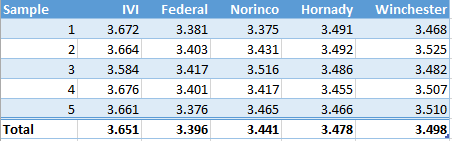
I've done my own tests of case weights, but I actually don't think it's all that useful without measuring actual volume. I wound up with the following densities in grains (weight) per inch of length of five samples of five different headstamps, all fully prepped:
(Note that 'total' should actually read 'average'. The raw data is
here)
Not only is there a fair amount of variation in weights between headstamps, but there is a fair amount of variation between samples of the same headstamp. Norinco varied the most, with .1413 g/inch, whereas Hornady varied least at only .0363 g/inch
The problem with just measuring weight is that the brass itself may of differing density, or it may be thicker in some areas that don't affect internal volume. (E.g.: at the outside of the shoulder, the size of the primer pocket where the brass is thickest etc).
It seems to me that the simplest and most consistent thing to do is to work in large batches and treat the headstamp as one of the variables in your load. For best results, if you change headstamps, you need to work up different load data.
Note that that strategy makes sense where the variation in weights of a single headstamp is low (such as in the Hornady brass). It won't work as well on the Norinco, where the density varies a lot between cases with the same headstamp.