Is Norinco 5.56 brass actually 5.56 or 223?

BigDerp

Regular
Rating - 100%
28   0   0
Hello,

I've gotten into reloading the past few months and have taken to separating my brass either by head stamp or by spec (223 vs 5.56) as apparently the case volumes differ.
Now my question is, where does the Norinco brass play in?


Thanks,
Derp
 
There is no difference. The case volumes do not differ. If you don't believe me, weigh some samples of the different cases. The only way for there to be a volume difference is if the walls are thinner/thicker, which correlates to weight change.
 
There is no difference. The case volumes do not differ. If you don't believe me, weigh some samples of the different cases. The only way for there to be a volume difference is if the walls are thinner/thicker, which correlates to weight change.

I'm curious as to what you think about this video.

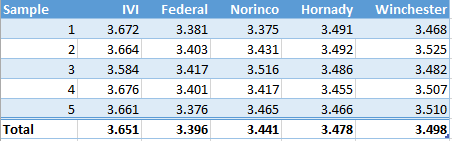
I've done my own tests of case weights, but I actually don't think it's all that useful without measuring actual volume. I wound up with the following densities in grains (weight) per inch of length of five samples of five different headstamps, all fully prepped:

GBAzhht.png


(Note that 'total' should actually read 'average'. The raw data is here)

Not only is there a fair amount of variation in weights between headstamps, but there is a fair amount of variation between samples of the same headstamp. Norinco varied the most, with .1413 g/inch, whereas Hornady varied least at only .0363 g/inch

The problem with just measuring weight is that the brass itself may of differing density, or it may be thicker in some areas that don't affect internal volume. (E.g.: at the outside of the shoulder, the size of the primer pocket where the brass is thickest etc).

It seems to me that the simplest and most consistent thing to do is to work in large batches and treat the headstamp as one of the variables in your load. For best results, if you change headstamps, you need to work up different load data.

Note that that strategy makes sense where the variation in weights of a single headstamp is low (such as in the Hornady brass). It won't work as well on the Norinco, where the density varies a lot between cases with the same headstamp.

 
I'm curious as to what you think about this video.

I've done my own tests of case weights, but I actually don't think it's all that useful without measuring actual volume. I wound up with the following densities in grains (weight) per inch of length of five samples of five different headstamps, all fully prepped:

GBAzhht.png


(Note that 'total' should actually read 'average'. The raw data is here)

Not only is there a fair amount of variation in weights between headstamps, but there is a fair amount of variation between samples of the same headstamp. Norinco varied the most, with .1413 g/inch, whereas Hornady varied least at only .0363 g/inch

The problem with just measuring weight is that the brass itself may of differing density, or it may be thicker in some areas that don't affect internal volume. (E.g.: at the outside of the shoulder, the size of the primer pocket where the brass is thickest etc).

It seems to me that the simplest and most consistent thing to do is to work in large batches and treat the headstamp as one of the variables in your load. For best results, if you change headstamps, you need to work up different load data.

Note that that strategy makes sense where the variation in weights of a single headstamp is low (such as in the Hornady brass). It won't work as well on the Norinco, where the density varies a lot between cases with the same headstamp.

Why are you doing this per inch?
It's not like you will have some cases coming in at 1" in length and others at 3" in length.

The video link at the top explains it the best. 5.56 chambers have a longer leede.
Case web thickness is greater which is why the internal volume is lower on the .556 cases (less water weight capacity).
The conclusion is that if you want loads created with both types of cartridge cases to have the same velocity then you better reduce the powder going into the military case.

Ps I really have no clue why the guy in the video was weighing the water volume in ounces and coming up with numbers like 0.218 etc.
In reloading we are used to weighing in grains so why not keep everything simple?
 
Why are you doing this per inch?
It's not like you will have some cases coming in at 1" in length and others at 3" in length.

To factor out differences in length between the cases. If all of the cases were exactly the same length then you could simply record the case weight for comparison. But there's always going to be a slight difference in overall length (my samples vary by as much a 1/100th of an inch) so you need to divide the weight by the length (or the length by the weight) to come up with a common unit for comparison.

For instance, if you just said 'this case weighs X' it would mean nothing for comparison because the case might be slightly heavier than what you're comparing it to because it is slightly longer.
 
Why are you doing this per inch?
It's not like you will have some cases coming in at 1" in length and others at 3" in length.

It's been a while since I watched that video. Was he maybe talking about fluid ounces? If so, that would make much more sense than grains, since he's measuring volume.
 
It's been a while since I watched that video. Was he maybe talking about fluid ounces? If so, that would make much more sense than grains, since he's measuring volume.
There is no way to accurately measure fluid ounces since some water will remain in the case.
If you use predictive reloading software such as Quickload you can enter case volume in grains of water weight.
The weight of water is a known constant and the internal volume can be determined.
I this is done after the brass is processed all your brass should be the same length.
The process is very simple since you put a piece of brass on an electronic scale then tare the weight.
Add water till it is flush with the top of the case and there you go
 
Last edited:
There is no way to accurately measure fluid ounces since some water will remain in the case.
If you use predictive reloading software such as Quickload you can enter case volume in grains of water weight.
The weight of water is a known constant and the internal volume can be determined.
I this is done after the brass is processed all your brass should be the same length.
The process is very simple since you put a piece of brass on an electronic scale then tare the weight.
Add water till it is flush with the top of the case and there you go

Right. We are in agreement. You weigh the case empty, then use an eye dropper to fill the case until the water is level with the case mouth. Then you record the weight again. Since the density of water is known (assuming constant temperature), then difference in weight can easily be converted to a volume.

I think that's what the guy in the video did, and is referring to fluid ounces and not ounces in weight. Or, if he didn't, that's what he should have done.

You would also need to take care to ensure that the primer pocket is not not included in the volume measurement.

Again, I've not watched it in a while but that's what I'm going to do when I get around to it.

Bottom line for OP is, AFAIK, case volume does vary between 5.56/.223 but it also varies between headstamp among .223 and 5.56. So sort by headstamp and consider the headstamp a part of your load recipe that you work up.

 
Last edited:
Back
Top Bottom