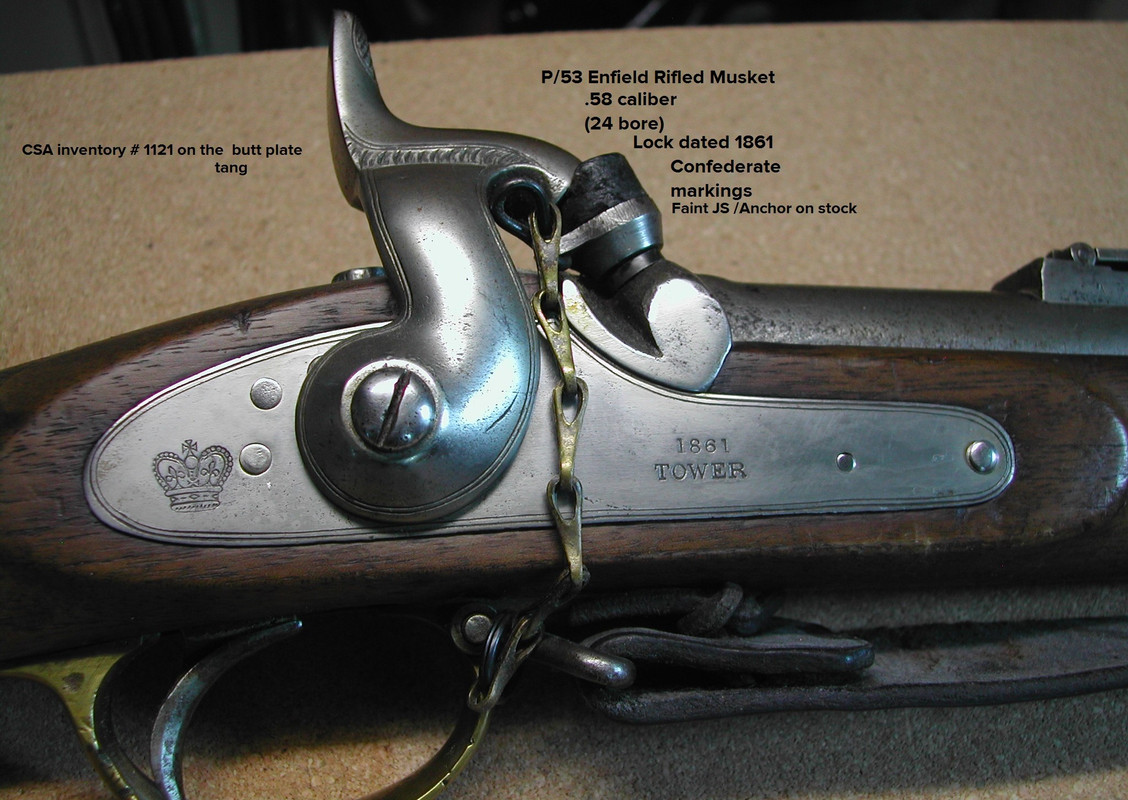
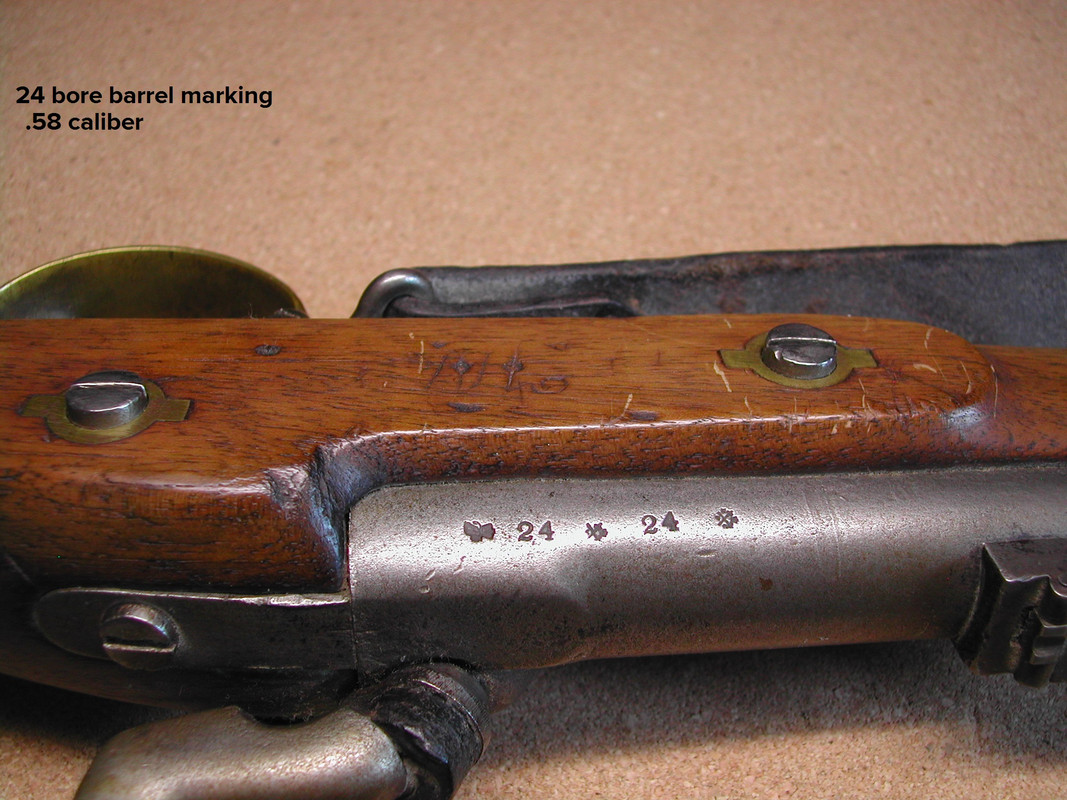
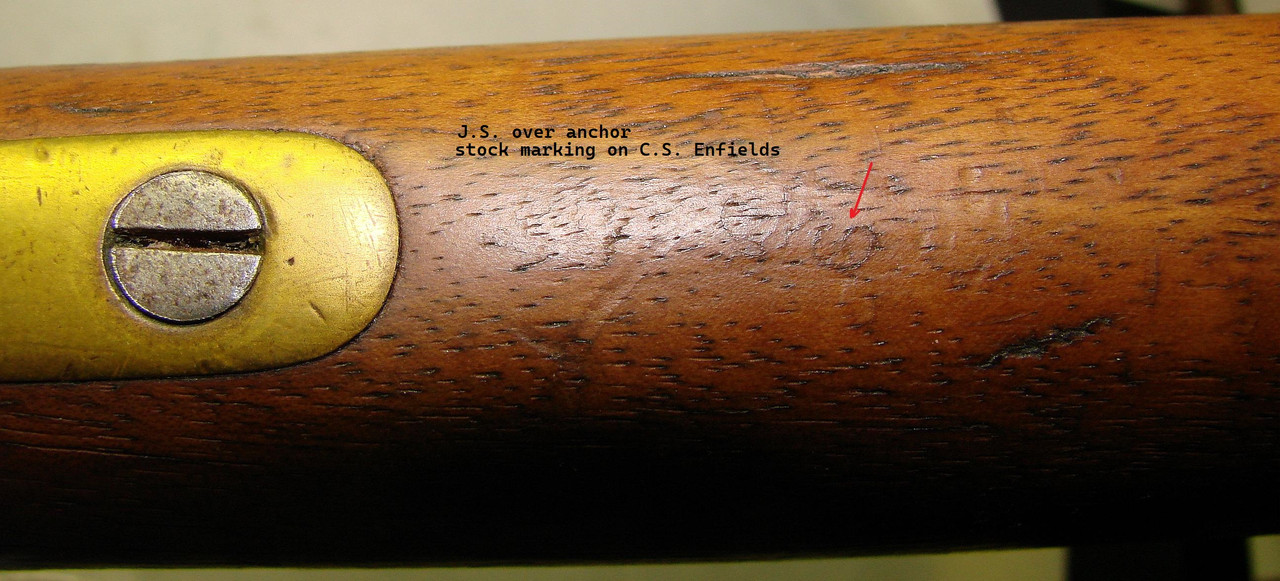
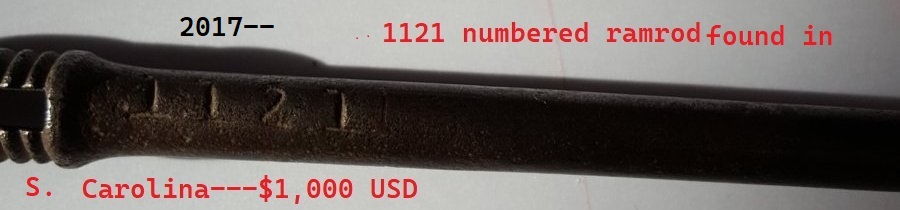
An email that I received back in 2018.
C.S. purchased Enfields----The Georgia Contract. Reference to #1121 and the Fingal.
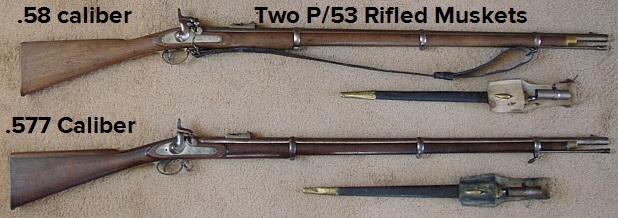
Being a Confederate Enfield collector from Georgia I can tell you that I am GREEN with envy. What you have was once a 2-band fusil that was part of the second Sinclair Hamilton Confederate government contract and especially made for the state of Georgia, thus the letter "G" stamped in the stock. Most of the approximate 5500 Enfields purchased by Georgia were the 3-band P-53 models, but about 800 were the 2-band fusils marked either TOWER, Parker Field & Sons, and CARR. The fusil is similar to the 2-band P-56 except the wood extends to within about 3 1/2" of the muzzle and it takes a socket bayonet rather than a saber bayonet. Below is some detailed info about the Georgia contract:
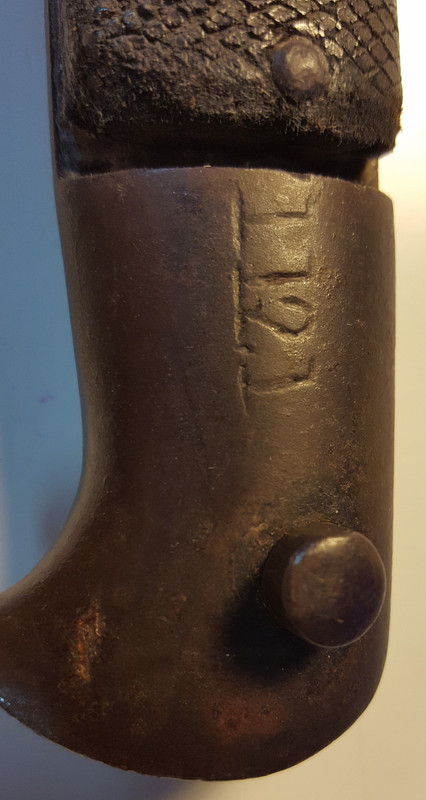
In 1861, Major Edward C Anderson was sent to England to act as a Confederate central government purchasing agent of small arms and munitions. As Anderson was a Georgian, Georgia Governor Joseph E Brown relied upon Anderson to work as a purchasing agent for that state as well. During September of 1861 Anderson arranged the purchase of 5,500 “Enfield” pattern small arms through the firm of Sinclair, Hamilton & Company. Of these guns, 4,700 were P-1853 “long” Enfields, and 800 were P-1856 “short” Enfields, which were apparently Sergeant’s Fusils for India Service rifles. Anderson returned to the Confederacy aboard the Confederate Blockade Runner Fingal on October 8, 1861. In addition to Anderson, the Fingal brought the first 1,100 guns of his purchase for the state of Georgia, as well as 1,000 that had been purchased by Louisiana and 7,520 that had been purchased by the Confederate central government. Among these guns that were on Fingal were the Georgia purchased “long” Enfield’s with the engraved numbers 1-1000. These guns were shipped in crates of 20, complete with socket bayonets for each gun, a bullet mold and two nipple keys (cone wrenches). Based upon an analysis of the Gladiatorcargo manifest it is probable that Fingal also carried the Georgia purchased “long” Enfield’s numbered 1121-1220. The crates that contained these Georgia purchased arms were marked with the initials (for Governor Joseph E Brown) in a rhomboid over the letter G and were numbered. To date only 6 of the Fingal delivered “Georgia G”marked guns are known to have survived. The Fingal arrived in Savannah, GA on November 13, 1861, after a brief stop in Bermuda. The next shipment of Georgia purchased arms left England on the Blockade Runner Gladiator on November 6, 1861. The bill of lading for the Gladiator is in the archives of the Museum of the Confederacy, and it lists 900 “long” and 580 “short” Enfields. The long Enfields were numbers 1001-1120 (cases 51-56), 1221-1300 (cases 62-65), 1301-1960 (cases 78-110), 1961-1980 (case 123) and 1981-2000 (case129). The other cases (66-77, 111-122, and 124-128) contained the “short” Enfield Sergeant’s Fusils for India Service, numbers 1-580. These guns were all marked with the JS / (ANCHOR) inspection mark in the wood behind the triggerguard tang, in the belly of the stock, and have engraved Confederate inventory numbers on the tang of their brass buttplates. The guns are additionally marked with a 5/8” tall capital letter G on the obverse buttstock. The Gladiator arrived in Nassau, Bahamas on December 9, 1861. There she was unloaded and her cargo was transshipped to the Confederacy via the smaller, faster Blockade Runners Cecile, Kate and Florida. The Kate delivered her cargo to Smyrna in early February of 1862, Florida made her delivery to the same destination in mid March, and Cecile delivered her cargo into Charleston in mid-February 1862. To date, only 16 of the 900 Georgia marked “Gladiator Enfields” are known to have survived. The balance of the Georgia purchased arms were shipped aboard the Blockade Runners Bermuda (1,000 arms) and Economist (the final 1,920 arms). Economist made its delivery into Charleston Harbor in mid March 1862.
Based upon examination of the limited number of Georgia “G” marked P-1853 Enfield rifle muskets known to exist, it has been determined that the guns numbered 1-2000 and 3700-4700 were guns marked in the above manner. However, it appears that approximately 1700 guns (likely the guns numbered between 2000-3700) were delivered by the London gunmaker Barnett, and these guns have their numbers stamped on the toe of the buttplate, rather than being engraved on the buttplate tang. These guns also bear a G mark on the obverse buttstock (but of a slightly larger size), and are marked with the CH / 1 inspection stamp in the wood, in front of the buttplate tang, instead of a JS/(ANCHOR). To date less than 50 “G” marked P-1853 Enfields of all types are known to have survived, with less than 30 of the engraved number guns being known and less than 20 of the Barnett guns with stamped numbers being known. This observation is based upon some 25 years of surveying extant examples by several noted arms historians, who have maintaining a very extensive and detailed database of Confederate imported Enfields with engraved numbers.