The early Hornady 55 SP with the cannalure will hold together just fine on deer.I loaded 24gr /Win 748 /55gr in my Dad's .222 for about 12 years until he quit hunting.He never had to shoot a deer twice [ got one every year]or the 3 nuisance black bears.Harold













































You are using an out of date browser. It may not display this or other websites correctly.
You should upgrade or use an alternative browser.
You should upgrade or use an alternative browser.
Largest Animal You've Taken With a 22-250?
- Thread starter the spank
- Start date

No Draw Coyote licence requires maimum of .225 centrefire in NL, unfortunately some of the shadier hunters here in NL use that as an excuse to illegally harvest moose...
When confronted by wardens, everything looks legal.
With that said, there are moose taken in NL with both .22-250 and .223.
When confronted by wardens, everything looks legal.
With that said, there are moose taken in NL with both .22-250 and .223.
Browning_300wsm
Regular
- Location
- Eastern Ontario
I've personally never shot anything with a .22-250 because I don't own one. Dad has one and he mainly shot groundhogs with it. A friend of mine's brother shot a moose last year with one though. Killed it stone dead. Personally I think that is way too small for moose hunting.
I have shot my share of deer with both the 222 @22 250 and my one hunting buddy used his 222 for many deer. Shot placement is key. All shots are in the ribs threw both lungs. The nice thing about the call is how accurate thy are.yoi can hold dead in out to 300 yards and hit a quarter.
I once bought a used .223 in a 788 that a greasy salesman sold a poor lady as a big game rifle for her husband[gift] Well he was happy to get the gun but knew it was too small and he was going moose hunting in a couple weeks. He bought a box of Rem FMJ's and sighted it in with irons . Shot a bull in the hump at 75 yards dropping him and one more between the lookers.I bought the gun minus 5 shells and he was off to buy a larger caliber.Harold

the spank
CGN Ultra frequent flyer
- Location
- Planet Earth Wearing My Tinfoil Hat
Untold numbers of caribou,walrus,seals and polar bears shot in the North by natives with .222 and .22 Hornets. BTW poachers gonna poach ,cause they don't follow rules anyways..........Harold
I've heard stories of the natives in the far north taking polar bears with a 22-250. Gutsy!! Bigger kojones than I have!
I've never shot anything with a 22-250, as I don't own one. The only thing I can go by is my experience with a .243. It kills things, certainly, but a .270 (even with very light loads and modest projectiles) does a far better job of it. Based on this, I would not personally choose to shoot deer-sized game or larger with a 22-250. That's not to say that others shouldn't. If you are happy with the results and the animal is recovered, then so be it.

- Location
- Somewhere on the Hudson Bay Coast
I've heard stories of the natives in the far north taking polar bears with a 22-250. Gutsy!! Bigger kojones than I have!
Don't confuse subsistence hunting with sport hunting. If a pack of dogs have a bear backed up against a pressure ridge, the hunter can shoot it at his leisure from a safe distance. Likewise, if the bear is run to exhaustion with a snowmobile, and just stops running, the machine is stopped at 100' distance, and the shot(s) is made; if you're going to hunt big animals with a high velocity small bore, this is probably the ideal setup. Occasionally a bear can be stalked while feeding, either on a kill or a bait, but I don't know how common the practice is anymore. Bears are frequently killed when they come off the sea ice and wander into a community.
This is not how a sport hunter prefers to hunt dangerous game, for him the confrontation is the point. A subsistence hunter doesn't typically see a benefit in jeopardizing oneself by directly confronting a potentially dangerous animal. I don't think there is a Inuktitut word for machismo, although their courage in dangerous seas, or miles from shore on unstable sea ice is not in question, although acceptance might be a better word. Should they suffer a serious injury while out on the sea ice, its no small thing. There is usually no helicopter to locate, and transport them to a trauma room; they simply disappear. Life in arctic is hazardous enough without intentionally looking for trouble. For the sport hunter armed with a desire to test his mettle against the white bear, a .375 is a better choice, and if he's a pointy stick shooter, his Inuit guide should be competent with the .375.
the spank
CGN Ultra frequent flyer
- Location
- Planet Earth Wearing My Tinfoil Hat
Don't confuse subsistence hunting with sport hunting. If a pack of dogs have a bear backed up against a pressure ridge, the hunter can shoot it at his leisure from a safe distance. Likewise, if the bear is run to exhaustion with a snowmobile, and just stops running, the machine is stopped at 100' distance, and the shot(s) is made; if you're going to hunt big animals with a high velocity small bore, this is probably the ideal setup. Occasionally a bear can be stalked while feeding, either on a kill or a bait, but I don't know how common the practice is anymore. Bears are frequently killed when they come off the sea ice and wander into a community.
This is not how a sport hunter prefers to hunt dangerous game, for him the confrontation is the point. A subsistence hunter doesn't typically see a benefit in jeopardizing oneself by directly confronting a potentially dangerous animal. I don't think there is a Inuktitut word for machismo, although their courage in dangerous seas, or miles from shore on unstable sea ice is not in question, although acceptance might be a better word. Should they suffer a serious injury while out on the sea ice, its no small thing. There is usually no helicopter to locate, and transport them to a trauma room; they simply disappear. Life in arctic is hazardous enough without intentionally looking for trouble. For the sport hunter armed with a desire to test his mettle against the white bear, a .375 is a better choice, and if he's a pointy stick shooter, his Inuit guide should be competent with the .375.
I would not dream of going after a white bear with my 22-250! The fellow who relayed the story to me many, many moons ago spent a great deal of his life travelling the ice and said what you are saying, that it was more a test of mettle than anything elsewith the natives he knew so well.


TacticalTeacher
CGN Ultra frequent flyer
- Location
- Georgian Bay, ON
Got a huge earth pig with my .22-250 that was re-barreled with a .223 SPS Tac 9" twist barrel and then re-chambered by Doug at Ellwood Epps outside Orillia, ON.
I lit up this guy at just over 125 steps....
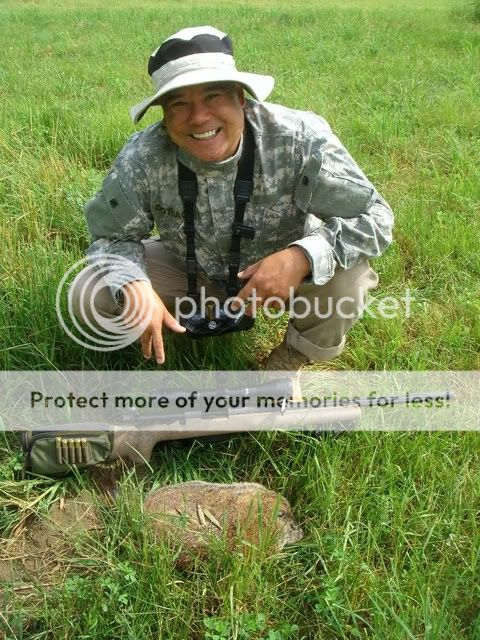
It was a heavy mother....
Peace be to journey!
Barney
I lit up this guy at just over 125 steps....

It was a heavy mother....
Peace be to journey!
Barney
bearkilr
CGN Ultra frequent flyer
- Location
- Nowhere, ......just past the middle
Oh sh!t sorry Spank..............missed the "with a 22-250" part..............
CGN has taught us that with proper shot placement being paramount, any caliber will kill everything. Don't you read the forum advice?
Holy smokes Douglas. That thing kicked so hard the scope broke off!! ;p
Oh sh!t sorry Spank..............missed the "with a 22-250" part..............

I have used a 22-250 to shoot at least 10 whitetails, including 2 big mature bucks, that I can think of right off the top of my head. I used a 222 just last week to shoot 2 1200lb steers and it work just fine so I guess a 22-250 would have been over kill.






















