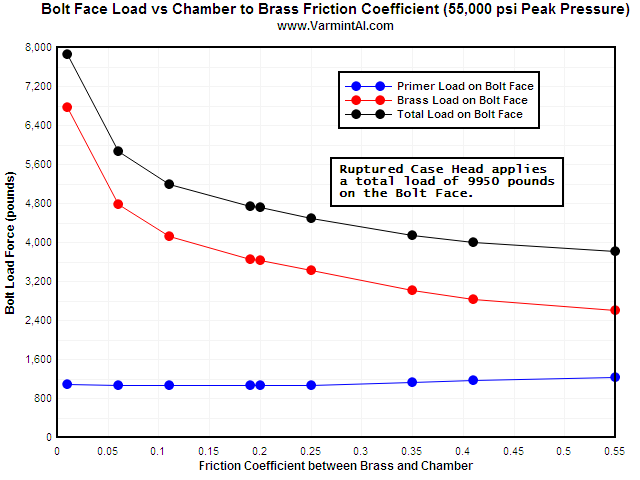
Lube on a case when it is fired creates enormous thrust on the bolt head... very bad and can lead to all manner of damage.
Jerry
Jerry, where did you get that information? I'm not saying it's wrong, but I have been unable to find anything much other than "forum lore" to confirm this.
The ABCs of reloading mention "Oil left on the cases will cause excessive back-thrust and batter your gun" (p.127). It's a great source by C. Rodney James, but it's still empirical data without numbers. Lyman's 49th says "After sizing, all traces of lubricant should be carefully removed by carefully wiping each case with a clean absorbent rag" (p.51), again without mentioning why they should do so. Hornady's 9th makes no mention of cleaning cartridges after seating the bullets AFAIK. Neither do other sources I've been looking at on the web, like "Ultimate Reloader".
I've been trying to confirm/debunk the case lube cleanup idea for several hours now, and the only serious study I found (meaning, something with numbers) shows only a small 7% increase in force on the bolt when you go from a "Very rough chamber, rough reamer finish with tool marks" (friction coefficient=0.55) to a "Polished chamber, polished brass
with grease" (friction coefficient=0.11). That's a 7% increase in force from a decrease to just 20% of the original friction!
I have seen one article that refers to a study (without any link to it) from the US DOD that alleged that excessive chamber lubrication in M249 SAW led to various case rupture problems. The article itself doesn't quite make sense to me, because it says "Most guns are designed to have some of the pressure being forced back on the bolt by the expanding gases be relieved by the friction between the case and the chamber. Because the case no longer gripped the chamber as much, all of that force was placed on the back of the cartridge and the face of the bolt. The increased pressure on the case head subsequently found an escape route thanks to the relatively unsupportive bolt head of the M249 (it doesn’t support the case as well as an M16 bolt), causing a case failure."
That last statement? The bolt of the M249 is operated by a gas-and-piston system... it wouldn't be moving (letting more case length be supported around the head and vulnerable to rupture) before the bullet has left the barrel and the pressure gone down. I can see no reason for "increased pressure on a case head", because pressure is
evenly applied to every surface of a container (the case) under pressure. More of the force being transmitted to the bolt? Sure, but since it's a locked bolt, how does that matter? Maybe I just don't understand the internal ballistics correctly.
 http://www.thetruthaboutguns.com/2011/05/foghorn/ndia-lube-in-your-chamber-is-bad/
Some reloaders apparently use a bit of wax in their dry tumblers, right? Doesn't that leave their brass with a thin film of protective coating too? And isn't most of that lube stripped off by the resizing die anyhow?
Like I said, I know you have a lot more experience than me on the whole reloading thing... that's why I'm plumbing your knowledge: do you know of anywhere I could find numbers to confirm/deny the assertion that lubricant on the cases cause excessive forces on the bolt? The only study I found about this seem to contradict that idea.
Thanks!