Lubing When Reloading

lawn gnome

CGN Ultra frequent flyer
Rating - 100%
83   0   0
So I am starting off in the reloading world.

I have myself a single stage press and a two die full length set.
Now the first stage is the full length resizing die and the de-primer.
I use case lube in this operation, that makes sense.

After re-priming and setting the new powder measure comes the seating and crimping die.
Do you use case lube for this step too?
I have seen a number of videos where the reloaders seem dead set against using lube during seating and crimping. Why?

I have reloaded with a friend using a progressive and once you lube the empty cases, through the entire process they go.
Why should a single stage be so different?:confused:
 
No need to re-lube in between stages, there's not enough forces applied to the case during the seat/crimp phase to make it necessary. Very different for the neck or full-length rezising of the case, which must be lubed.

My 9mm pistol dies supposedly don't require lube at all, but I still find just rolling the case on the pad once makes it go more easily into the FL resize die.

I've never been worried about rubbing off the lube from the cases before firing. Whatever for? Unless you slather it on with a trowel, the chambers have larger tolerances than the thickness of the lube film. It's not going to prevent proper obturation. If you read forums on the subject, you find about as many posters saying it's necessary as saying it doesn't matter. And there's this study about chamber roughness vs case deformation that shows that a polished or lubed chamber has little appreciable differences on the bolt face:

Finite Element Analysis of Rifle Chamber Surface Finish and how the resulting friction effects brass cartridge case stretching and bolt face loading.
http://www.varmintal.com/a243zold.htm

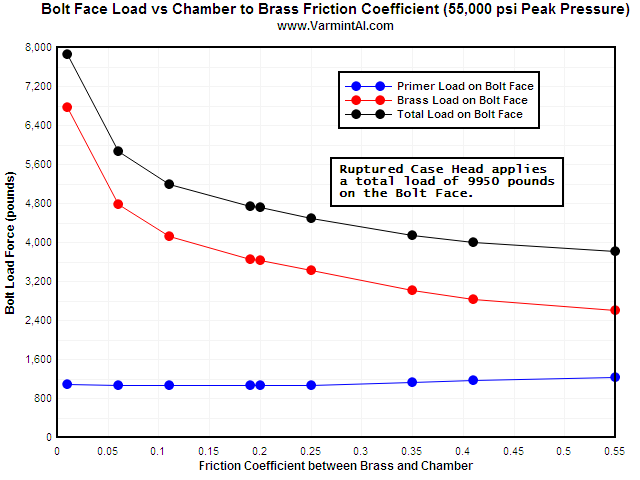
Look at the result's chart: cutting the friction coefficient from 0.55 to 0.11 only increased the force on the bolt from 4436 to 4787 lbs, and that's with a .243Win rounds.

DISCUSSION.... There have been many statements about the necessity of having a rough or "not too smooth" rifle chamber and for sure, not polished rifle chamber. Many of the statements go on to say that the friction between the cartridge bras2s and the rifle chamber prevent the load on the bolt face from being excessive. This series of calculations show, at least to me, that the bolt face load is not appreciably higher with a smooth or polished rifle chamber. What a rough or high friction rifle chamber does do is to stretch the brass on each firing if full length resizing is used. If only neck sizing is used, and the bolt closes with mild resistance, then only the deflections in the bolt lugs and the action stretching will, with a rough chamber, contribute to more brass case stretching but will be kept to a minimum.​

In my case, I use a Cx4 semiauto that is a straight blowback design. The "stress" on the bolt face is the force that actuates the entire eject/####/reload mechanism, so lube or not is not going to make any difference for me. :)
 
When reloading, lube is only needed when sizing a case... once done, remove and no more needed

Lube on a case when it is fired creates enormous thrust on the bolt head... very bad and can lead to all manner of damage. GET RID OF ANY AND ALL LUBE on a case once sizing is done.

Outside neck turning is another time for lube but that is likely not where you are right now.

Good luck and enjoy.

Jerry
 
Lube on a case when it is fired creates enormous thrust on the bolt head... very bad and can lead to all manner of damage.
Jerry

Jerry, where did you get that information? I'm not saying it's wrong, but I have been unable to find anything much other than "forum lore" to confirm this.

The ABCs of reloading mention "Oil left on the cases will cause excessive back-thrust and batter your gun" (p.127). It's a great source by C. Rodney James, but it's still empirical data without numbers. Lyman's 49th says "After sizing, all traces of lubricant should be carefully removed by carefully wiping each case with a clean absorbent rag" (p.51), again without mentioning why they should do so. Hornady's 9th makes no mention of cleaning cartridges after seating the bullets AFAIK. Neither do other sources I've been looking at on the web, like "Ultimate Reloader".

I've been trying to confirm/debunk the case lube cleanup idea for several hours now, and the only serious study I found (meaning, something with numbers) shows only a small 7% increase in force on the bolt when you go from a "Very rough chamber, rough reamer finish with tool marks" (friction coefficient=0.55) to a "Polished chamber, polished brass with grease" (friction coefficient=0.11). That's a 7% increase in force from a decrease to just 20% of the original friction!

I have seen one article that refers to a study (without any link to it) from the US DOD that alleged that excessive chamber lubrication in M249 SAW led to various case rupture problems. The article itself doesn't quite make sense to me, because it says "Most guns are designed to have some of the pressure being forced back on the bolt by the expanding gases be relieved by the friction between the case and the chamber. Because the case no longer gripped the chamber as much, all of that force was placed on the back of the cartridge and the face of the bolt. The increased pressure on the case head subsequently found an escape route thanks to the relatively unsupportive bolt head of the M249 (it doesn’t support the case as well as an M16 bolt), causing a case failure."

That last statement? The bolt of the M249 is operated by a gas-and-piston system... it wouldn't be moving (letting more case length be supported around the head and vulnerable to rupture) before the bullet has left the barrel and the pressure gone down. I can see no reason for "increased pressure on a case head", because pressure is evenly applied to every surface of a container (the case) under pressure. More of the force being transmitted to the bolt? Sure, but since it's a locked bolt, how does that matter? Maybe I just don't understand the internal ballistics correctly. :confused:
http://www.thetruthaboutguns.com/2011/05/foghorn/ndia-lube-in-your-chamber-is-bad/

Some reloaders apparently use a bit of wax in their dry tumblers, right? Doesn't that leave their brass with a thin film of protective coating too? And isn't most of that lube stripped off by the resizing die anyhow?


Like I said, I know you have a lot more experience than me on the whole reloading thing... that's why I'm plumbing your knowledge: do you know of anywhere I could find numbers to confirm/deny the assertion that lubricant on the cases cause excessive forces on the bolt? The only study I found about this seem to contradict that idea.

Thanks!

 
^^^ i fired a few rounds out of a rifle that i had just cleaned and oiled - i guess some oil got in the chamber from an errant over-oiled patch... Wowsa was there some funky stuff happening - fortunately, no damage, but totally noticeable with flattened (severely) primer, headstamped flattened, and ejector marks... and it didn't 'feel' right - this was the same mild load i had shot for a long time - made my 260 feel like a 300WSM!!!

The lube in the chamber stopped the brass from 'grabbing' the chamber, and all force was transmitted back on bolt thru the base of the case.. Yes i pitched the brass.

So now when i clean, even with bore guide, i de-grease the chamber with a chamber swab/brake cleaner. Have not had the issue since.

I will side with the group that believes "no lube on case" regardless of how it got there (resizing lube), as well as NONE in the chamber (cleaning rifle).
 
I don't doubt your observations Chris, but consider: however much lube there may be on the case or chamber, there's only a finite amount of powder/energy pushing the bullet forward and the gun backward. Action/reaction, yes? You can't have more energy from a floating case than from one that's stuck tightly in its chamber, though I can well believe the impulse felt (energy over time) could be different, perhaps sharper. Hmmm.. a bigger peak of force against the bolt in a shorter time because less force is expended radially against the barrel? That could also account for the flattening you describe on the primer/markings and ejector mark, yes? Maybe... And would it still be true in a straight-walled case?

Another possibility comes to mind: imagine what would happen to the chamber pressure if the bullet had to push a "ring" of extra gun oil ahead of itself down the barrel. All those case symptoms you mentioned... possible? I just don't know enough.

Man, this is black art. Fun as hell, but still black art, lol! :)
 
Any time you make a workup load starting at the suggested starting load the primers will back out of the primer pocket with the initial loadings. Meaning the chamber pressure is not great enough to cause the brass to stretch to meet the bolt face. If you go to Varmint Al's website you will see that a .243 case at 43,000 psi has the primer protruding and the base of the case never touched the bolt face.

In simple terms when the brass in the base starts to stretch under pressure it is acting like a shock absorber. Meaning a "DRY" case delivers less pressure and force to the bolt face and the dwell time the rear of the case is touching the bolt face is much less.

The British used the "Base Crusher" system of measuring chamber pressure, and a hollow copper crusher was used for the firing pin to pass through. The case had to be oiled to measure actual chamber pressure.

Below is from the 1929 British Textbook of Small Arms.

TBOSA2-1_zpsecf9f76c.jpg


Below is from Jim Sweets Competitive Rifle Shooting dated 1947 (Australian publication)
The No.1 Enfield rifle was made of softer steels than the No.4 Enfield rifle and oil or grease in the chamber would cause lug setback and a increase in headspace.

PagesfromJimSweet4-1_zpsdccynblv.jpg


The U.S. Military tells you to not lube your ammo.

dontlube-1_zps229e411c.jpg


The Lyman reloading manual tells you to not lube your ammo.

lyman1a-1_zps8612cbc3.jpg


The Sierra manuals tells you to not lube your ammo.

0048a-1_zps295e303e.jpg


The firearms manufactures tell you to not lube your ammo.

oilcover-1_zpsv57j3qif.jpg


oilinchamber-1_zps5e7hdxoj.jpg


And the H.P. White Testing Laboratory warns you about what can happen.

Overpressure-boltthrust_zps663146ce.jpg


Anyone who tells you its OK to lube your ammo is brain dead and doesn't have the test equipment to backup their stupid advice.
 
There is a old saying "Those that fail to read history are doomed to repeat it" and 99.9% of the people in forums are not aware of the British Base Crusher System of taking chamber pressure. Today's SAAMI chamber pressure readings are taken at the mid point of the case and do not read actual pressure at the base of the case.

Too many people think that pressure is equal in all directions in a cartridge case, "BUT" the chamber pressure must be greater than the yield strength of the thicker brass base of the cartridge. As a example military 7.62x51 NATO cases are stronger and thicker in the base and just one reason for this is it reduces bolt thrust.

I collected milsurp rifles and nothing made me more angry than someone coming in the forums and telling people to lube their cases to prevent them from stretching. The No.1 Enfield rifle was proof pressure tested using two oiled proof cartridges, and if the headspace increased more than .003 the rifle failed proofing. This failure was normally caused by improper heat treating or improperly made steel.

In the Ian Skeenerton book below there is a chapter on how the Australians perfected the conversion of their No.1 Enfield rifles to 7.62 NATO. This was done with harder steels and improved heat treating methods. It goes into detail of just rechambering to 7.62 and the damage done when proof testing at the higher 7.62 chamber pressures and continued firing. This convershion was not done to the Australian SMLE No.1 rifles because the cost was over 50% of the cost of a new 7.62 L1A1 (FAL) The conversion process was given to the Indians who went on to make the 7.62 2A1 Enfield rifles.

australian%20smle%20variations_zpslhsbmkhz.jpg


Bottom line, when a "DRY" cartridge is fired the case acts like a shock absorber reducing the amount of bolt thrust.

headspacestretch-c_zps8f362fcb.gif


Below is from Varmint Al's webpage

Rifle Chamber Finish & Friction Effects
on Bolt Load and Case Head Thinning.
FEA Calculations done with LS-DYNA

http://www.varmintal.com/a243z.htm

Please take note that with a average finished dry chamber a .243 case only exerts 4,000 psi max bolt thrust at 55,000 psi chamber pressure. This varies with chamber friction and a lubed case would deliver twice the bolt thrust.
 
Thanks for the great references, Pr589 and Bigedp51!

The most interesting thing is that we both found Varmint Al's pages, and that's where I got the data showing that a polished and lubricated chamber only increased the pressure on the bolt by 15% over a dry chamber.

From the link you provided, he gets 5185 pounds on the bolt with highly polished and lubricated chamber (Cf=0.11) but admit it's "probably not possible: Polished chamber, polished brass with oil or grease" to get a friction coefficient this low. And for dry brass in a polished chamber, (Cf=0.25) the peak total load on the bolt face is at 4495 pounds.

bolt-face-load-summary.png


Coefficient of Friction
-------Peak Primer Load on Bolt Face (lb)
-------------Peak Brass Head Load on Bolt Face (lb)
-------------------Total Peak Load on Bolt Face (lb)
0.01 1083 6775 7858
0.06 1074 4783 5857
0.10 1072 4113 5185
0.19 1071 3659 4730
0.20 1071 3638 4709
0.25 1072 3424 4495
0.35 1136 3010 4146
0.41 1170 2831 4002
0.55 1229 2603 3818

Yet all those other reference you got us show that his results should be wrong, the 1929 testing (presumably on a Lee-Enfield) showed an increase in pressure from 11 to 19 tons per sqin (+70%) for oiled ammo. And the Jim Sweet data on shooting wet (water) cartridges show that not every rifle is equally sensitive to that issue, but some can even fail catastrophically.

The US Explosive Safety Bulletin is one telling document, that mostly convinces me that having lubed cases is a bad idea because it stresses the bolt needlessly. But I'm still not wet tumbling or putting my finished ammo in the dishwasher to clean it. A little dry toweling will just have to do. :)
 
Back
Top Bottom