
Can someone clarify - The Coyote rifle comes with its own design of handguard, but is it able to take standard AR handguards too?
Own design, but not able to take AR handguard













































Can someone clarify - The Coyote rifle comes with its own design of handguard, but is it able to take standard AR handguards too?
Can someone clarify - The Coyote rifle comes with its own design of handguard, but is it able to take standard AR handguards too?

First page TL/DR?
Sure, I mean it can still be taken apart, right? Monolithic uppers invited a whole host of problems (mostly with regards to manufacturing, aka cost.) As well as modularity. without REALLY that much gain with regards to performance. Or at least not enough to justify the cost.No, i love innovation. Do an NR restricted AR, or not. I like this dualithic system. But take all of the positive aspects ? Like the interchangeability and modularity i guess..
Probably because NEA didn't really exist at that time. No one cared what they were being made out of because none were being made or sold at the time.Lot of testing between 6061 and 7075 as been done before NEA, belive me. We still are on 7075. I don't take this test as cash. Why NEA didn't publish this revolutionary test online to back this decision ?
Not trying to be a ####, but I found this almost impossible to read/understand.Sorry but that is bull####. Im a CNC machinist and i work i lot in majority with aluminum. 6061 is way more easy to machine. I work with a few CNC business and its all the same. Test it, send some submission to CNC business for the same drawing, ask for 6061t6 AND another one for 7075t6. Sometime the 7075t6 will be more expensive, and its not for the material. Because yes, 7075t6 is more expensive than 6061t6. The real problem is cheap aluminum. 6061 or 7075, its gonna be gummy af. If 7075 is easier to machine, AR lower will be made of 7075. The real challenge on an AR is the lower, not the upper.
Also keep in mind that while on paper 6061 has higher "machinability", the reality is that its gummy af, and most machinists you will talk to prefer to deal with 7075 because it's easier to acheive and maintain a nice finish. (Especially when drilling and/or tapping smaller holes.
- Do you have any idea to boost the public image of BCL ?
- Yeah lets make an upper in 6061 on the lower of Maccabe with a proprietary handguard !
- Sound great !
Then don’t purchase it and stick with your 50’s vintage SKS. There is nothing I mean nothing wrong with any NR black rifle offering (bull pups Tavors and CZ’s don’t count) which gives us the Canadian black rifle owners a selection. Ever AR form factor is good.
Then don’t purchase it and stick with your 50’s vintage SKS. There is nothing I mean nothing wrong with any NR black rifle offering (bull pups Tavors and CZ’s don’t count) which gives us the Canadian black rifle owners a selection. Ever AR form factor is good.
To all you machinists and wannabe cool gun gurus - If both the upper and lower aluminum receivers are nothing other than cases, and they are both protected with the same level anodizing or other coating, does the grade of aluminum really matter?
If the 7075 is easier to machine, why every AR lower are in 6061 ? I ask you because when its time to machine an AR, the real deal is to machine the lower, not the upper.
Not all AR lowers are made from 6061. Pretty sure the Milspec TDP specifies a 7075 forging. I'm fairly sure the 7075 lower is the standard.
If you ask the purists, they will say yes. But again, just because 7075 is stronger, that doesn't automatically make 6061 completely useless garbage. Steel or titanium or exponentially stronger than aluminum, but that doesn't make aluminum total crap.
That has piqued my curiosity though....I'm gonna go do some digging for you and find some numbers.
There is a thread buried somewhere on here of a 6061 AR (ironically an OLD quad rail NEA) with over 10,000 rounds through it, and still chugging. Ironically, if I'm not mistaken, the receivers weren't even anodized. Actually BCL posted a clip from their 5,000 round torture test of the coyote, and the receivers were shiney, meaning not anodized. (Though the retail models will be anodized.)
The vast majority of people will NEVER wear one of these receivers out. But hey, if they purchase something made from 7075, then it gives them something to flex on us poors lol
EDIT: "The#hardness#of the anodic coatings is usually measured on their cross sections. It strongly depends on the chemical composition of the alloy. In the case of the#6061#alloy, the#hardness#is between 420 and 490 HV (43.5-49 Rockwell C)and does not depend on the thickness of the coating"
For 7075 I am having trouble finding hard numbers, but this is an anecdotal example. Anodizing hardness varies greatly depending on the process and alloy, so I imagine these hardness numbers are pretty low on the scale, especially when compared to 6061.
"We have a problem with hard anodize wearing through on a 7075-T6 aluminum part that gets heavy wear. The hardness of the coating is 350–360 HV. Would increasing the hardness of the coating show a significant increase in wear resistance?"
I'll see if I can dig up some more info later....I gotta press pause though or imma miss my appointment lol
Anodizing thickness is between 6 and 25 μm. Thats not change the deep structure and overall stress resistance of the upper/lower. Anodizing is for protection and aesthetic.
Not all AR lowers are made from 6061. Pretty sure the Milspec TDP specifies a 7075 forging. I'm fairly sure the 7075 lower is the standard.

If you ask the purists, they will say yes. But again, just because 7075 is stronger, that doesn't automatically make 6061 completely useless garbage. Steel or titanium or exponentially stronger than aluminum, but that doesn't make aluminum total crap.
That has piqued my curiosity though....I'm gonna go do some digging for you and find some numbers
Yes both of them in fact. But the upper is way more critical. This why lot of AR have a 6061 lower and 7075 upper.
Just have a conversation with BCL and they use 6061 because its cheaper lol..
You don't have to, as it was sort of rhetorical.
Why is it critical the upper is made with 7075 over 6061?
https://www.royalarms.com/6061-vs-7075-billet-lowers/When it comes down to it, 6061 will work just as well as 7075 as your billet lower does not see the stresses that the upper and barrel do
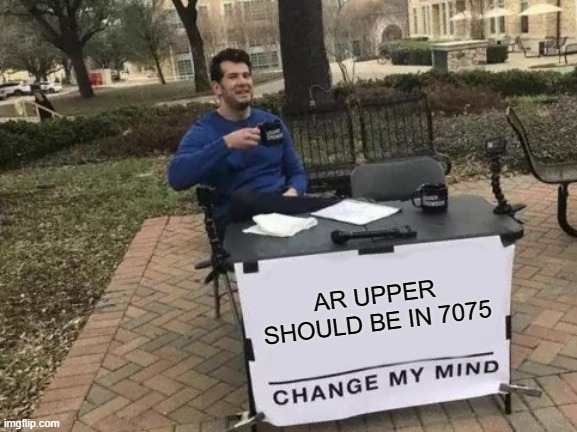

Just think about it, where is the energy and figure out how the stress travel in the gun. This is why polymer lower can work and the polymer upper was a fail.
The upper transfer all the stress all around him, coming from the barrel (in majority).
And this is why you can see AR with 6061 lower and 7075 upper.
So yes, for me, 6061 upper is a joke. I don't really care about the lower. But for saving a few buck.. com'n BCL. No excuse.
By the way, the lower of the SLR coyote seems to have a steel reinforced lower. More info soon.
First I don't work with Metal, but my critical thinking is half decent, so... Most of the stress and energy is contained in the barrel, barrel extension, and bolt. In fact all the parts that contain the expanding gas are steel, without any help from the Aluminum regardless of alloy.
The Aluminum just keeps the parts aligned as they move back and forth, and support all the crap hanging on the action to make it work
Take it from someone that has broken kit the hard way, I apply so much stress to my 6061 receiver that I damage it, how do you think it would have fared if it was 7075? Apply enough force to break one, it's probably a fine line before the other fails.
They're not saving a buck, they're making one.
Also even though they aren't the least expensive, they are affordable

























