More Swiss 1882 cartridge ideas...

The Kurgan

CGN Ultra frequent flyer
Super GunNutz
Rating - 100%
112   0   0
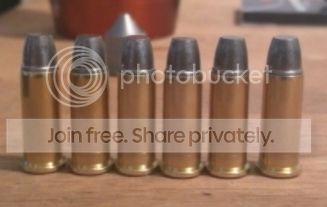
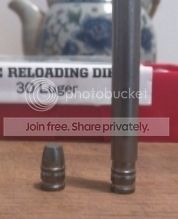
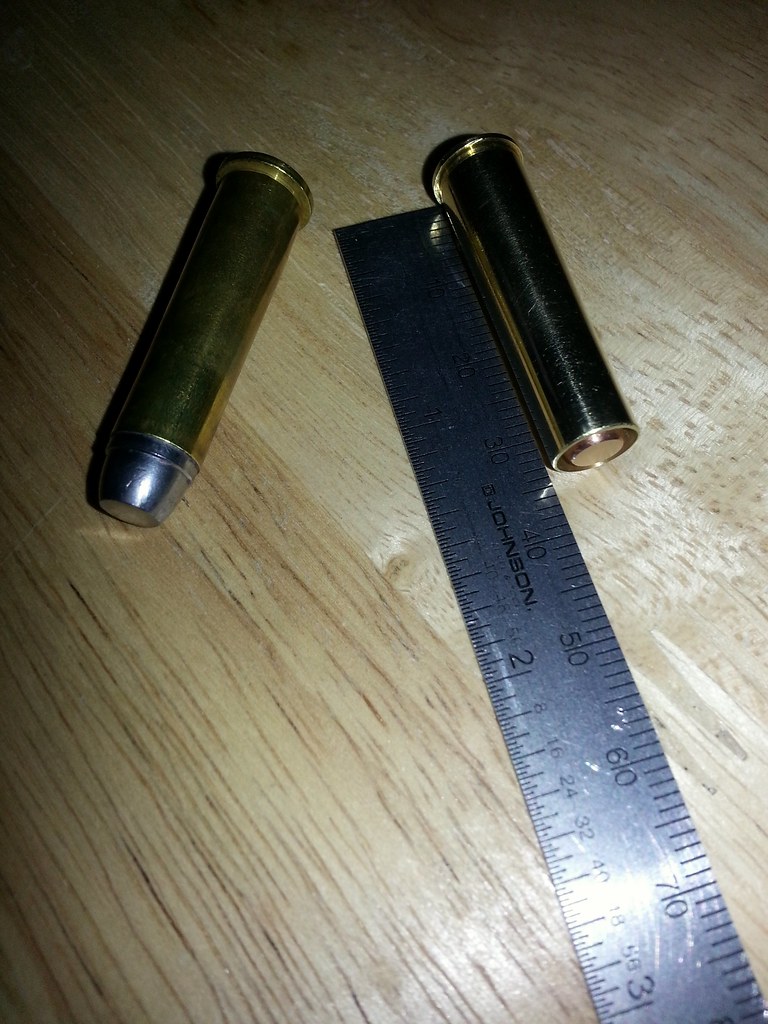
Left: My 7.5x33R handload utilizing a waxed .314" 110 grain lead round nose flat point bullet with gas check over 3.5 grains of IMR Trail Boss. The brass is full length 32-20 Starline brand resized in a 30 Carbine die. The bullet was cast by our local gun nut, jethunter, and is pure perfection!

Right: A modified factory Prvi Partisan 7.62mm Nagant cartridge. I carefully resized the factory cartridge in a 30 Carbine die, set the factory .308" 98 grain FMJ further down into the case, and shortened the case to 33mm in length.

The factory specs on the 7.62mm Nagant cartridge are pretty anemic with a muzzle velocity of only 738 fps, and therefore perfectly safe for use in any Swiss 1882 revolver. For comparison sake, my mild handloads are pushing 1000 fps with absolutely no ill effects on my revolver.

Slug your bore before trying any of my handload recipes as it seems that Swiss bore groove diameters range from .305" to .316" depending on who you ask, where they measure, what they measure with, and how many beers they were drinking! Mine is ~ .315" at the muzzle, but seems to offer ok accuracy with .311" diameter FMJ's. I don't expect a .308" diameter FMJ from a 7.62mm Nagant cartridge to offer much in the way of accuracy from my revolver, but you never know. I will report back results from the range. In the end, I don't use many FMJ's as I prefer the much increased accuracy that I experience with soft cast lead bullets, and of course, I favour bore longevity!
24618996331_2e5c1c2652_b.jpg


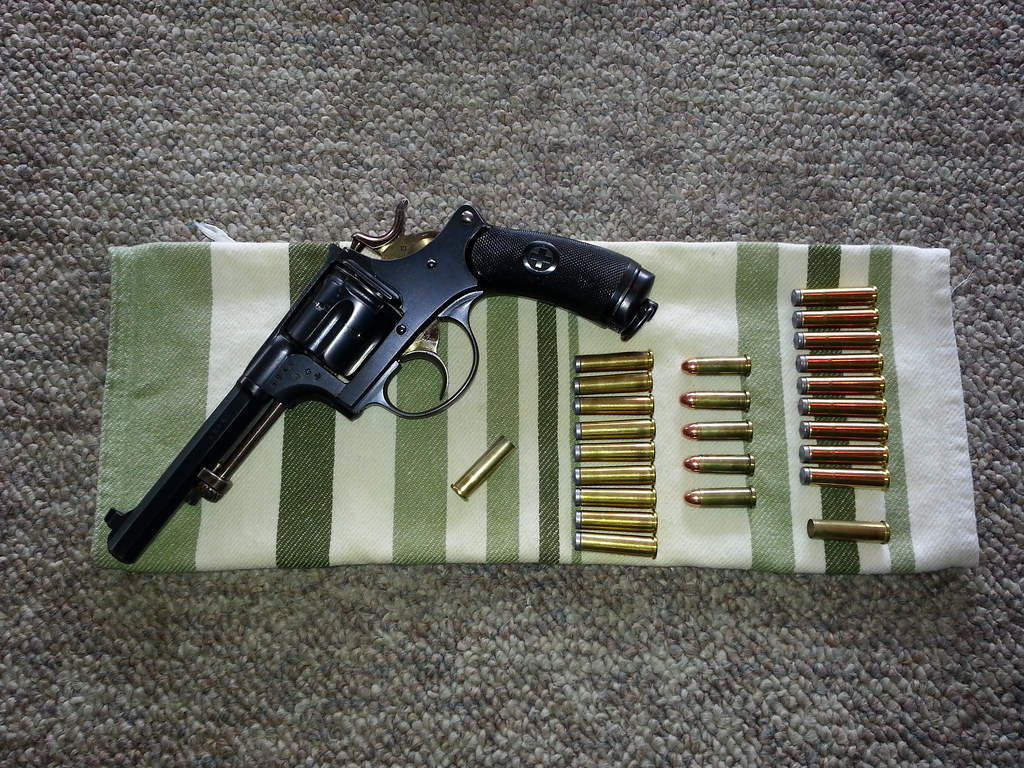
The usual tried and true specimens ("gold standard" in terms of accuracy)...

7.5x33R handload (3.1 grains IMR Trail Boss, deep seated .314" H&N 100 grain LWC, full length 32-20 WCF Starline brass resized in a 30 Carbine die, bullet seated with a 30 Luger die) -- approx. 841-866 fps (3.3 grains of TB is pushing over 900 fps, and 3.5 grains of TB is pushing 1000 fps)

7.5x23R handload (3.1 grains IMR Trail Boss, .311" Hornady 71 grain 32 ACP FMJ, cut to Swiss Ordnance spec 32-20 WCF Remington brass resized in a 30 Carbine die, bullet seated with a 30 Luger die) -- approx. 950-975 fps
20324941411_e9d0b95906_b.jpg
 
Last edited:

Thanks! Appreciate the info!

Just wish the usual suspects around here could get some Trail Boss in!
I have some Tite-Group, but have not got busy with the casting yet.

Cheers
Trev
 
very interesting write up mister.
You will be surprised how well it will shoot with PPU.
Are these ppu bullets have an exposed led base in nagant cases? Did you pull any out? I haven't had a chance to play with ppu stuff yet. If ppu use real fmj then bullets will obturate and expand to the bore diameter of your revolver.
I cut my fiocchi cases at 27mm when they crack after use in 7.62 nagant, then I can reload either swiss/Swedish or 8mm French ord.
This is how they compare in French cylinder


Rims a bit thinner on fiocchi brass, but they work. PPU I think is a bit thicker.
here's finished product.
 
Last edited:

You just made me cry. Beautiful gun. Always the way it goes. When you're not looking...
Is the other one for sale?

The same caliber (7.5mm) Belgian Nagant made Swedish M1887 sold at the same time, they both had many multiple offers to buy and sold faster than any gun I have posted on the EE, no sooner had I posted it at about 11pm and then refreshed my screen and the offers started coming in fast and the first guy who PM'd me within 10 minutes took them both.

I did sell them cheap, especially for their condition and the Nagant is a rare postal service model to, so that was probably why they got so much interest and went so fast. I even had one guy later offer to pay more than I was asking if I sold to him instead of the first guy but I don't play that way.
 
I get offers to buy mine out of the blue, every time I post a photo. I paid a bundle for mine, and the amount of money I invested in reloading equipment, 2 holsters (antique pigskin and a circa 1939 military issue) makes her a real keeper.

The Swiss knew what they were doing over 120 years ago. Mine is tight, wickedly accurate, and like a Swiss watch--simply well engineered and durable. I expect it will keep ticking for another 120 years with proper maintenance. They're not hard to look at either.

ps... Now I'm on the hunt for an antique Russian Nagant revolver. :)
 
Last edited:

I get offers to buy mine out of the blue, every time I post a photo. I paid a bundle for mine, and the amount of money I invested in reloading equipment, 2 holsters (antique pigskin and a circa 1939 military issue) makes her a real keeper.

The Swiss knew what they were doing over 120 years ago. Mine is tight, wickedly accurate, and like a Swiss watch--simply well engineered and durable. I expect it will keep ticking for another 120 years with proper maintenance. They're not hard to look at either.

ps... Now I'm on the hunt for an antique Russian Nagant revolver. :)

Canadian Antique status Russian Nagants are very hard to find, even in America were most of the surplus Russian Nagants went.
 
I'm reviving an old thread because I just picked up a sweet 1882 Swiss made in 1892.

It's one of the ones with a thinner topstrap so I'm trying to keep my loads as close to original specs as possible. Using unique powder I'm shooting for around 750 fps with a 96gr cast .313 .32-20 bullet. Does anyone have experience with unique loads in these revolvers?

One problem I've run into is when I try to seat with the .30 Luger die the crimp is too tight and it pushes the top driving band down and slightly swages it. This is with the seating plug removed. Basically it seats the bullets a little crooked too. What are you guys doin for crimp?

I'll see if I can get a picture that shows what I'm talking about.
 
I can't quite picture what is going on with your crimp. Its not a simple matter of backing up the die a turn or 2? For a mild load like that you can probably do without any crimp.

Sometimes you have to get creative with off-label die use. I will sometimes make spacers or different seating rods to adjust for different lengths etc.
 
you can see a couple are off kilter in the pic.
theyre also seating past the crimp groove just from the seating die without the removed bullet seating stem. This suggests the crimping neck in the die is pushing the bullet down into the case (unevenly) while compressing the front driving band.

Maybe the answer is to size with the .30 carbine decap/sizing die initially.Then try a .32 S&W long seating/crimp die.
Why are people using .30 Luger dies in the first place?

As for loads
I'm starting at 2.5gr Unique and working up with the chrono to 2.8 then maybe trying 3.0 depending where I'm at. From my research it would suggest 3.0 in .32 S&W would be closest to 750 fps.


Edit: Actually it looks like I wound up with the same Swiss mkrnel sold and posted pics of on page one! Maybe he knows what it likes to shoot?
 
Last edited:

Looks like a nice bullet. I might have to find that mold.

Seems weird that the 30 carbine dies would seat them without even having the stem in. Must be really tight. .313 is only about 5 thou bigger than the bullets its made for.

Using the 32 dies should work just fine for seating and probably for sizing as well. They are designed to shoot. 312-313.

2.5-3gr of unique sounds pretty reasonable. I upped my 8mm Lebel from 2.8 to 3 to try and get a better seal and prevent the cases from getting sooty. In the same range with my 7.62 Nagant.
 
Your seater die is not correct for the type of bullet you are using. 30 luger is designed for .308 round nose bullets, yours are flat nosed. That's why you are setting them crooked.
What you need to get is correct seater for flat nosed bullets for your die. Depending on the brand of dies, you have? Lee for example you can flip the seater in the die and get away without buying different seater.
I use lee 30 carbine die to seat my bullets and then roll crimp with seater die that my set came with. I use flat nosed bullets as well, however my bullets have more ogive and seat in as if they were round nose.
3 grains of unique is nice load for this round. Keep in mind that 7.5 swiss is 30 caliber. So 308 bullets is the proper diameter for this cartridge.
If you are using bigger diameter bullets, it may create higher pressure, as well can cause improper seating of bullet.


I'm reviving an old thread because I just picked up a sweet 1882 Swiss made in 1892.

It's one of the ones with a thinner topstrap so I'm trying to keep my loads as close to original specs as possible. Using unique powder I'm shooting for around 750 fps with a 96gr cast .313 .32-20 bullet. Does anyone have experience with unique loads in these revolvers?

One problem I've run into is when I try to seat with the .30 Luger die the crimp is too tight and it pushes the top driving band down and slightly swages it. This is with the seating plug removed. Basically it seats the bullets a little crooked too. What are you guys doin for crimp?

I'll see if I can get a picture that shows what I'm talking about.
 
Your seater die is not correct for the type of bullet you are using. 30 luger is designed for .308 round nose bullets, yours are flat nosed. That's why you are setting them crooked.
What you need to get is correct seater for flat nosed bullets for your die. Depending on the brand of dies, you have? Lee for example you can flip the seater in the die and get away without buying different seater.
I use lee 30 carbine die to seat my bullets and then roll crimp with seater die that my set came with. I use flat nosed bullets as well, however my bullets have more ogive and seat in as if they were round nose.
3 grains of unique is nice load for this round. Keep in mind that 7.5 swiss is 30 caliber. So 308 bullets is the proper diameter for this cartridge.
If you are using bigger diameter bullets, it may create higher pressure, as well can cause improper seating of bullet.

Thanks for the advice. I guess all the research I did suggests .314 is the best diameter for this round in the Swiss 1882. I'll slug my bore and get a better idea of actual diameter. Not that I put too much faith in Wikipedi but it lists the diameter for 7.5mm Ordnance as 8.00 mm (0.315 in) (Swiss), 8.30 mm (0.327 in) (Swedish)
Did you slug yours and its .308?

Your definitely right the seater stem is concave for RN bullets heres a pic of how the FN .32-20 sits in it. Its not seating the bullet though as I've got it removed. Do you think I can flatten out the seater stem with a file so it just hits the nose?

Definitely the crimp neck on the .30 Luger die is too tight as its compressing the front driving band as it forces the bullet into the case. I ordered a .32 S&W crimp die to try instead.

IMG_20160410_104846_zpsot0h5nh2.jpg
 
Last edited:

There is no need for slugging anything.
What you need to know is the diameter of your muzzle (business end of barrel) to determine what are the best bullets to use. Just measure like this. put the jaws of the caliper in the grooves and it will let you know the overall diameter. Bullets will leave your muzzle at that size. Be careful not to damage the crown.


If you wish to beat up your revolver you can use what ever diameter bullets Wikipedia tells you to. However high pressure is the one that destroys the frame and cylinders, so your choice.

My M1929 has .305 bore. My Swedish .307 My 7.62 M1895 has 309 bore. So I would not use anything bigger than 308 diameter, bullets.

As for the dies, well its that you have to find out what works for you.
I sometimes use ch4d 8mm lebel die as well so, there is a lot of options.
 
Last edited:

Great info Gewehr
Yes the muzzle on mine groove to groove measures .308 as well.
Interestingly though the cylinder mouths are .315 and the unrifled forcing cone is .316. It then tapers down to the rifling in a 3/4 inch. Here's a pic of a .313 bullet plugged into the forcing cone.

4678bf4b-8232-4c66-857f-4112cb1f7b7f_zps70umor8o.jpg


This would explain why people have good results from .311 acp bullets up to .314 HB wadcutters, as all will feed through the cylinder, and aren't squeezed down till they're well on their way down the barrel. I'll be keeping my loads reasonable in deference to the .308 grooves, but it would seem that the bullet isnt forced into that diameter until pressures are lower.
One thing that concerns me with using .308 bullets is how much slop there is in the cylinder and forcing cone which would suggest the .308 bullet could be crooked as it enters the rifling. But if your getting good results with .308 I could be wrong

By way of comparison my .357 Ruger will not fit bullets into the cylinder mouths or into the forcing cone at all. In fact the mouths and forcing cone are a few thousandths smaller than bullet diameter.
 
Last edited:

Back
Top Bottom