












































You are using an out of date browser. It may not display this or other websites correctly.
You should upgrade or use an alternative browser.
You should upgrade or use an alternative browser.
Neck sizing die creates runout!?
- Thread starter MozPhoq
- Start date


I use a Redding neck thickness gauge to check and sort my cases below. After sizing I check case neck runout and make sure the runout is close to the neck thickness variation. Then after seating the bullet I check bullet runout, just remember these are two different checks. And bullet runout is the reading that counts for a concentric cartridge.
Bottom line I prefer the Redding neck thickness gauge because one twist of the wrist tells you a great deal about the quality of the case. I have Remington .223 cases with over .009 neck thickness variations and this thickness variation can extend into the case body wall and cause the case to warp when fired.
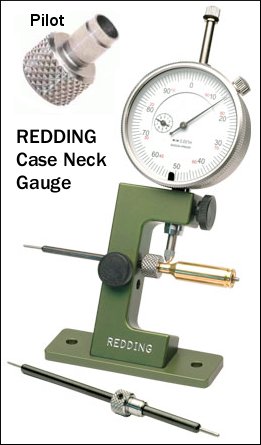
I also have a RCBS ball micrometer but prefer the Redding gauge for it fast total thickness variation reading.

After setting up the die and checking the cases for minimum neck runout you will know the expander is not pulling the neck off center and the cases are concentric.
And the expander with the bushing dies are for reloaders who do not neck turn their case necks. Meaning the expander pushes the thickness variations to the outside of the case neck on unturned necks. So again bushing dies work best with neck turned brass with a custom tight neck chamber. And this is why your better off using a standard full length die with a SAAMI chamber. And a full length resizing die with a expander is not the end of the world and can produce very concentric ammunition.
Forster is the only die manufacture that will hone the dies neck to your desired diameter for a small fee.
FL Bushing Dies vs. Honed FL Dies
http://www.accurateshooter.com/technical-articles/reloading/fl-bushing-dies-vs-honed-fl-dies/
Are Your Sizing Dies Overworking Your Rifle Brass? (below you will see not all dies over work the case necks)
http://www.massreloading.com/dies_overworking_brass.html
Bottom line I prefer the Redding neck thickness gauge because one twist of the wrist tells you a great deal about the quality of the case. I have Remington .223 cases with over .009 neck thickness variations and this thickness variation can extend into the case body wall and cause the case to warp when fired.
I also have a RCBS ball micrometer but prefer the Redding gauge for it fast total thickness variation reading.
After setting up the die and checking the cases for minimum neck runout you will know the expander is not pulling the neck off center and the cases are concentric.
And the expander with the bushing dies are for reloaders who do not neck turn their case necks. Meaning the expander pushes the thickness variations to the outside of the case neck on unturned necks. So again bushing dies work best with neck turned brass with a custom tight neck chamber. And this is why your better off using a standard full length die with a SAAMI chamber. And a full length resizing die with a expander is not the end of the world and can produce very concentric ammunition.
Forster is the only die manufacture that will hone the dies neck to your desired diameter for a small fee.
FL Bushing Dies vs. Honed FL Dies
http://www.accurateshooter.com/technical-articles/reloading/fl-bushing-dies-vs-honed-fl-dies/
Are Your Sizing Dies Overworking Your Rifle Brass? (below you will see not all dies over work the case necks)
http://www.massreloading.com/dies_overworking_brass.html
Last edited:
Ok to end the subject, here is what I found out:
1- About the runout induced on brass that previously had none or little: solved by loosening the bushing cap more than instructed by Redding. Documentation says you should unscrew the equivalent of 1/16 of a turn. I unscrewed past a full quarter . This allows more room for the bushing to center around the neck I guess. Good brass going into neck sizing bushing die now remains straight.
2- About the incapacity to correct runout with a neck bushing die: the capacity for the bushing to ajust around the neck means that if you put garbage in you'll get garbage out. For example if I run a batch and induce runout by misusing the expander die, chances are this runout will show up at next reloading time only to be resized with the same runout intact or worse.
To break the chain, I resized all faulty brass with the FL Lee after removing the expander ball and they all came back within one thousandth. Running them through the expanding die did not affect runout as long as the interior of the necks had been brushed clean. Now that they are straight, on the next cycle the will go back to the neck sizing.
End of story... probably. Thank you all for your efforts.
1- About the runout induced on brass that previously had none or little: solved by loosening the bushing cap more than instructed by Redding. Documentation says you should unscrew the equivalent of 1/16 of a turn. I unscrewed past a full quarter . This allows more room for the bushing to center around the neck I guess. Good brass going into neck sizing bushing die now remains straight.
2- About the incapacity to correct runout with a neck bushing die: the capacity for the bushing to ajust around the neck means that if you put garbage in you'll get garbage out. For example if I run a batch and induce runout by misusing the expander die, chances are this runout will show up at next reloading time only to be resized with the same runout intact or worse.
To break the chain, I resized all faulty brass with the FL Lee after removing the expander ball and they all came back within one thousandth. Running them through the expanding die did not affect runout as long as the interior of the necks had been brushed clean. Now that they are straight, on the next cycle the will go back to the neck sizing.
End of story... probably. Thank you all for your efforts.

It may not be a big problem at ranges within 300m but when you shoot beyond that it will show. Whatever the results downrange, I was only explains how I got to investigate and realize the dies were creating all this runout. To me this is not normal. Some people will tell you that resizing cases that are near perfect will induce runout on them and that this is normal, I don't think it is true. A good die set should not create cases that are beyond 2 thousands IF they were under that to begin with.
So if anyone out there has an explanation on why these dies can take near perfectly straight (and new) casings and induce so much runout please step forward!
Thanks
If the die has been set up properly and the case is not getting over compressed somehow then:
I was initially thinking it might have been due to uneven expansion with internal donuts but when you said brand new cases come out the same way the other thought was something is doing something odd internally to the case.
Are you using a button expander with the die? If so, is it free to float on the stem? Has the stem ever been bent? Is it a carbide expanding button? I find carbide is much better / more slippery in use and less likely to bind on the stem. If you are in doubt about any of this, remove the expander stem and button and try it without.
If this still fails, then disassemble, carefully and thoroughly clean the entire die; maybe some gunk is forcing the neck sizing bushing off center or canted somehow. Take it apart, soak it in a light solvent. Give it a light scrub with a nylon brush. NO wire brushes!! Soak again and wipe it out with clean cotton swabs. Very lightly oil with good quality gun oil while reassembling. Leave the expander assembly out!! Try it again. No joy? something is wrong with the die.
If it works then re-install the expander stem but leave the button off. Try it again. No joy? Stem is bent enough to cant the plunger which pushes on/holds the neck bushing which is also then canted ever so slightly under the pressure of use.
If that works too then put the expander button back on the stem and try it again. You see where I am going with this by now I hope. At this point either it all works OR something is wrong with the expansion button or the stem at the point where the button rides or both the button and stem.
I normally run Redding Competition dies. I also have Redding Instant Indicators. I also have Lee collet neck dies which I use before neck turning should that be required. Bottom line is that I managed to screw up a Redding Comp 223 resizing stem by bending it. Not enough to notice visually, or even by rolling the stem on a flat surface to look for any wobble, but enough to see that ammo wasn't working as well as it used to be. It didn't take much to bend that stem, just one case that wasn't in the shellholder fully. There is no such thing as repairing it, it has to be replaced. Good luck finding the problem and the solution, it just takes a little time. Best part is that you get to see in depth exactly how all the parts of the die works and that Redding stands behind their products. Be honest and tell them exactly what happened. Fill in the form on their web page with all the pertinent info. They have never asked me to see / get anything back and have sent replacement parts in the mail.
Last edited:
Bushing dies induce runout because the bushing can move side to side and even tilt when the neck is sized. Think about it, the bushing floats and you can hear rattle inside the die.
If you place the numbers up on the bushing the raised stampings can cause the bushing to tilt when sizing the neck.
Now ask yourself why so many reloaders prefer using a Lee collet die than a bushing die.
On a standard off the shelf factory rifle the case neck will expand more than .004 and when using a bushing die reducing neck diameter .004 or more will induce neck runout.
You are told to reduce the neck diameter in two steps when reducing the neck diameter .004 or more. So again what centers the bushing in the die when it has side to side movement.(nothing)
Bushing dies work best with custom tight neck chambers and neck turned brass. And off the shelf factory rifles with standard SAAMI chambers do not fall into this category.
I have Remington .223 brass with over .009 neck thickness variations, and all a bushing die will do is push the neck defects to the inside of the case neck if not neck turned.
A bushing die comes with a expander for those who do not neck turn their brass, but guess what happens when you size the neck with a bushing die and then pull the expander through it.
A standard full length die fully supports the case body and neck when the case is sized. If the expander is removed from the die the sized case will be concentric and straight as it ever will be.
You hear people say standard full length dies overwork the case neck. "BUT" you have no control over how much the neck expands, meaning the neck expands more than .004 and a bushing die is not the best choice for sizing.
Forster still offers to hone the inside of the neck of their dies to your desired diameter. And this means the case body and neck are fully supported and concentric after sizing.
If you want to make concentric ammunition then buy a Forster full length benchrest die and don't mess with bushing dies with standard SAAMI chambers.
Too much of what benchrest shooter do filters down to the average reloader and it is not needed with our factory rifles.
And this is not just my opinion, at the Whidden custom die website they tell you the most concentric cases come from non-bushing full length dies.
The main cause of neck runout is if the expander is locked down off center and with the Forster die with its high mounted floating expander it will not pull your case necks off center.
Bottom line, when you are standing on your hind legs shooting at running game how much of what benchrest shooters do really matters.
If you place the numbers up on the bushing the raised stampings can cause the bushing to tilt when sizing the neck.
Now ask yourself why so many reloaders prefer using a Lee collet die than a bushing die.
On a standard off the shelf factory rifle the case neck will expand more than .004 and when using a bushing die reducing neck diameter .004 or more will induce neck runout.
You are told to reduce the neck diameter in two steps when reducing the neck diameter .004 or more. So again what centers the bushing in the die when it has side to side movement.(nothing)
Bushing dies work best with custom tight neck chambers and neck turned brass. And off the shelf factory rifles with standard SAAMI chambers do not fall into this category.
I have Remington .223 brass with over .009 neck thickness variations, and all a bushing die will do is push the neck defects to the inside of the case neck if not neck turned.
A bushing die comes with a expander for those who do not neck turn their brass, but guess what happens when you size the neck with a bushing die and then pull the expander through it.
A standard full length die fully supports the case body and neck when the case is sized. If the expander is removed from the die the sized case will be concentric and straight as it ever will be.
You hear people say standard full length dies overwork the case neck. "BUT" you have no control over how much the neck expands, meaning the neck expands more than .004 and a bushing die is not the best choice for sizing.
Forster still offers to hone the inside of the neck of their dies to your desired diameter. And this means the case body and neck are fully supported and concentric after sizing.
If you want to make concentric ammunition then buy a Forster full length benchrest die and don't mess with bushing dies with standard SAAMI chambers.
Too much of what benchrest shooter do filters down to the average reloader and it is not needed with our factory rifles.
And this is not just my opinion, at the Whidden custom die website they tell you the most concentric cases come from non-bushing full length dies.
The main cause of neck runout is if the expander is locked down off center and with the Forster die with its high mounted floating expander it will not pull your case necks off center.
Bottom line, when you are standing on your hind legs shooting at running game how much of what benchrest shooters do really matters.
Last edited:





















