Need HELP to do a Reality check for reloading in RENTAL apartment with TIGHT SPACE.

1) Where you are matters, but landlords generally are required to give 24 hours notice and cannot go anywhere in the unit but where they say they need to. If they go into the boudoir without your permission, for example, they're in trouble.
2) Use a Black and Decker Workmate. Solid, reasonably inexpensive and folds.
Only need to use the press one month per year. HAHAHAHAHAHAHA!!!!!! That's funny. Buddy of mine shot 2500 rounds per week when practicing for Second Chance long ago. Reloading makes ideas like only loading once in a while go away.
 
I think this could work for me. I have a extra long computer table like this: http://www.ikea.com/ca/en/catalog/products/S69857764/
it's 7 x 3 FTs long. on one side, I have my computer and 3 monitors on a multi-monitor stand clamped on the other side of the table. I could do exactly the same thing, probably adding a piece of thin rubber to protect the table surface(as it's my reading table).
then when I am not pressing, I can just store it away. thanks!


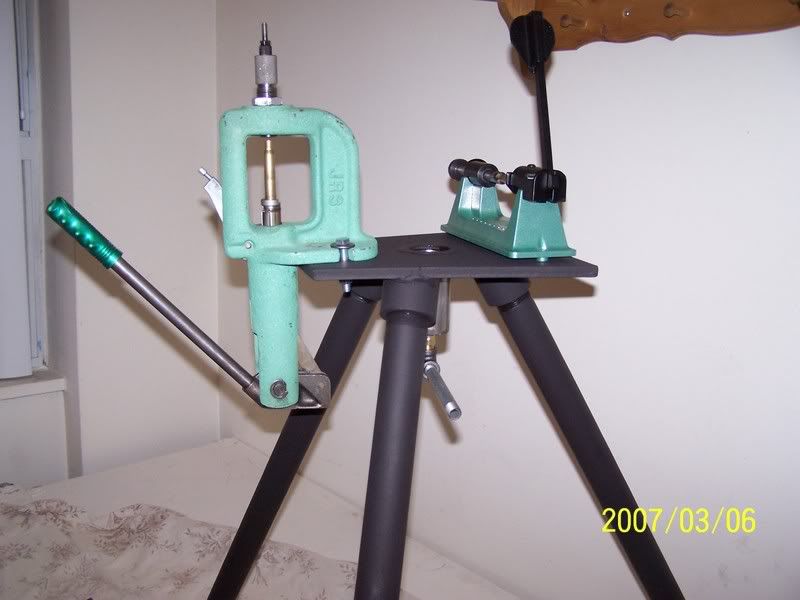
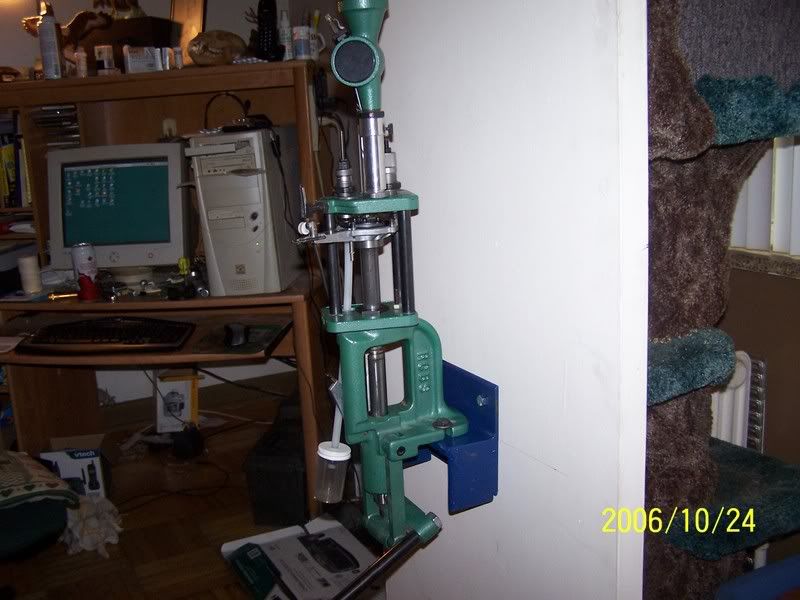
Here's how I did it when I lived in an apartment:
DSC00254.JPG


The Strong Mount is one of the nice features of the Dillon presses. It spreads the load of the press over a greater area and makes a nice, unitized package that can be easily moved.
 
I am going to give the bench a try as well and always can return it if not working. I do like the foldable feature very much. with that, I can load it in my family room. and move it into the bedroom and say my wife is sleeping if inspection or urgent maintenance(like a water leak etc). :)

Then worst case, I will clean up one section of my extra long computer desk, then clam it there for the time being.

1) Where you are matters, but landlords generally are required to give 24 hours notice and cannot go anywhere in the unit but where they say they need to. If they go into the boudoir without your permission, for example, they're in trouble.
2) Use a Black and Decker Workmate. Solid, reasonably inexpensive and folds.
Only need to use the press one month per year. HAHAHAHAHAHAHA!!!!!! That's funny. Buddy of mine shot 2500 rounds per week when practicing for Second Chance long ago. Reloading makes ideas like only loading once in a while go away.
 
how's this compared to the B&D workbench. http://www.homedepot.ca/product/portable-folding-worktable/823586
I saw youtube video showing a guy was trying this, but never saw the end result as the video just show the idea which was two piece of thick plywood on top of this table and clam the press to it. however, when people asked if the table will be tilted on the other side, the question was never answered.


This is a bad idea for the pollution reason you stated. While it would be possible to clean between reloading and cooking most folks would not do the "hospital operating room" sort of scrub down that would be wise to perform. We just are not that detail oriented.

I like the idea of Lead Hammer's coffee table modification. Although a coffee table is way too low. But if the table were replaced with a slab sided monolithic box that has a top which lifts off, flips over and bolts back down a support stand could be fixed to the new top side.

Going back to the stands. Of the three shown so far that would be considered portable the B&D workmate would be best. Still not as good as solidly clamping it to something fixed to a wall but head and shoulders better than the Ikea or Franklin tables.

It's not that the press will just over balance the table and flip it. There's the lost motion that will occur on just about any free standing lightweight portable table of this sort. Even the nicely clamped table setup in tjhaile's pictures above looks a trifle spindly and wobbly in the legs. It may have worked but I'll bet there was some give to it with every handle pull.

And in the end that's the issue. If the stand or table moves around you're working harder than you need to work to run the lever. And in the case of overly wobbly stands like that Ikea or Franklin table there's going to be a few times you need to catch it from simply falling over from even a slightly enthusiastic lever pull. And that's the two reasons why you need something solidly mounted or solidly stiff and heavy to use as a base for the press.

You asked about the use of a progressive as being possible overkill for hand gun ammo only. Nope, it's the other way around. The higher consumption and reloading required for competitive handgun shooting pretty much demands a good progressive. So you are most certainly going in the right direction. What is needed is a slight compromise to suit your confined living accommodations as to noise and size of the setup. If you can't spare the room for even a compact vertical cabinet which would allow for the closed doors covering up the press then you need to set up something that lets you easily lift out the press and clamp it to somewhere that won't shake around or fall over. For example even if the missus did let you clamp it to the dining table I've seen only a few which I would consider as rigid enough to use for reloading over the long term. Far better to rig up something that allows clamping it to a bathroom counter top or a sturdy dresser top or something of that sort.

It would be different if you were only loading a few rounds now and then In that case even a wobbly surface is fine. It's not great but we can work with it for a short while. But you're talking major numbers of lever pulls so ANY flex or wobble to the mounting surface will become old REAL fast.

I was originally given three boxes of Lee presses and other reloading gear by a helpful sort after I gave them a hand with cleaning up their storage area. It was the gear he started with before seeing the light and going to Dillon. I started out with this and suffered with a lot of little niggling things that I modified to make the Lee 1000 into a decently relliable press. Then along came a used Dillon 550b setup and I jumped on it. I've since passed the always frustrating Lee gear on to a shooting buddy. And I can easily say I won't miss it. There's just too many iffy things going on with the Lee 1000 to make it a nice press to use. I ended up performing a solid 6 modifications to it before I would say that it was as reliable as the Dillon. Even then the silly little "ski slope" primer feed would require cleaning on fairly regular intervals with brake cleaner to remove some little spot of oil that got onto the plastic and caused the primers to stick.

So for your situation where you'll be reloading somewhere around 10K a year I'd say you're going in the right direction with a Dillon or a Hornady. My needs are well supported with the 550. But if you're looking ahead a 650 would keep the doors open to somewhere in the future eventually going with the case and bullet feeders once you move into a house. So if you can spare the added cost keep the future in mind. And of course the Hornady progressive also has the options for all those add ons. But for now in your apartment it sounds like you're in agreement that these add ons are going to be too noisy.

One way in which a wheeled small table would work is if it were made so it wheels into place then clamps to some sort of stub of wall. If you can set up something like that then you get a small size easily rolled away stand but the rigidity of being clamped to something that won't move. Again without seeing the options you have in your apartment it's hard to make anything more than generic suggestions. You need to take these as inspirations and open up your mind to the options for good solid mounting while still being small and easily put away in the blink of an eye.
 
how's this compared to the B&D workbench. http://www.homedepot.ca/product/portable-folding-worktable/823586
I saw youtube video showing a guy was trying this, but never saw the end result as the video just show the idea which was two piece of thick plywood on top of this table and clam the press to it. however, when people asked if the table will be tilted on the other side, the question was never answered.

IF you can work it with the computer desk then that would be the way to go. It's better to use something that is already there than to work a new piece of furniture into a snug apartment.

That Ikea table doesn't fill me with confidence. Being raw at this I don't think you're fully understanding what we've been telling you that you need for a firm surface to work from. The lever on the press gives you a mechanical advantage that multiplies your 15 or so pounds of force on the lever into something that will pretty easily flex a table of that sort.

If it were a nice solid office desk with the solid panel side panels and a heavy front privacy panel I'd say go for it. A desk of that sort is very rigid if you mount the press near one end so it gets a lot of support form the end panel. But the open legs with no real bracing like that Ikea table? Not so much.

Even if it means trading off your present computer table for a heavier and more rigid office desk at least you would not be adding another piece of furniture to trip over and take up space. So that would be the way to go over a Workmate or that portable work table. It would be more suitable both for the equal amount of furniture as for being more rigid and weighted down where a Workmate or that work table needs to be stored and handled.
 
I think you are right, but I do really want to keep the reading area on the computer desk where I usually do some light reading and put my another laptop. Unless it's absolutely necessary.....
In my living room, besides my wife's piano, there is a spot where I think I can fit the foldable workbench, beefed up with a piece of plywood on top and then the press bolted into the plywood and then clamp the thing on the bench. hope this will work as it gives me the mobility I need while it should be solid at the same time. fingers crossed. Or.... a crazy idea is .... move to a bigger aparment, just for this. Am I really going nuts on this sport or what. lol..

IF you can work it with the computer desk then that would be the way to go. It's better to use something that is already there than to work a new piece of furniture into a snug apartment.

That Ikea table doesn't fill me with confidence. Being raw at this I don't think you're fully understanding what we've been telling you that you need for a firm surface to work from. The lever on the press gives you a mechanical advantage that multiplies your 15 or so pounds of force on the lever into something that will pretty easily flex a table of that sort.

If it were a nice solid office desk with the solid panel side panels and a heavy front privacy panel I'd say go for it. A desk of that sort is very rigid if you mount the press near one end so it gets a lot of support form the end panel. But the open legs with no real bracing like that Ikea table? Not so much.

Even if it means trading off your present computer table for a heavier and more rigid office desk at least you would not be adding another piece of furniture to trip over and take up space. So that would be the way to go over a Workmate or that portable work table. It would be more suitable both for the equal amount of furniture as for being more rigid and weighted down where a Workmate or that work table needs to be stored and handled.
 
The piano would make a GREAT stand to mount the press on! ! ! ! !


:d

If you go that way I'd aim for a Workmate over that other table. It folds up a lot smaller. I also would not buy the lighter of the two. I've got one of the lighter ones and I would not want to use the press on it for any length of time. It's not that the top won't take the press. It's simply too small and light and you run the very real risk of pulling it over if a casing gets a trifle sticky in the resizing die for any reason. Even on other small tables it's not the table top that needs reinforcing in most cases. It's the legs that need the help. And on the smaller tables you need a place to mount a bunch of weight to hold it firmly to the floor. Like you buy the 10K worth of bullets THIS year for loading NEXT year and when you start you order up the FOLLOWING year's worth to use for table ballast for next year. OK, OK, I'm kidding.... somewhat.... :d But the key is that any sort of smaller footprint stand or table you get is going to need considerable ballasting to sit solidly in place. A nice table with drawers would be nice. Ballast the lowest drawer and use the others for keeping die plates and other press related goodies in it. Although the Ikea tables you've shown so far look pretty wobbly for reloading an end table with drawers would not be a bad way to go if used in this way.
 
Wife does have a piano. Don't think she would like that idea though. Lol....
for the reloading cycle, it's no joke, my plan is to run through about 3000-4000 out of my 5000 stock before starting the factory, depending on the waiting time on the components. This way I can plan way ahead and more chances to catch deals and buy bulk. Less worry about running out.
for the tables, yes, have to really consider the weight carefully. Going to homedepot on the weekend to try them out. I do have a pair of 40 pound dumbbells, maybe buying some more(need exercise anyway) to tie the table down on the opposite side. That should help too.


The piano would make a GREAT stand to mount the press on! ! ! ! !


:d

If you go that way I'd aim for a Workmate over that other table. It folds up a lot smaller. I also would not buy the lighter of the two. I've got one of the lighter ones and I would not want to use the press on it for any length of time. It's not that the top won't take the press. It's simply too small and light and you run the very real risk of pulling it over if a casing gets a trifle sticky in the resizing die for any reason. Even on other small tables it's not the table top that needs reinforcing in most cases. It's the legs that need the help. And on the smaller tables you need a place to mount a bunch of weight to hold it firmly to the floor. Like you buy the 10K worth of bullets THIS year for loading NEXT year and when you start you order up the FOLLOWING year's worth to use for table ballast for next year. OK, OK, I'm kidding.... somewhat.... :d But the key is that any sort of smaller footprint stand or table you get is going to need considerable ballasting to sit solidly in place. A nice table with drawers would be nice. Ballast the lowest drawer and use the others for keeping die plates and other press related goodies in it. Although the Ikea tables you've shown so far look pretty wobbly for reloading an end table with drawers would not be a bad way to go if used in this way.
 
Last edited:
If the stand itself can live in the spot permanently then I vote for a wider and deeper night stand table with drawers. Then to make up for the low top height use a riser stand such as shown in that picture a few posts back.

A night stand looks enough like a living room table that it will blend in just nicely. The drawers will prove handy as blazes for storing some of the various items you'll collect and work as ballast as well. And the solid "box" makeup of a good size night stand will provide the rigidity you want. And assuming you don't move it around the night stand will fit in better sitting by the piano if you pick the right design and finish colour.

The only downside will be that you'll want to drill for hold down bolts to mount the press. If you're handy this could be done by removing the finished top and replace it with a layer of 3/4 inch plywood. The plywood being drilled for the hold down bolts and top hat insert nuts put in from below. When used for reloading lift off the finished top and set aside. Bolt down the press on the riser setup and pull away. When the press is removed to the closet just set the top back onto the night stand. Little stub bolts drilled and threaded in from below can be located to fit into the hold down holes so the top doesn't slide around.

A good night stand conversion of this sort would have it all over the workmate or that other stand which needs to be folded up and takes up room in the closet while providing no additional storage space and looking ugly as blazes to boot.

It's not a modification I'd want to do in your apartment but if you know someone with a garage and a skill saw it's something that could be easily done some afternoon. The holes and top hat nuts you can do with a hand drill later even in your apartment once you have the press and riser stand similar to the one shown above. Keep in mind you only need the riser because of using the low top night stand. For a writing desk height and a regular office style chair you don't need or want the riser. It would put the lever up too high.

1/4 inch bolts are just fine for holding the press down. But using 5/16 bolts might make it easier for locating and sizing the anti skid pins for the fancy dress top being easier to put in place when the press isn't on the table.
 
Just build a proper bench. Something that's big enough for all your gear and sturdy. Nothing half-assed

Then sew yourself a nice large dust cover. Box corners, dark that's not see-thru, that covers the whole bench. The dust cover will keep dirt/dust/moisture away as well as prying eyes. If asked, just say "it's my work bench."
 
went to homedepot today to check out the foldable bench. none of them looks half decent for the press. So, I think I will follow the advice here to build one for myself. I am thinking to squeeze some of the closet space and built one inside so that nobody would know because wife does remind me that in our building, the management office does a very good job and come in to all the rooms to vaccum/dust all the air conditioning outlets every year. so, closet is the only place they won't have access to.

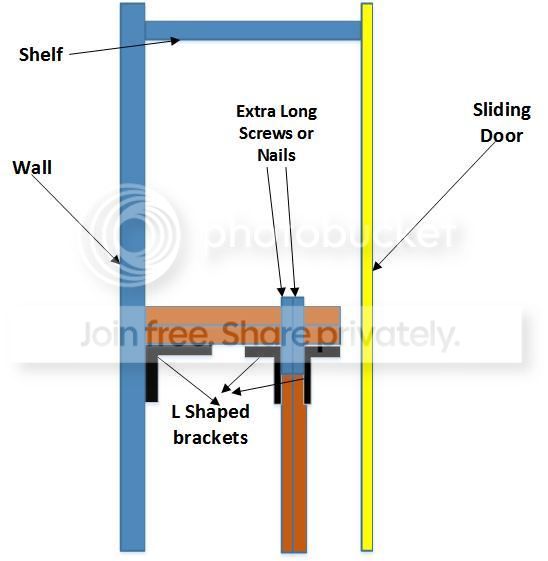
this is my idea of the design.
workbench_zpspukgtx6q.jpg

since even though I am quite handy and have no problem do the work, I have never built a workbench like this before, I really need advices on the material and some of the fine details on how to secure the legs.

background info. the closet high clearance is 63 inch until it hit the shelf, 23 inch deep to the sliding door. So, the questions are:

1. what kind of wood and how thick is enough so that it won't flex from the weight and handle pull?
2. what kind of wood for the leg and how thick it should be?
3. to secure the leg to the table table, would the 4 L shaped brackets from 4 sides of the leg, and the extra long screw/nail from the table top down be enough? or it's better to cut a hole half into the table top, and then with the brackets and screws/nails from the top?
4. should I add a beam along the long side of the table top, between the two legs, drill screw/nail into the legs, then add the L shaped brackets to make the two legs straight up without any movement? I checked my dinner table is like that.
5. given the high clearance, how tall the table should be? I will be buying the strong mount which makes the 550b around 29-30 inch tall?

Thanks!
 
Last edited:
I'll dig through some photos tonight of my last bench I built. 2x4 for the frame is plenty strong, and you can always double them up if you like to gain more strength. 2x4 is cheap and strong, and can easily be covered with siding or trim if you want to make it look better.
 
thanks Kevin.

I'll dig through some photos tonight of my last bench I built. 2x4 for the frame is plenty strong, and you can always double them up if you like to gain more strength. 2x4 is cheap and strong, and can easily be covered with siding or trim if you want to make it look better.
 
You're going overboard with the brackets. You don't need anywhere near as many.

Here's what I'd do in the same situation where I want a working area in the closet. The top is a single layer of GOOD 3/4" plywood. Or if you wish double it to make it 1 1/2 thick. But really I think that is overkill. I'm showing in the sketch below a 16 inch wide top for the reason that all presses when mounted stick out from the front edge by some amount and you want to close the door with the press still mounted. My Dillon 550 sticks out 6.5" and the Hornady single stage sticks out about 4.5". So you can't really go much wider than 16".

My sketch shows a 2x4 cleat screwed to the wall at the stud locations. Then the top is screwed down to that cleat. The front is a 2x4 apron with two 2x4 legs screwed to the apron and extending to the floor.

To avoid the carpet producing any give in the front edge the inset shows my suggestion for screwing 4 drywall screws through the carpet and into the plywood floor underneath. Leave then sticking up enough that the heads are more or less even with the top of the carpet knap and level them with each other. The ends of your legs will rest on the set of 4 (or 6) screw heads and be held in place by a smaller than you show flat L bracket. Something about 2.5" is fine. It's only there to keep the leg from being kicked away.

Because the top is so narrow to let the door close with the press mounted it does not need to be all that thick. You may elect to make the top wider other than a cut away that goes down to the 16'ish inch top width at the location of the press. That's up to you.

There are no angle brackets at the top because it's already held very nicely by the cleat on the wall and the apron and legs. Once the feet of the legs are secured with the angle bracket and to the wall cleat that bench isn't going anywhere.

The screws you need for all this are #8x3 for going through the 2x4's and into the wall or the other 2x4. They are overkill for holding the plywood down but they'll work fine instead of buying another size. And a few #6x1 1/4 for the feet areas of the two legs.

All those angle brackets you show are not needed because fixing things to the wall and floor locks everthing solidly. The only brackets you need are a couple of the 2.5" flat steel brackets to keep the feet of the front legs from being kicked out of place.


Closet%20reloading.jpg
 
Thanks a lot, BCRider!

Your design is much simpler and looks great. Thanks for the measurements as I never even thought about the sticking out part. One more question, if to go with one sheet for the top, would MDF harder/stronger than plywood? Or if I really want to go overboard for two sheets on the top, I just need to screw them together, no superglue or anything like that, right? Thanks again
You're going overboard with the brackets. You don't need anywhere near as many.

Here's what I'd do in the same situation where I want a working area in the closet. The top is a single layer of GOOD 3/4" plywood. Or if you wish double it to make it 1 1/2 thick. But really I think that is overkill. I'm showing in the sketch below a 16 inch wide top for the reason that all presses when mounted stick out from the front edge by some amount and you want to close the door with the press still mounted. My Dillon 550 sticks out 6.5" and the Hornady single stage sticks out about 4.5". So you can't really go much wider than 16".

My sketch shows a 2x4 cleat screwed to the wall at the stud locations. Then the top is screwed down to that cleat. The front is a 2x4 apron with two 2x4 legs screwed to the apron and extending to the floor.

To avoid the carpet producing any give in the front edge the inset shows my suggestion for screwing 4 drywall screws through the carpet and into the plywood floor underneath. Leave then sticking up enough that the heads are more or less even with the top of the carpet knap and level them with each other. The ends of your legs will rest on the set of 4 (or 6) screw heads and be held in place by a smaller than you show flat L bracket. Something about 2.5" is fine. It's only there to keep the leg from being kicked away.

Because the top is so narrow to let the door close with the press mounted it does not need to be all that thick. You may elect to make the top wider other than a cut away that goes down to the 16'ish inch top width at the location of the press. That's up to you.

There are no angle brackets at the top because it's already held very nicely by the cleat on the wall and the apron and legs. Once the feet of the legs are secured with the angle bracket and to the wall cleat that bench isn't going anywhere.

The screws you need for all this are #8x3 for going through the 2x4's and into the wall or the other 2x4. They are overkill for holding the plywood down but they'll work fine instead of buying another size. And a few #6x1 1/4 for the feet areas of the two legs.

All those angle brackets you show are not needed because fixing things to the wall and floor locks everthing solidly. The only brackets you need are a couple of the 2.5" flat steel brackets to keep the feet of the front legs from being kicked out of place.

Closet%20reloading.jpg
 
I want to say go for plywood. But the truth is that a top this narrow can be made from almost anything and be strong and stiff enough. Note that I separate "strong" and "stiff". By now I hope you and the others looking for advice here understand the difference. We want both at once for a good reloading bench top.

Since you don't want a whole lot of left overs I won't mention the plywood option. It's silly to cut this small a work top from a full sheet of plywood. Instead I'd look for some sort of prefinished shelving that you can laminate two layers together to get a good work top.

Since the top will likely be finished already forget about glue working on it. Instead I'd go with drilling a pattern of holes in the lower layer and screw up into the top layer with drywall screws. To effectively "sew" the two layers together go for 4 rows of holes with the holes spaced 4 to 5 inches apart. You want a "grid" of screws that effectively lock the two layers together as if they were glued. The outer rows would run about an inch in from the front and rear edges. Then over the remaining width on the 16 inch width shelving stock run two more rows. You will want to drill and countersink for the screws so you don't have them sticking out below and catching on anything for any reason.

Go for the good finish on the shelving. If you're going to avoid varnishing it should be with something that doesn't mark or stain easily and certainly something water proof.

We didn't talk about it yet but I'd also add enough extras to build on a shelf or two for holding your supplies below the working area. I've found that because the presses stick out from the edge of the table and we need to be back a little to get a good swing on the arm that there's just no need for leg clearance below the table. So spacing the front legs from the wall such that a couple or three of 12 inch wide shelves can be included is a great option.


 
Back
Top Bottom