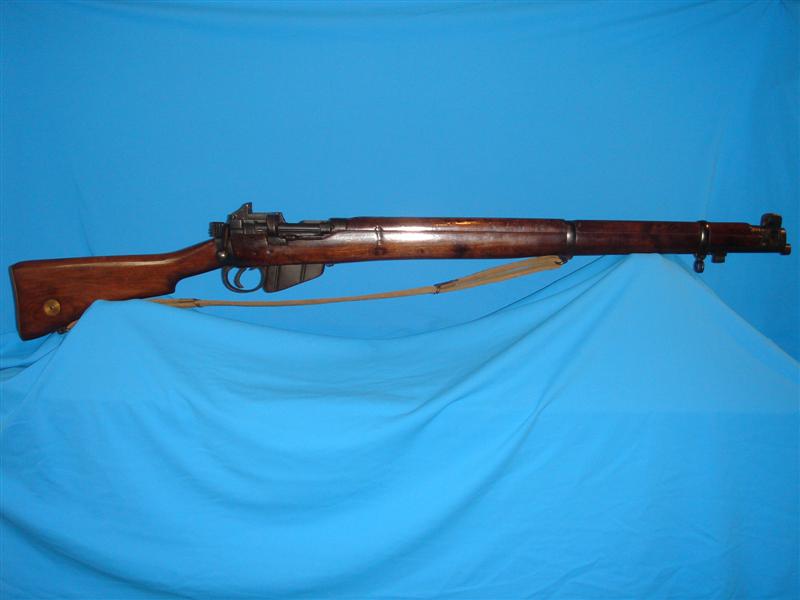
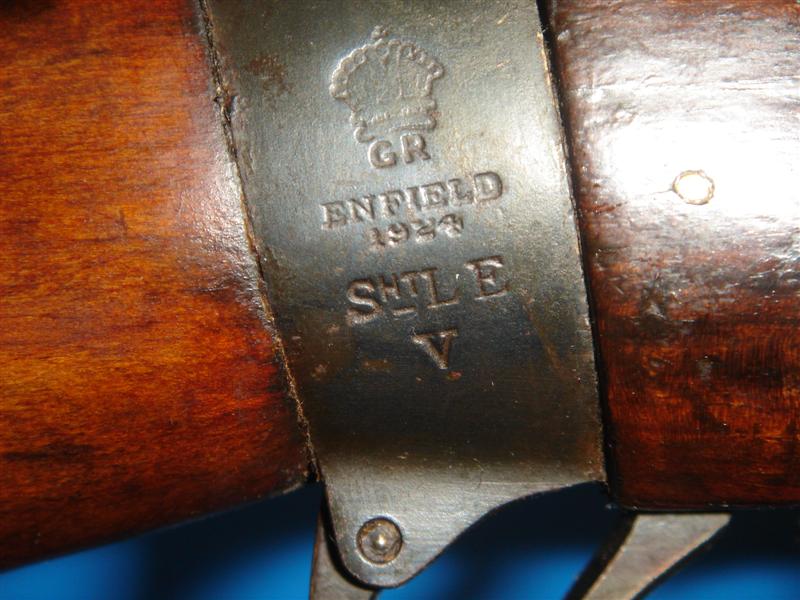
The Australian practice was to put the entire history of the rifle onto the right side of the butt. In the case of your rifle, it was back to the factory for an FTR in July of 1945; that's your "7/45" marking.
I do not know the precise criteria for the paint, although I suspect that, at times, it might have been applied out of sheer frustration. I have one here, a 1918, with a RED band around the Butt, just aft of the pistol-grip. It has FTR markings on it from 1933 and 1944 but still has the 1918 barrel in perfect condition. When my friend Gavin Tait bought it, it appeared completely unfired, EVER.
We took it to the range (three times!) and the best we could get was an 8-inch spread on a 2-round group.... at 100! My test loads grouped 14 inches. It was not grouping, it was shooting two separate, very small, groups, separated vertically by a foot at 100 yards. At 300, it was useless. THIS was the rifle on which I was taught how to do the bedding, by none less than Bill Brown, Canadian Team style as used at the Bisley shoot. And it started with fixing The Damned Crack. Work time and curing time took 5 days, then we were back out to the range...... and the "impossible" rifle shot 3/4 of an inch groups with Gavin's 150-grain test load, half an inch with my 180 test load. Today (October 19) is the anniversary of that shoot. Gavin decided that, now that the thing was shooting the way it COULD, that he had lost interest in improving it. He gave it to me on the spot. I still have it and treasure it and, once in a while, red band and all, it goes to the range and makes very small groups for me.
And so I learned a few things, one being about The Damned Crack, another about bedding for long-range SR Match shooting.... and I learned that Coachwood likely works fine in Oz, but it does not like our very dry climate...... and so it needs a little help. After that, it's fine. And I learned that, from time to time, a rifle could become downgraded when there was nothing really wrong with it that could not be repaired with a bit of time, a few tools, and a tiny bit of Acra-Glas (which the old-time Armourers did not have).
And I learned that the often-maligned Lee-Enfield rifle can, if it wants to, keep with with almost anything else in an iron-sight shoot..... if only Rifle, Shooter and Ammunition are working TOGETHER.
I do not know the precise criteria for the paint, although I suspect that, at times, it might have been applied out of sheer frustration. I have one here, a 1918, with a RED band around the Butt, just aft of the pistol-grip. It has FTR markings on it from 1933 and 1944 but still has the 1918 barrel in perfect condition. When my friend Gavin Tait bought it, it appeared completely unfired, EVER.
We took it to the range (three times!) and the best we could get was an 8-inch spread on a 2-round group.... at 100! My test loads grouped 14 inches. It was not grouping, it was shooting two separate, very small, groups, separated vertically by a foot at 100 yards. At 300, it was useless. THIS was the rifle on which I was taught how to do the bedding, by none less than Bill Brown, Canadian Team style as used at the Bisley shoot. And it started with fixing The Damned Crack. Work time and curing time took 5 days, then we were back out to the range...... and the "impossible" rifle shot 3/4 of an inch groups with Gavin's 150-grain test load, half an inch with my 180 test load. Today (October 19) is the anniversary of that shoot. Gavin decided that, now that the thing was shooting the way it COULD, that he had lost interest in improving it. He gave it to me on the spot. I still have it and treasure it and, once in a while, red band and all, it goes to the range and makes very small groups for me.
And so I learned a few things, one being about The Damned Crack, another about bedding for long-range SR Match shooting.... and I learned that Coachwood likely works fine in Oz, but it does not like our very dry climate...... and so it needs a little help. After that, it's fine. And I learned that, from time to time, a rifle could become downgraded when there was nothing really wrong with it that could not be repaired with a bit of time, a few tools, and a tiny bit of Acra-Glas (which the old-time Armourers did not have).
And I learned that the often-maligned Lee-Enfield rifle can, if it wants to, keep with with almost anything else in an iron-sight shoot..... if only Rifle, Shooter and Ammunition are working TOGETHER.