No4 Enfield Severe Overpressure

Torandir

CGN Regular
Rating - 100%
44   0   0
Location
Newfoundland
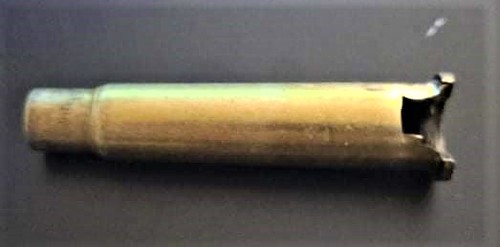
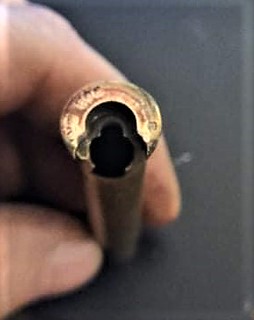
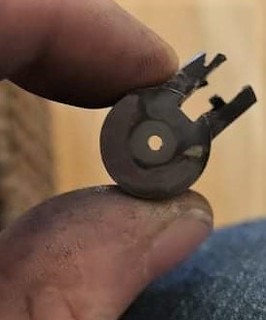
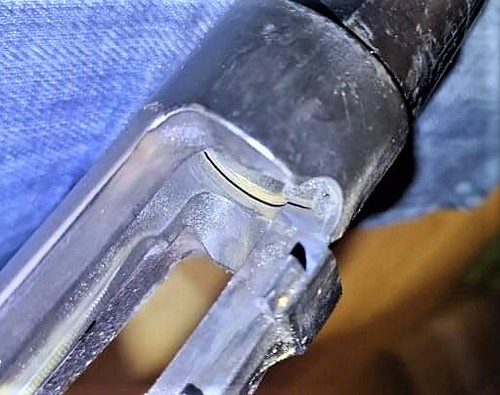
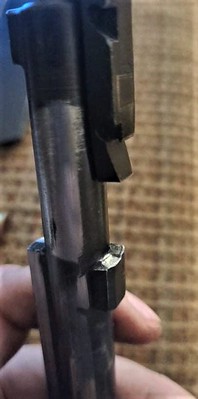
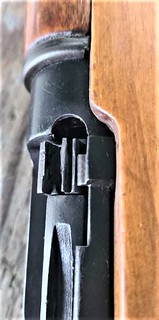
I will preface this with i have yet to determine what occured to overpressure the round to this extent. Using Load manual data on the mid range side (Lyman 314299 gas checked, 25gr of D5744 (AA5744)). Rifle fired 17 rounds of the exact same ammof before the ill fated kaboom. Chronograph data put the velocity in the 1820 fps range, so nothing crazy. I've never had a rifle kaboom up to this point thankfully, and have checked that it wasn't a double charge (wont fit in the case). It is however interesting to note that the rifle faile exactly as designed and only the bolt head and extractor plus case head blew out. Considering the flow of brass in the case head i would assume pressure to be above the 80 000 psi range, but i'm no expert here. Gun will be going into the gunsmith ASAP to see if there is any chance the rifle is salvageable or its worth parts (It was a very nice matching rifle). Thankfully I was uninjured, didn't damage the barrel or wood that I can tell other than the extractor cut out. But for those who consider the enfields to have a weak action, I would say that this held up as good as anything else could resonably be expected to do.
Photos:
51825674619_994aa25117.jpg

51825653709_d755fc3bb1_n.jpg

51825311471_a5fe89b3ba_w.jpg

51825421258_6e91120228.jpg

51825653674_d8a608896c_n.jpg

51825421268_bfd2d5f509_n.jpg

51824364777_ea6aed1116_w.jpg

51824364737_53d214f0b3.jpg

51824364772_5aa2446d41_w.jpg
 
Light loads with fast powders are notorious for "pressure excursions".

Often they are caused by double charges - sometimes not. There has been much debate regarding pressure waves and partial ignitions.

Most of the catastrophic disassembled rifles which I've seen were a result of "light loads" - sometimes with no obvious cause.
https://reloadammo.com/light-loads-can-explode/


If you have the chronograph data and it doesn't show a velocity increase, i would start looking for other causes -

What was you brass headstamp?
 
Last edited:
Headstamp in this particular case was Federal, however, headspace on this rifle was perfectly fine (has been checked with go/no go/field gauges)
I also wouldn't consider this a light load. Comes directly from the lyman 48th reloading manual, Exact same bullet, AA5744 data runs from 21gr to 27.5gr, putting my load (24gr) right in the middle. Chronograph was established with the first 10 rounds, the next 10 were for groups. As mentioned, none of the other rounds showed any kind of sign whatsoever and were quite pleasant to shoot. It's a head scratcher for sure, either way the pressure experienced by that particular round would have been exceptionally high for the brass to flow like it did.
 
Have you pulled the top wood to check for a bulge???

I've seen similar kabooms caused by gas checks being left behind in the bore. Usually they just get pushed out with the bullet or the compressed air in front of the following bullet.

I had a similar issue with a very nice No1 MkIII, the gas check came off about a half inch past the throat and the next bullet hung up on it. The bulge was about six inches in front of the barrel knox and barely visible, but it was there.

Les Viel, an old time Vernon smith, had seen it happen before and it was about the only thing we could figure.

Your kaboom looks like it may have been caused by some sort of barrel obstruction, rather than a load issue.

I'm willing to bet that receiver/bolt will be just fine, when a new bolt head is fitted. If there's no bulged in the barrel or if it's very slight, it should be all right as well.

The reason I believe it's from a barrel obstruction is from the lack of severe damage.

Chamber kabooms are usually catastrophic to the point of destruction of the firearm's action.

I'm willing to bet the fore stock isn't cracked on the underside, in front of the king screw. That would also indicate a bore obstruction kaboom.

I'm glad you came out of it OK.
 
glad you have all your body parts, that is a pretty standard load you were using. have been using the same load for 30 years without issue across all of my milsurps. i would second bearhunters observation. stay safe....
 
I think that the case failed. It occurred at the web where Enfields tend to stretch their brass.
It may have been flawed or perhaps tuckered out and went out with a bang.
I read, back in the nineties that SEE, secondary explosion effect had never happened with cast bullets. Of course, that may
have changed in the last quarter century.
So, how many times have the cases been loaded? Was it a wartime rifle with a slightly generous chamber?
I'm afraid that there are more questions than answers.
 
I think that the case failed. It occurred at the web where Enfields tend to stretch their brass.
It may have been flawed or perhaps tuckered out and went out with a bang.
I read, back in the nineties that SEE, secondary explosion effect had never happened with cast bullets. Of course, that may
have changed in the last quarter century.
So, how many times have the cases been loaded? Was it a wartime rifle with a slightly generous chamber?
I'm afraid that there are more questions than answers.

That's what I was thinking. Your use of a chronograph eliminates a number of theories related to very high pressure.

The brass failed exactly where it is unsupported, and with the high incidence of failed brass in Lee Enfields due to thinning, this seem to be just another incident, albeit not a separation.
 
Thanks for the ideas guys, the gas check theory may be correct, however there is no bulge in the barrel that can be seen with the bore camera or externally. I guess it could have in theory gotten stuck right at the throat. As bearhunter suspected, the wood is totally undamaged, along with everything else cosmetic. only the bolt head and the chamber cut out for the extractor are. there is a slight indentaion on the bolt locking lugs, but the lug seats in the reciever appear fine when examined with a bore camera. Brass in that particular case had been reoladed 4 times, all neck sized only from factory fired in that gun. definitely a scary one for sure
 
I do not know what happened, but would ask about a few things if I were you - the fact that was a fourth reload brings up the reloading and case forming sequence - whether the brass was correctly fire-formed on the very first firing - or whether it was a factory round simply fired in that chamber? My impression from your pictures is that the brass case wall is very thin - like paper thin - where it separated.

Also, had you confirmed the "clocking" on that bolt head? I am a bit curious that the case let got, at least partially, where the rim should have been fully supported by the bolt head face - just "spitballing" some thoughts. We presume that a firearm is in correct and tip-top shape - with mil-surps from that era, it seems that is not a good assumption any more, especially if people do not know or follow the procedures that were used to assemble and check the rifles, from 80 years ago. Is not a "modern" rifle - had it's own "quirks".
 
Well - The weakest part of the chamber is right at the extractor cut. Could have been a random flaw there causing short cycle fatigue. If this was the case, good thing the loads werent full pressure.
 
I will preface this with i have yet to determine what occured to overpressure the round to this extent. Using Load manual data on the mid range side (Lyman 314299 gas checked, 25gr of D5744 (AA5744)). Rifle fired 17 rounds of the exact same ammof before the ill fated kaboom. Chronograph data put the velocity in the 1820 fps range, so nothing crazy. I've never had a rifle kaboom up to this point thankfully, and have checked that it wasn't a double charge (wont fit in the case). It is however interesting to note that the rifle faile exactly as designed and only the bolt head and extractor plus case head blew out. Considering the flow of brass in the case head i would assume pressure to be above the 80 000 psi range, but i'm no expert here. Gun will be going into the gunsmith ASAP to see if there is any chance the rifle is salvageable or its worth parts (It was a very nice matching rifle). Thankfully I was uninjured, didn't damage the barrel or wood that I can tell other than the extractor cut out. But for those who consider the enfields to have a weak action, I would say that this held up as good as anything else could resonably be expected to do.
Photos:

51824364777_ea6aed1116_w.jpg


51824364772_5aa2446d41_w.jpg

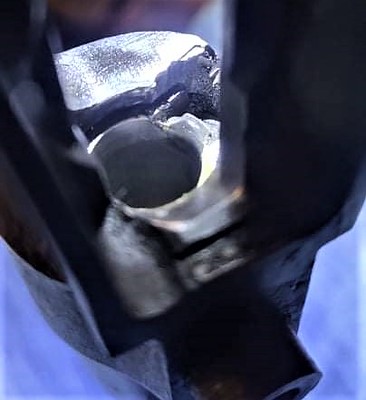
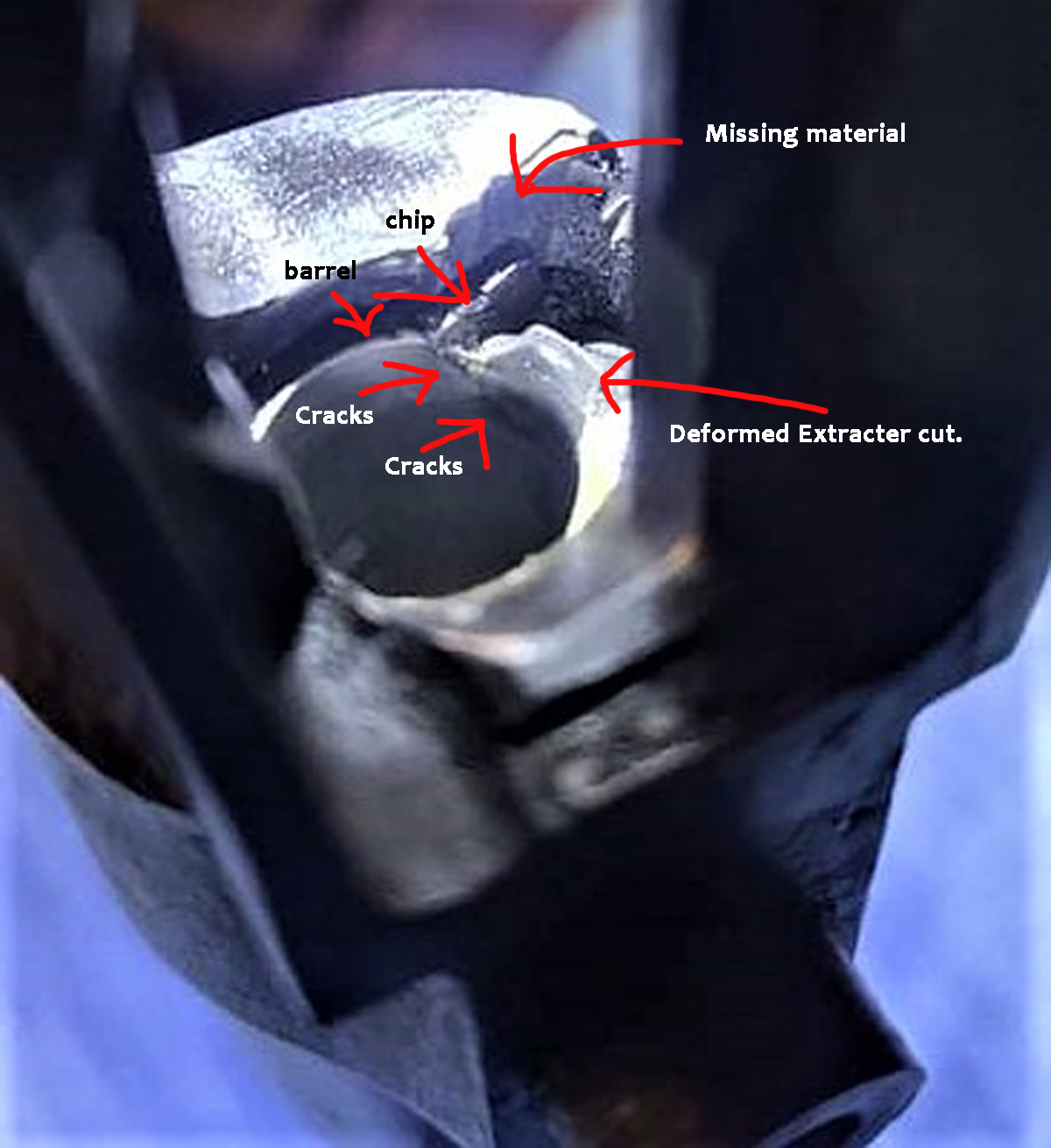
It looks like a crack in the chamber, or loss of material in the extractor cut. It looks like the chamber may have failed.

technically the extractor cut shouldn't enter the chamber.

and is that bolt set back on the lug??
 
Some details on this specific rifle. As mentioned previously, it had passed go/no go gauges easily and headspace was very tight. Rifle was fully FTR'd in 1963 at fazakerly, along with entirely new parts except the reciever, barrel is also dated from 63. The crack in the chamber is more of a deformation, it basically bent the thinnest section outwards slightly. Not all that suprising considering the barrels aren't hard/hardened and that is the thinnest section by far. you are correct that those marks on the lugs are indeed bolt set back. those were not there previous to this incident. As far as the brass being trimmed. It was trimmed after it's second reload, but being only neck sized in a collet die, very little was actually trimmed off. Given how generous lee enfield chambers are I doubt this was this issue, but you never know. I can't check the deformed case for a thin web as it's guaranteed to be there due to the extreme amount of deformation present. The rim has expanded nearly 1/16" on the diameter that it wasn't before. If the case had a imminent head separation, I would have expected it to happen. as it is, the case head didn't completey separate despite being exposed to 80kpsi or so to get it to flow like that.
 
You seem to rely on the FTR - remember what was the point of the military use - fire a new case once, that did not split or separate, extract that and on to a new case. So far as I read, the military designers were not concerned about reloading the cases, one bit. That is all on us. So, they would have done what they thought was adequate "proof" testing for their needs. Might not have been an adequate test for your needs. The "fun and games" of playing with mil-surp rifles ... And, although FTR'd in 1963, that means not much if a civilian swapped out the bolt head (without checking or re-proofing), etc. in the 59 years since then.
 
Glad you were not hurt.

FTR are rebuilt from damaged, worn, and generally unserviceable rifles. But your rifle is scrap, the receiver is damaged and so is the barrel. I can see material missing on the receiver and deformation on the chamber where the extractor cut is.

See below:

XjCyewf.jpg
 
Last edited:
I use reddot powder in my 303 cast and I have never had a problem. my rifles are a 1918 and a 1943 #4. of the many rounds I have shot I only shoot cast and have had only one separation and the brass has been reloaded many times. the ftr rifles sound to be a bit of a gamble if they are low quality rebuilds.
 
Both bolt lugs to have deformation spots, no arguent there, I suspect that part is toast. the lug seats are fine, no deformation or cracks visible with a camera and no peening measurable with a depyh mic. the defomation in the extractor cut is the extensive damage in the chamber area. I have cleaned the chamber for a bettr look, there are no visible cracks or material missing. The action and bolt will be going in to get magnafluxed to check as well. with regards to FTR, in this case the rifle started as a no4mk1* savage manufacture. in 1963 the rifle was updated to the no4mk1/3 pattern with the hung trigger. When undergoing FTR pricess, the rifles came out as essentially new, as any worn or damaged parts were replaced, and everything would have been redone as would be done on a standard production rifle. while i would agree that parts could have been swapped in it's history, nothing here would leave me to believe that. Every part on the gun has been marked with the F63 marking, indicating fazakerly 1963 production, bolt head included. the suncorite finish applied is consisten across allthe parts withno indicators of parts swapping. With regards to the rest of the cases, they are all fine and square, as they should be. One thing that occured to me would be the potential scenario that a gas check fell off the seated bullet and ended up in the case on top of the power charge, would this have the potential to essentially cayse a bore obstruction?
 
Back
Top Bottom