Old 1911

I have revolvers similar to the own you show. A Smith and a Colt, both in 455. What serial number range would be appropriate for a gov't purchase?

SMITH & WESSON HAND EJECTOR ("NEW CENTURY") REVOLVERS:

The .455 S&W model actually ordered (by both Canada and Britain) during WWI was the Second Model Hand Ejector, but my references indicate that both Canada and Britain accepted a few First Model HE revolvers (also referred to as the "Triple Lock" Hand Ejector) which S&W had in stock and was thus able to ship immediately. One such First Model with a C-Broadarrow stamp illustrated in Law's book is s/n 5498.

The first Canadian order for 1,500 S&W revolvers was placed 21 August 1915, with a second order for 1,000 placed "shortly thereafter" ..... though only the first 850 pistols from that second order were actually delivered in 1915. (My own S&W Hand Ejector was apparently from this second order - the S&W letter I obtained for it states that it was shipped to the "Canadian Government" on 24 December 1915 - and accordingly may be one of the 150 revolvers not actually received until early in 1916.)

Two subsequent orders made up the balance of the Canadian S&W purchases - 6,000 ordered in late 1916 and another 6,000 in 1917. Clive Law apparently did not discover any complete range of S&W serial numbers, but he includes a list of .455 S&W revolvers in the Royal Canadian Navy Esquimalt Depot as of October 1944, ranging from a low of 3889 (presumably First Model) to a high of 85910. Any RCN-issue revolver would likely have Navy markings, I believe.) In any event, it seems logical to assume that the WWI-purchase serial number range would include Hand Ejector revolvers manufactured from 1915 through 1917 (or perhaps even early 1918). Unfortunately, my reference library is sadly lacking in the S&W area (haven't filled in that gap because I only have my .455 Hand Ejector and an early WWII Canadian-purchase .38 Military & Police revolver) and I'm not aware of any online postings of S&W serial number ranges. Perhaps some other CGN membe has this information avaialable.

FWIW, my late-1915 .455 S&W Hand Ejector revolver is s/n 33169 .....


COLT NEW SERVICE REVOLVERS:

As you likely know, the 943 Colt "New Service" revolvers purchased by the Government in 1900 for issue to later Boer War contingents were chambered in .45 Colt, the same as the Model 1878 revolvers, to simplify ammunition supply. (This despite the statement in the Canadian War Museum online presentation regarding the Boer War that the New Service revolvers were .455 - the error has been brought to their attention but they have never corrected it.)

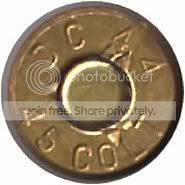
The extensive research by Clive Law for his "Canadian Military Handguns, 1855 - 1985" turned up a reference to purchase of 70 more .45 Cal. New Service revolvers in 1915 (i.e. after the Colt 1911's had been acquired) possibly because the initial Mobilization Orders were apparently worded that ".45 Calibre revolvers" were to be issued to certain specified NCO's (.... a later, amended Scale of Issue specified Model 1911 pistols.) His research would indicate that no record exists of any .455 cal. Colt New Service revolvers being purchased by the Canadian Government for military service. However, he does list a total of twenty .455 cal. Colt revolvers registered to the Royal Canadian Navy as of April 1935, in the s/n range 11108 through 11201. (As stated above, I'd expect any Navy-issue revolver to be so marked.) A further 600 .45 cal. New Service revolvers were subsequently acquired during WWII for the Royal Canadian Navy - 300 in May 1940 and 300 in May 1941 - and .45 Colt cartridges were definitely available in the Canadian supply system during WWII -
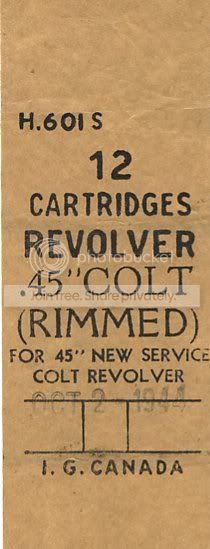
45LongColt.jpg
45longColths_2.jpg


Any other .455-chambered Colt New Service revolvers purchased by Canada would likely have been for issue to the RNWMP - that model and calibre was adopted as the official sidearm of the Mounted Police in 1904, and 700 revolvers in that calibre were shipped to Regina in September of that year, with another 650 being acquired in 1913 and 1914. Beginning in 1919, the Colt New Service revolvers for the Mounted Police were acquired directly from Colt (rather than from Canadian suppliers) and were chambered in .45 Colt. With the 1920 merger of the RNWMP and the Dominion Police to form the RCMP, in an effort to simplify ammunition supply logistics it was decreed that the .455 revolvers would remain in service in the West and North (i.e. the original NWMP jurisdiction) and the .45 revolvers would be issued from the Lakehead east .....

I believe that the serial numbers of all RNWMP and RCMP Colt New Service revolvers are known .... and are listed in "Arms & Accoutrements of the Mounted Police, 1873 - 1973". In any event, any Mounted Police-issue Colt New Service should bear Force markings on the rear or bottom of the grip strap - either NWMP (because the first revolvers were received before new stamps were available to the armourers) or RNWMP, M.P., or the fused MP.

Having said all of the above, the fact that a .455 Colt New Service revolver lacks any Canadian military or Mounted Police markings, or other such provenance, does not rule out military service as the personal sidearm of a Canadian officer .... The expectation was that their personal sidearm would be a serviceable and reliable piece chambered for an "issue" cartridge, and .455 definitely satisfies the chambering requirement. (For example, I have a 1916-dated .455 Webley MkVI revolver- which was definitely never a Canadian "military issue" model - that is engraved on the backstrap with the identity of a young Canadian officer .... "LT. S.W. SEAGO" .... I have obtained Lieut. Seago's entire Canadian Expeditionary Force service record.) However, if the firearm is not engraved with a traceable owner's name, and any other such provenance is lacking, proving Canadian military service is likely impossible.
 
A shooting friend served in WW2. After he passed his brother gave me his handguns. I assume they are "bring backs", but he was a career officer who joined the Army before the war.

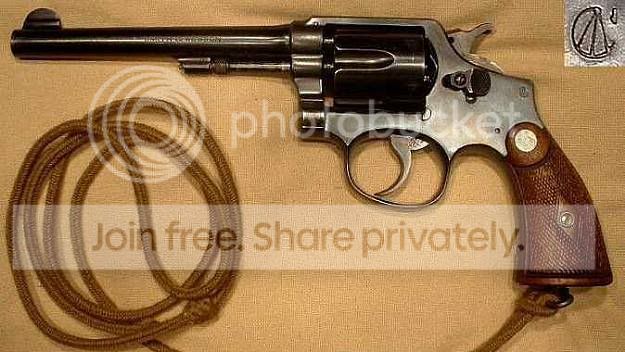
The Webley, Colt and Smith are all 455. When I picked them up for the first time, I was shocked how comfortable and natural pointing the Webley is. The "conventional" revolvers are not so nice in the hand.

I have developed a profound respect and affection for the Webley. I even shoot it from time to time.

The Smith # is 4379X . I assume an Army officer carried it. Was it a personal purchase or a gov't contract gun?

The Colt is marked New Service 455 Eley. # 408X

Both Smith and Colt have a lanyard loop in butt. Did all revolvers have that, or only military guns?

I sure wish these things could talk to me...

BRINGBACKS2.jpg


Sw455.jpg
 
There was a minty Colt Government model serial number C10,### for sale at our local 2 day gunshow this weekend. Had a fairly good look at it. I'd say 95% + brite blue finish left & original two tone lanyard mag. [Would've given GrantR's one a run for it's money on condition]. Anyway, the seller was asking $2,100 which wasn't too far off the mark... Funny though, seller told me he'd "researched it" and it was made in 1912. I told him it was definitely made in 1914. Little back & forth ensued, then I asked him if maybe he hadn't been looking at a reference list of the Colt 1911 military serial numbers. He conceded that maybe was the case. Anyway, I had to pass on it as I'm still "tapped out" for the moment after picking up the WWII Union Switch & Signal 1911A1 awhile back.... :redface: :(.

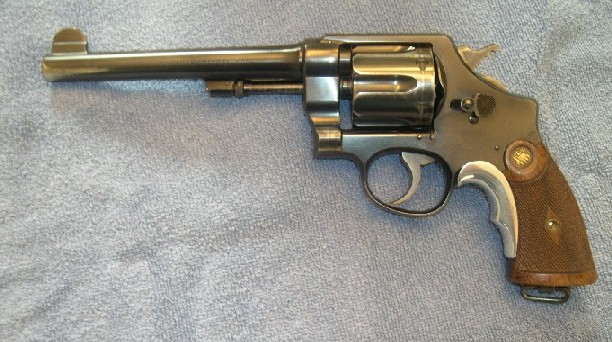
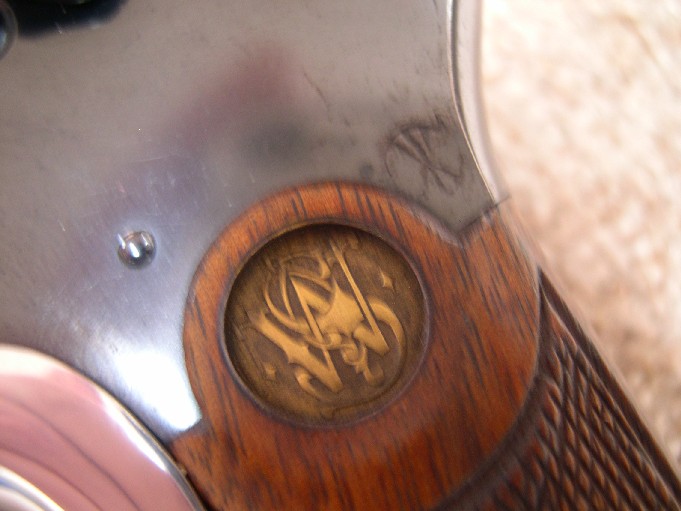
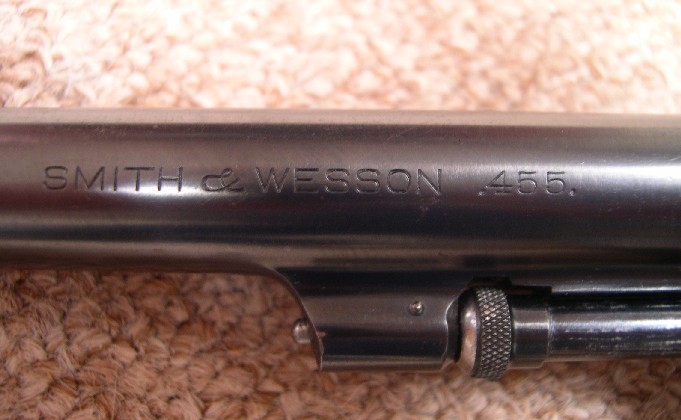
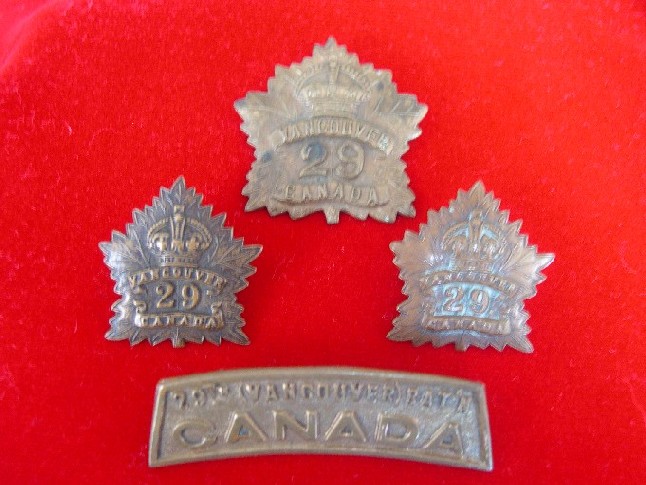
Anyway, here's a pic of my big S&W Handejector .455..... [It's engraved on the right side of the barrel: "Lieut. H.F. Beattie, 29th Canadians"]. :cool:

The 29th CEF [Tobin's Tigers] were formed out of Vancouver, B.C.

2007-01-17_204407_SW455b2.jpg


2007-01-17_204122_SW455d.jpg


2007-01-17_205715_SW455c.jpg


2007-01-17_210046_SW455ee.jpg
 
Ganderite:

A lanyard loop or ring was pretty much standard on military (and even law enforcement) handguns from the latter half of the 19th Century until WWII and beyond. Although sometimes also appearing on civilian handguns, if even available on any particular make and model it was an extra cost "option" and thus not seen all that often ....

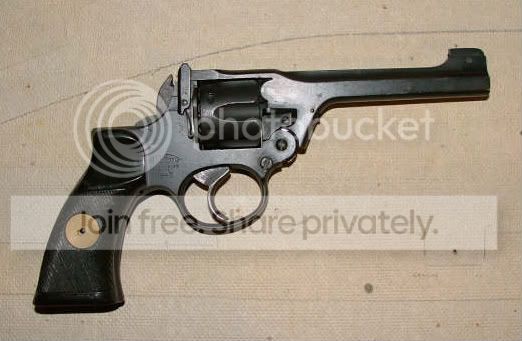
Interesting that all of the "Allied" revolvers are .455 caliber ..... During WWII the standard military-issue revolvers of Britain and the other Commonwealth nations were all .380 caliber, which was basically a British military version of the .38 Smith & Wesson cartridge (i.e. not .38 Special), originally loaded with a 200 gr non-jacketed bullet which was soon changed to a 178 gr jacketed bullet after it was decided that the lead bullet contravened the Hague Convention against expanding bullets in military firearms .... The standard-issue military revolver of Britain (and most of the rest of the Commonwealth) was the Enfield No. 2 revolver (top one in the image below, the design for which had been based on the Webley MkIV .380 revolver, being the lower one, below. Many such Webleys were also acquired for British military service during WWII) -
EnfieldWeblyComparison.jpg


Actually, most Enfield No. 2 revolvers one encounters will lack the hammer spur, which was eliminated about 1938 - with the result that the revolver could be fired in double-action mode only. That was entirely in keeping with British military practice of that era, which called for handguns to be primarily utilized rapid-fire at very close range. The commonly heard explanation for the change, however, is that it was to preclude snagging of the spur in the confines of armoured vehicles - but that makes no sense, really, because standard British web holsters didn't permit the spur to project, anyway, and in any event all Enfield revolvers were produced in this MkI* version thereafter. Nevertheless, one often sees this version erroneously called a "Tanker revolver" ....
DSCF0229.jpg


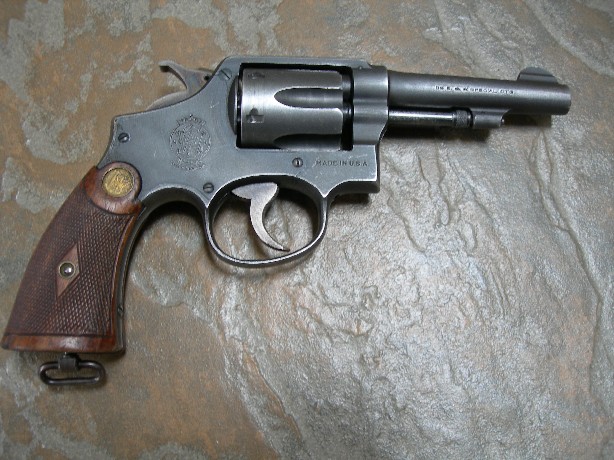
Canada, on the other hand, adopted the .38 Smith & Wesson Military & Police revolver as its standard-issue handgun at the start of WWII - being chambered for .38 S&W, they required no modifications to accept and shoot .380 service cartridges. This is my example - an early-war purchase, when they were still being made in full "commercial configuration" (i.e. polished, blue, checkered walnut grips, etc.) As the war progressed, they got progressively plainer (brushed blue finish and finally just parkerized, smooth walnut grips, and usually shorter barrels) -
swmp08a.jpg


At any rate, lots of .455 handguns left over from WWI and earlier were pressed into service also during WWII, although primarily in secondary roles, and would have been the first to be declared obsolete and disposed of, which may explain why your friend acquired them (if they were, indeed "bring backs".)
 
Gotta get me one of those 5" S&W Victory models in .38 S&W to go with the 4" S&W Victory model I have in .38 Special. The later was WWII U.S. issue....

2007-10-27_214740_zVictory1.jpg
 
I stand in awe, as usual when looking at Grant's collection. His knowledge is second to none in this area also. Some of us have to settle for something a little more ordinary. My 1916 mfg Colt Commercial Model in .45acp.

dscf4462abeh3.jpg

Shot with FinePix E550 at 2008-11-02
dscf4461aboa5.jpg

Shot with FinePix E550 at 2008-11-02

For those that follow Cowboy Action shooting, you will already know that SASS has introduced a "Wild Bunch" stage into cowboy action. This is based on the 1969 Sam Peckinpah movie of that name. This allows firearms or replicas up until 1918. In the last couple of months I have been lucky enough to shoot this "genre" at 3 different matches using my 1916 Colt. Its fun to be able to see your proficiency with 4 different types of firearms in a timed stage that lasts less than 60 seconds.
 
Last edited:
My dad flew in the RCAF in WW2. He had a S&W M10. When he gave it to me it was in a blue canvas holster, but I don't know if this was what he wore or if the holster was acquired later.

I recall he and I going to the local dump, in about 1954, and shooting it at a target nailed to a piece of half inch plywood. The ammo was issue ammo, jacketed bullets. When we took the target down, the bullets were all sticking out of the plywood, like darts. To this day I cannot understand why such a fine revolver was down loaded to pop gun power.

Dad was a dedicated rifle shooter and shot at Ottawa and Bisley as often as possible. He was a fine shot, but had no interest in handguns. But when he and his warime flying buddies got together, I would hear how he was one of the world's greatest pistol shots.

Like his father before him, he was a smallbore and fullbore target rifle shooter, and everyone knew that. The air force had them all shooting skeet, to teach them how to lead moving targets, and he was a good shotgunner, too, and they all knew that, before the pistol shot of the century.

One day they were in a dingy, going out to an anchored Canso (flying boat anti-sub plane). A formation of ducks flew by. Dad pulled his revolver and fired a shot. One of the ducks, missing its head, promptly fell out of the sky.

Dad, of course, was acted as if it was no big deal. Since he had hardly ever fired it before, I don't know if he actualy assumed it was a good shot, or if he knew that the shot was fired as a joke and he was as surprised as everyone else.

In about 1956 we went hunting for sea ducks. We lived in Newfoundland and some locals invited us. Turns out the ducks are shot while you are standing in a dingy on the ocean. I forget the name of the kind of duck. Starts with "T" I think. Anyway, dad was deadly. Almsot never missed. His shotgun had removable choke tubes and the full choke had rusted in place, so he was used to shooting skeet and everything else with full choke. The locals were impressed. They hit about 1 in 5. He explained that the last time he shot a duck while standing in a dingy he used a pistol.

Years ago I traded that Victory for a powder measure. I still have it. If the guy that made that deal contacts me, I will trade back. Dad is getting tired from all that spinning (in his grave).

Edit: The newfie ducks were called Turs. Not sure of the spelling.
 
Last edited:
I recall he and I going to the local dump, in about 1954, and shooting it at a target nailed to a piece of half inch plywood. The ammo was issue ammo, jacketed bullets. When we took the target down, the bullets were all sticking out of the plywood, like darts. To this day I cannot understand why such a fine revolver was down loaded to pop gun power.


The ammo was fine, you just can't buy good plywood any more. :D
 
I believe that the serial numbers of all RNWMP and RCMP Colt New Service revolvers are known .... and are listed in "Arms & Accoutrements of the Mounted Police, 1873 - 1973".

Actually, believe it or not there are even gaps in Klancher's book on the actual serial numbers. Earlier this year I fixed up another CGN'er on the location of an old "RCMP" marked Colt New Service wheelgun that was for sale. It was not in Klancher's book. The CGN'er was actually able to contact the author & determine that it was authentic, although not (yet)listed. Probably will be in the next edition...lol...

http://www.canadiangunnutz.com/forum/showthread.php?t=245740
 
Back
Top Bottom