Open sight adjustment?

45C

CGN Ultra frequent flyer
Super GunNutz
Rating - 100%
181   0   0
Location
Canada
Hey
I have a Winchester XRP 6.5 PRC .
Right now it’s scoped using Talley 1pc low rings.
I’m waiting on QD rings.
So question,
What distance would you recommend zeroing the iron sights .
Shooting 99.99 % time inside 100 yards.
Open sights are a backup
 
Last edited:
Calculate the maximum point blank range.

Basically point and shoot out to a certain distance and your bullet will land somewhere within your margin of error.

If you choose a 6” target size, the trajectory will be no more than 3 inches above or below a certain distance.

You’ll need to know your velocity and BC, punch the info into a MPBR calculator, and it will tell you what range to zero.
 
Calculate the maximum point blank range.

Basically point and shoot out to a certain distance and your bullet will land somewhere within your margin of error.

If you choose a 6” target size, the trajectory will be no more than 3 inches above or below a certain distance.

You’ll need to know your velocity and BC, punch the info into a MPBR calculator, and it will tell you what range to zero.
Thanks, I think I could figure it out that way and I have the tools.
Seems a bit complicated though 😁

So basically I can put a target at 100 yards and use my chrony and Hornady app?
 
  • Like
Reactions: DGY
All the above!! We all agree we all do the same hahaha unless you are a turrets twirler then you twirl the turrets…
 
Thanks, I think I could figure it out that way and I have the tools.
Seems a bit complicated though 😁

So basically I can put a target at 100 yards and use my chrony and Hornady app?
It really doesn’t have to be perfect, usually you choose a target size based on the game you’re going after.

My .308 shoots a 168gr SMK @ 2680 and if I had iron sights and my front sight was 1” above the centerline of the bore, my MPBR for a 6” target (according to shooter’s cslculator) is 259 yards; with my near zero being 16 yards, and my far zero being 219 yards.

This means if I aim dead centre at my 6” paper target at any distance from 0 to 259 yards the bullet will hit, as the bullet’s trajectory would not be anywhere more than 3” above, or below, the line of sight.

As others have said, a 200 yard zero works perfectly for most hunting cartridges. Anything over 250 yards in the field is a pretty gifted shot, anyways, and using a 6” target size as your benchmark, is going to be within the kill zone for most medium and large game. So yeah, if you have your MPBR zero and point dead center of the vitals, you’re going to hit somewhere in the breadbasket. No dialing your scope, no holdovers, just point-and-shoot.
 
I think you need to get some practice in shooting with your iron sights. 100 yards can be a very challenging shot, and may temper your expectations as far as practical maximum range. I would sight in at 50 yards with buckhorn sights, perhaps 100 y with peep sights. Bullet drop under either scenario would be negligeable for maximum range.
 
After playing around in 4DoF with Precision Hunter data, I'd zero irons for 100 yards. Remember that the "scope height" in a ballistic calculator should be roughly 0.7" with irons. Measure it to be sure. That will bring the near zero and far zero pretty close together and also affects MPBR calculations. Even easier with my crusty eyeballs is to zero 0.3" - 0.5" high at 50 yards and call it a day.
 
Last edited:
So ,do you cover the target with the iron sights, or see the target above the front sight?
I believe I sighted in my 30 30 the front sight kinda covers the target??
 
Last edited:
Wow, some terrific, thoughtful and well-reasoned answers here...and all waaaaaay too complicated, IMHO. I'm a firm believer in back-up iron sights on a hunting rifle, although I much prefer a back-up scope, pre-sighted-in and mounted in quality QD rings.

But if that's not an option, and I ever wind up removing a damaged or defective scope in the field, I know dang well I won't be shooting at critters at anything much over 100 yards. The gun and cartridge may well be capable of accuracy at many times that distance, but plain ordinary open sights combined with my eyes makes that immaterial because I won't be able to take advantage of that accuracy at long range, especially under hunting conditions. I won't take a shot at a warm target unless I know I can make it, so for me that means about 100 yards, even with a flat-shooting long-ranger like your gun. My back-up open sights are always set @ 100 yards. They're strictly a last-ditch emergency way to save a hunt, but I don't delude myself into thinking that they aren't a huge handicap compared to an optic.

You can improve on that quite a bit by using an aperture rather than an open rear sight. How easily this is accomplished depends upon the gun/scope combo and the size of the sight itself. I have a favourite hunting rifle, a Ruger #1 in .300WM, on which I have replaced the standard open rear leaf sight with a model that has a fold down aperture that came off an old Ruger Ranch rifle. This sight takes up no more space on the gun than the original open sight, but allows me to stretch the effective range to maybe 250 yards in good light. It's better than any "open" sight, but it ain't no scope.
 
My technique brushes on many of the points already made, but also diverges from them. Speaking in generalities, and not to the specifics of the equipment in question this is how I go about it. Just for the same of the discussion I’ll use a bead front which for me, my rifles, and the barrel lengths I usually use seems to regularly cover 8” at 100 yards. Your’s can vary, but knowing what it is will come into play in a bit. I’ll sight it so the POI is at the top of the bead at 100. This allows a precise aiming point from zero to out past 100, how far depending mostly on velocity because BC doesn’t enter into it much at powder-burn ranges like that.
Still with me? On a big game sized target, if you think about it wouldn’t have mattered much if you had aimed with the center of your bead, you’d still have your deer it you did everything else right. Much past the 100 mark, depending on trajectory the POI starts dropping behind the bead, but remember its still behind the bead. Everything behind the bead is still in a whole lot of trouble for good long ways, and although the top of the bead doesn’t change the apparent size of the whole bead is getting bigger. It doesn’t track exactly, doesn’t have to but the ITBTB ( In trouble behind the bead, technical term I just made up😂) does stretch with range, at least its going the right way.


How far this will work depends on the apparent size of your bead to you and your trajectory. In really broad terms though, even rather anemic cartridges will keep you in vension out to as far as you can keep the bead on a deer’s body, which is already at or past the point of thinking about quitting. Darn front sight turned into a range-finder.😆
 
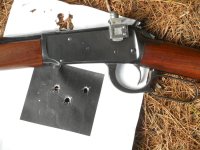
I use a 4" square black bull and using a 6-o'clock hold sight it so it the group is in the centre of the bull. A 4" bull looks awfully tiny at 100 yds btw, especially if your eyes are starting to age. DSCN0794.JPG
 
  • Like
Reactions: DGY
Wow, some terrific, thoughtful and well-reasoned answers here...and all waaaaaay too complicated, IMHO. I'm a firm believer in back-up iron sights on a hunting rifle, although I much prefer a back-up scope, pre-sighted-in and mounted in quality QD rings.

^^ Right answer ^^ ..... A back up scope is a far better sighting option than open sights and easier to do as well.
 
My technique brushes on many of the points already made, but also diverges from them. Speaking in generalities, and not to the specifics of the equipment in question this is how I go about it. Just for the same of the discussion I’ll use a bead front which for me, my rifles, and the barrel lengths I usually use seems to regularly cover 8” at 100 yards. Your’s can vary, but knowing what it is will come into play in a bit. I’ll sight it so the POI is at the top of the bead at 100. This allows a precise aiming point from zero to out past 100, how far depending mostly on velocity because BC doesn’t enter into it much at powder-burn ranges like that.
Still with me? On a big game sized target, if you think about it wouldn’t have mattered much if you had aimed with the center of your bead, you’d still have your deer it you did everything else right. Much past the 100 mark, depending on trajectory the POI starts dropping behind the bead, but remember its still behind the bead. Everything behind the bead is still in a whole lot of trouble for good long ways, and although the top of the bead doesn’t change the apparent size of the whole bead is getting bigger. It doesn’t track exactly, doesn’t have to but the ITBTB ( In trouble behind the bead, technical term I just made up😂) does stretch with range, at least its going the right way.
How far this will work depends on the apparent size of your bead to you and your trajectory. In really broad terms though, even rather anemic cartridges will keep you in vension out to as far as you can keep the bead on a deer’s body, which is already at or past the point of thinking about quitting. Darn front sight turned into a range-finder.😆
This ^ is good stuff; ITBTB is an idea whose time has come. :) It's an example of the difference between guys who read and post and argue about the esoterica of shooting...and guys who spend that time shooting. :)

This acronym should take its rightful place beside BC, SD, OAL, ELD and the myriad other terms that are so beloved by shooters today. Best of all, it's an idea that can be used to increase one's effectiveness as a shooter, instead of just being used as an excuse for why that last shot missed...
 
  • Like
Reactions: DGY
I ran open sights on my main hunting rifle as the primary sighting system for years, with the scope as a secondary just in case I had a very long shot.
I could keep the shots inside a pie plate at 200 meters with no issues from a rest but the vast majority of my kills were( and still are) inside 150or even closer.
However, my eyes in the last few years have take a crap so I rarely use the open sights or even aperture sights now for hunting , a ow powered optic is on my rifle .
I always tell guys to zero their rifles and hold where they are comfortable aiming, some like to hold where they want the bullet to impact and that works until you have to hold over to compensate for distance, trajectory, etc.
Then, practice in knowing where to hold is imperative, and most do not want to ut in th time and effort to do that.
All of these animals were shot holding where I wanted the bullet to impact, and the shots were both under 125 yards so well within the maximum point blank range of the O/U 6.5X55 and the .303 Brit single shot.
The doe was standing at 100 yards and the buck was loping at 60 yards ( both ranged after the shot)
The doe with the 8X56MS Mannlicher Schoenauer was shot at 90 paces with the factory open sights.
Cat
 
Last edited:
  • Like
Reactions: DGY
Factory irons and a big game rifle is a pretty nuance based sight in.
The ability to keep shots into the front half of a deer sized critter much beyond 200 yards/meters ain’t for the faint of heart.

Therefore sight in at 100 y/m a few inches high………

For yucks and giggles I think I’ll take my 336 Marlin 30/30 out tomorrow and see what my 62 year old eyes can muster at 200 with a Williams peep and a fibre front bead……..
 
I’ll be going to the range next weekend, thanks for the reply’s
It’ll be for hunting moose only
No buck tails here😁
Possible to see moose anywhere from 25 yards out to 1000 yards.
You never know
I like to add, I’m not shooting a moose at a 1000 yards.
It was just an example 😁
 
Last edited:
  • Like
Reactions: DGY
Factory irons and a big game rifle is a pretty nuance based sight in.
The ability to keep shots into the front half of a deer sized critter much beyond 200 yards/meters ain’t for the faint of heart.

Therefore sight in at 100 y/m a few inches high………

For yucks and giggles I think I’ll take my 336 Marlin 30/30 out tomorrow and see what my 62 year old eyes can muster at 200 with a Williams peep and a fibre front bead……..
I am about in same boat - my eyes will be age 71 this Fall - not what I think they used to be, but all that I have on hand!! I switched many rifles to aperture rear sights after I was not satisfied with "sharpness" of vision on the barrel mounted rear sights. But I doubt that I would ever hunt "game" (grouse, gophers and crows excepted) without a scope.

"Back-up" may be more "good idea" rather than "real" - I know I had one scope die when trying to sight it in - a decent enough "group" for first five shots - but not centered where I wanted - then the holes started walking to right side of paper target - I think shots 13, 14 and 15 were right off the paper. That rifle still sitting in gun cabinet - I never did any more with it. I do not recall "ever" replacing a scope or removing a scope on a hunt - never had a reticule break - would not know if scope became mis-aligned - not sure when or how I would know that the scope was no good - WHILE OUT HUNTING. I have missed game many times - maybe I can blame that on the scope - more than likely that was on "me", not my gear. It checked out to be fine when I was back home, and on the rifle range.

I sort of follow my version of "statistics" - if it is going to mess up, a very good probability that stuff goes wrong first time that you use it - not so much the 200-th time it gets used. So, probably 100 or more rounds on target at rifle range for every shot taken at "game". Maybe why I seldom experienced "problems" when out and about (except slipping and falling).

My own use and "sighting in" of iron sights - I want the bullet holes to appear just at tippy top of the front sight bead - a bit of light each side of the bead in the rear leaf sight. Top of front sight bead even with the top of rear sight leaf. I have no illusions about how far I can hit stuff with irons any more - so perhaps 50 or 75 paces or so from shooting table to paper target, to "sight in", seems to work for me for "iron sights".
 
Last edited:
  • Like
Reactions: DGY
Back
Top Bottom