












































You are using an out of date browser. It may not display this or other websites correctly.
You should upgrade or use an alternative browser.
You should upgrade or use an alternative browser.
Parker Hale muzzle loaders
- Thread starter y2k
- Start date


As for desirability, depends on your tastes and personal preferences, I guess. The Board of Ordnance adopted
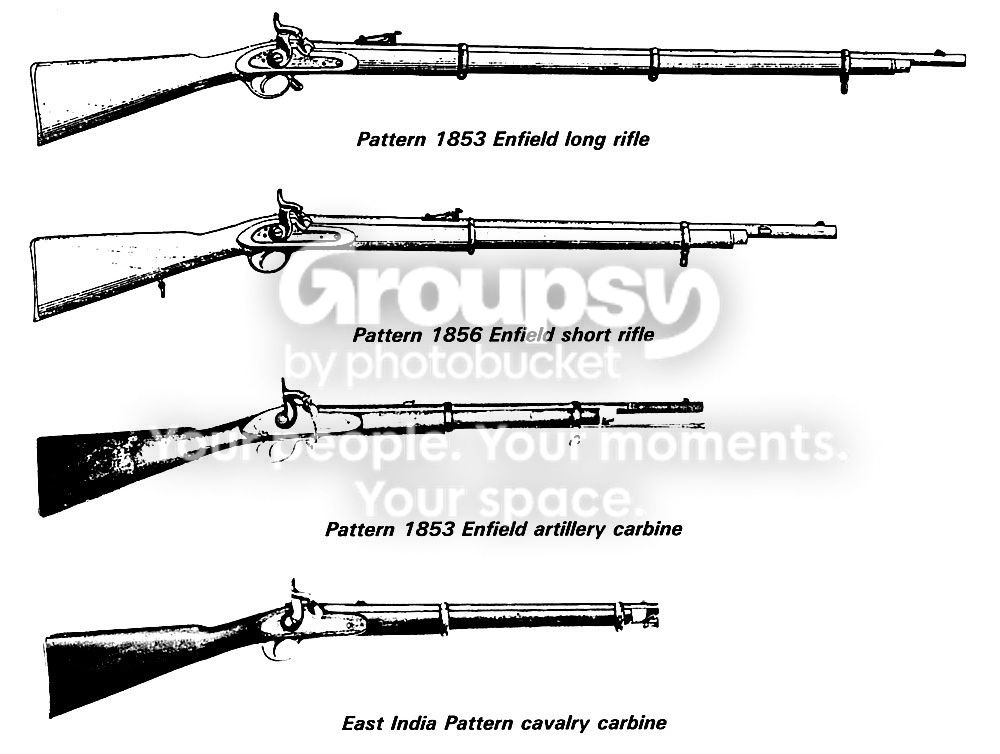
several "Patterns" of the .577 muzzle-loading Enfield, for different applications. The primary variants were -
- the Pattern 1853 Rifle (a.k.a. "Long Rifle") - standard-issue rifle for regular infantry. 39" barrel held in
place by three barrel bands, 3-groove rifling, one turn in 78", used a triangular-bladed socket bayonet, and
fitted with brass "furniture" (i.e. buttplate, trigger guard, nosecap and escutcheons for the lock bolts.)
- the Pattern 1856 Short Rifle ("Land Service") and variants called the Patterns 1858, 1860 and 1861
- standard issue to all ranks in "Rifles" regiments and to Sergeants of Infantry. 33" barrel held in place by two
barrel bands, the later patterns had five-groove rifling, one turn in 48", used a "Yataghan" bayonet with
a longer, "re-curved" sword blade (to give men armed with these rifles the same "bayonet reach" as
regular infantry), iron furniture.
- Pattern 1858 Sea Service (i.e. Naval) Short Rifle - this was actually the first of the Enfield variants to be
fitted with the 5-groove, faster twist rifling (which was found to be more accurate, and ended up being used
in all the variants except the standard infantry rifle, for some reason - probably because by the
time it was introduced, many 3-band rifles had been produced and issued to infantry, and a changeover would
have been too problematic). Essentially the same configuration as the Land Service Short Rifle, but fitted with
brass furniture and a cutlass bayonet. (The 2-band rifles produced by Parker-Hale - and other manufacturers -
are more or less repros of the Sea Service Short Rifle, because they fitted them with the same brass furniture
as they put on their 3-band rifles rather than going to the trouble and expense of making the same parts in
iron/steel.)
- Pattern 1853 (and Pattern 1861) Artillery Carbine - 24" barrel, two-bands, (the P'61 had the improved 5-groove
faster twist rifling,) brass furniture, used essentially the same Yataghan bayonet as the Land Service Short Rifle.
(The Parker-Hale "Musketoon" was a reproduction of the P'61 Artillery Carbine.)
- the Patterns 1856 (or "East India Pattern") and 1861 Cavalry carbine (the latter having the 5-groove, faster
twist rifling.) 21" barrel held by two bands in a stock extending almost to the muzzle, brass furniture, "captive"
swivel-mounted ramrod (to avoid the possibility of a mounted trooper dropping the ramrod), no provision for
a bayonet.
several "Patterns" of the .577 muzzle-loading Enfield, for different applications. The primary variants were -
- the Pattern 1853 Rifle (a.k.a. "Long Rifle") - standard-issue rifle for regular infantry. 39" barrel held in
place by three barrel bands, 3-groove rifling, one turn in 78", used a triangular-bladed socket bayonet, and
fitted with brass "furniture" (i.e. buttplate, trigger guard, nosecap and escutcheons for the lock bolts.)
- the Pattern 1856 Short Rifle ("Land Service") and variants called the Patterns 1858, 1860 and 1861
- standard issue to all ranks in "Rifles" regiments and to Sergeants of Infantry. 33" barrel held in place by two
barrel bands, the later patterns had five-groove rifling, one turn in 48", used a "Yataghan" bayonet with
a longer, "re-curved" sword blade (to give men armed with these rifles the same "bayonet reach" as
regular infantry), iron furniture.
- Pattern 1858 Sea Service (i.e. Naval) Short Rifle - this was actually the first of the Enfield variants to be
fitted with the 5-groove, faster twist rifling (which was found to be more accurate, and ended up being used
in all the variants except the standard infantry rifle, for some reason - probably because by the
time it was introduced, many 3-band rifles had been produced and issued to infantry, and a changeover would
have been too problematic). Essentially the same configuration as the Land Service Short Rifle, but fitted with
brass furniture and a cutlass bayonet. (The 2-band rifles produced by Parker-Hale - and other manufacturers -
are more or less repros of the Sea Service Short Rifle, because they fitted them with the same brass furniture
as they put on their 3-band rifles rather than going to the trouble and expense of making the same parts in
iron/steel.)
- Pattern 1853 (and Pattern 1861) Artillery Carbine - 24" barrel, two-bands, (the P'61 had the improved 5-groove
faster twist rifling,) brass furniture, used essentially the same Yataghan bayonet as the Land Service Short Rifle.
(The Parker-Hale "Musketoon" was a reproduction of the P'61 Artillery Carbine.)
- the Patterns 1856 (or "East India Pattern") and 1861 Cavalry carbine (the latter having the 5-groove, faster
twist rifling.) 21" barrel held by two bands in a stock extending almost to the muzzle, brass furniture, "captive"
swivel-mounted ramrod (to avoid the possibility of a mounted trooper dropping the ramrod), no provision for
a bayonet.
Last edited:


stevejones
Regular
- Location
- Courtenay, BC
mold
If its the mold meant for the PH rifles its the one to use. Does it have a manufacturer stamp on it? If you go to the Lyman web site you can use the model number I gave earlier to see how yours compares. When you cast add some tin by adding 50/50 plumbers solder to your pure lead. I use about 5 feet of it and it is enough to get the minnies casting properly.
Cheers. Steve
Cheers. Steve.
Is my weapon on the rare side?
I also have the molds that came with the rifle as new, is the mol,d`s bullets good or should i go to a different mold?
If its the mold meant for the PH rifles its the one to use. Does it have a manufacturer stamp on it? If you go to the Lyman web site you can use the model number I gave earlier to see how yours compares. When you cast add some tin by adding 50/50 plumbers solder to your pure lead. I use about 5 feet of it and it is enough to get the minnies casting properly.
Cheers. Steve
Cheers. Steve.


I was at the Pattern Room in 1976 and saw the original Enfield gauges, just after they got them back from PH. Must have been 40 feet of gauges along that table and some of them went 2 feet up the wall. Really impressive!
I DID have the very first of the Parker-Hale Enfields in my hands that day AND the Sealed Pattern for the same rifle; they were side by side on the big rack. All I will say is that, to me, the Parker-Hale appeared even better made than the original, although a little lighter in weight..... likely due to the fact that the stock had had 100 years less to absorb BLO.
Should have mentioned that the Pattern Room was really happy to have got their Master Gauge set back, PH had had it for several years, during which they made a brand-new set of slave gauges (duplicates) from the Masters and these slave gauges, made from the original Masters, were used to govern production of the rifles built. The job took several years just to make the gauges because of the sheer number of gauges to be made and the precision which was demanded in order that the new rifles be as precise as it was possible to make them. The finished product was a real tribute to Sir Joseph Whitworth.
Parker-Hale did a BEAUTIFUL job on these rifles.
That bit about the parts being interchangeable with the originals is pure bunk. My original 1853 bayonet was too small on three different P-H 1853's. Stocks are also a bit heavier. In fact, not even the lockplate would fit on any of my four Sniders. They are still the best repro muskets, though.

I'm also concerned about how to properly identify an original British manufactured PH from the newer Euroarms versions. From what I understand, boths have Birmingham markings. Does anyone know of a foolproof check (perhaps based on serial number?)
For a start, you could look at the Birmingham Proof Marks on the Birmingham-made gun. They will not be present on the Italian version UNLESS you are looking at a very early Italian-made version, assembled from the last of the barrels made at Golden Hillock Road. Birmingham proof stamps are Crown over BP and a 'RECOMMENDED CHARGE - 90GR' type stamp.
In any event, all Italian-made guns ALSO have to be proofed and stamped accordingly, showing a number of easy to identify markings, including 'PN' - pulvero nero = black powder, a date code letter and the word 'ITALY' somewhere on the barrel - usually, in the case of these guns, underneath where it does not show. There are three standard stampings on every Italian-made black powder revolver, pistol, rifle and shotgun. Reading from left to right, they are -
1. the year of manufacture,
2. Gardone Val Trompia black powder proof house stamping, and
3. Gardone proof house stamping.
Here are the date codes -
X 1954
XI 1955
XII 1956
XIII 1957
XIV 1958
XV 1959
XVI 1960
XVII 1961
XVIII 1962
XIX 1963
XX 1964
XXI 1965
XXII 1966
XXIII 1967
XXIV 1968
XXV 1969
XXVI 1970
XX7 1971
XX8 1972
XX9 1973
### 1974
AA 1975
AB 1976
AC 1977
AD 1978
AE 1979
AF 1980
AH 1981
AI 1982
AL 1983
AM 1984
AN 1985
AP 1986
AS 1987
AT 1988
AU 1989
AZ 1990
BA 1991
BB 1992
BC 1993
BD 1994
BF 1995
BH 1996
BI 1997
BL 1998
BM 1999
BN 2000
BP 2001
BS 2002
BT 2003
Please note that it is an offence in European firearms manufacturing law to mark up a gun as having been made in one country when it was actually made in another.
My Whitworth #888 and musketoon #1316 are both the real deal.
Hope this helps.
tac
That bit about the parts being interchangeable with the originals is pure bunk. My original 1853 bayonet was too small on three different P-H 1853's. Stocks are also a bit heavier. In fact, not even the lockplate would fit on any of my four Sniders. They are still the best repro muskets, though.
They did not fit because the modern barrels are of different diameters to the originals. There is also the matter of so-called 'mechanical manufacturing tolerance creep' where parts tend to get made very slightly bigger - or smaller - over time as the tooling wears in, or out.
As for the lockplate not fitting on the Sniders, well, that depends on which subcontrator made the Sniders. Most were converted from P53s and many P53's were only assembled in the Tower from contracted-out parts.
tac
Last edited:























