Percussion Fowler

NorthCoastBigBore

CGN frequent flyer
Rating - 100%
64   0   0
Picked this up earlier in the month. The barrel is rusted through so I'll not be touching it off. I wanted it for the hardware and maybe hang it on the wall so it matters not to me. British proofmarks on the barrel, no maker's mark (I see this style around a lot and it seems to have been your low end garden variety fowling piece).

rqkXgTV.jpg


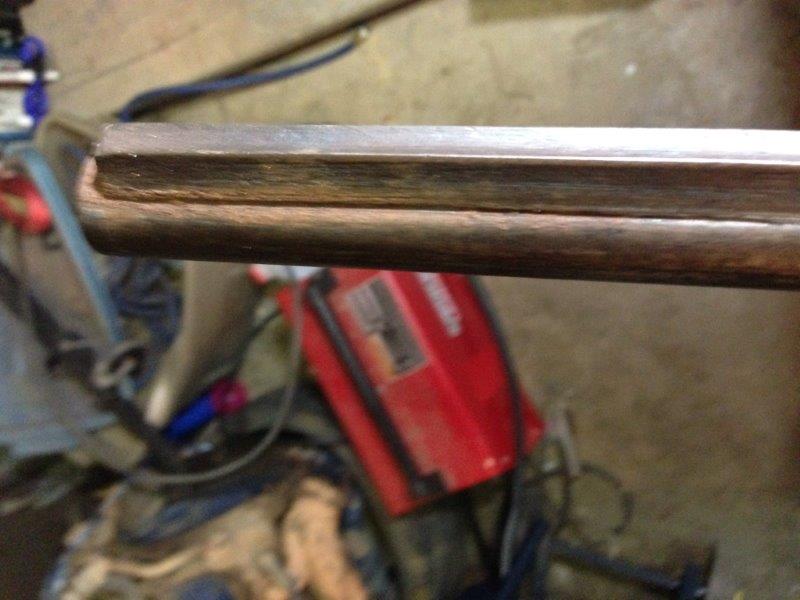
One thing I'm curious about is that the barrel appears to be made from a series fine strips forged in a straight pattern rather than Damascus or Twist style. The rusting does follow the seams of the apparently forged strips in this pattern... I DO recall reading about this straight seamed pattern sometime in a book (remember those?) but it could be my memory.

I poked around Google but all I could come up with is Damascus and Twist (similar but different), all the images I see online are "twisted", albeit at different rates. Sorry the photo is blurry...but I think you can see the straight seams.

X3trtjO.jpg


Any input on this method of barrel making is appreciated!
 
Hmm that is quite different indeed. How thin are the barrels at the end ? Any obvious cracks or anything ?

I'm sure moon coon will chime in soon. Can't say I've ever seen anything like that nor can I find anything similar online or in any of my books.
 
Once upon a time, I had a Banermanized 58 cal musket that looked very much like that. It was bored to 16 gauge. I did fire it, in fact I got up over 100 grains with it, and used it deer hunting with buckshot once. (no luck) The breech area was very very thick. In rifle form it must have been quite heavy. I traded it years ago for an 1892 Winchester in 38-40. That has since become a 44-40.
I think BP shotgunners must have been good shots. either that or starve. Loading was slow. But I did eventually come up with a method of prepared charges and greased wads.
 
I am wondering if the straight lines are only on one side or if they go all the way around the barrel. Of the non traditional damascus barrels that I have seen, the following patterns are what I have run across.

1. wrought iron (smooth rifle @ 1800) which was a series of elongate blotches
2. a french Delvigne pistol (1830s ?) which was made up of layers like plywood
3. a model 1839 Springfield rifle which was made by forming a flat strip into a tube and then a longitudinal forge weld to join the edges. That one looked like the portion of the barrel in the photo
4. Remington reportedly began rolling barrels in the late 1840s; start with a tube 3" diameter and 5 or 6" long with a hole in the center, then run through a series of grooved rollers to end up with a 30" long tube
5. I do have a british cartridge shotgun @1870 with apparently fluid steel barrels (presumably rolled) and no pattern

I guess my best guess is that if the lines form a pattern about 1/2" wide and run the whole length of the barrel, your barrels would fit description #3. If the lines extend all the way around the barrel, I would be hard pressed to explain it

cheers mooncoon
 
I am wondering if the straight lines are only on one side or if they go all the way around the barrel. Of the non traditional damascus barrels that I have seen, the following patterns are what I have run across.

1. wrought iron (smooth rifle @ 1800) which was a series of elongate blotches
2. a french Delvigne pistol (1830s ?) which was made up of layers like plywood
3. a model 1839 Springfield rifle which was made by forming a flat strip into a tube and then a longitudinal forge weld to join the edges. That one looked like the portion of the barrel in the photo
4. Remington reportedly began rolling barrels in the late 1840s; start with a tube 3" diameter and 5 or 6" long with a hole in the center, then run through a series of grooved rollers to end up with a 30" long tube
5. I do have a british cartridge shotgun @1870 with apparently fluid steel barrels (presumably rolled) and no pattern

I guess my best guess is that if the lines form a pattern about 1/2" wide and run the whole length of the barrel, your barrels would fit description #3. If the lines extend all the way around the barrel, I would be hard pressed to explain it

cheers mooncoon

Thank you for that Mooncoon; I'll clean it up and have a closer look based on this.

Happy New Year to all - NCBB
 
Perhaps you could post a pic of your barrels on doublegunshop forum. There is a Dr. Drew Hause on there who has done a lot of research into various types of damascus barrels, both in identification and tensile strength.
 
Perhaps you could post a pic of your barrels on doublegunshop forum. There is a Dr. Drew Hause on there who has done a lot of research into various types of damascus barrels, both in identification and tensile strength.

I hadn't thought of that - it's a good idea. Only a single barrel on mine but the question is about the process.

I had a look and the lines continue around the barrel - it could be that they were filed in there for decoration perhaps, if it isn't forged together? I'll try and find a moment to put up some better pictures here.
 
I have a Belgian made "hardware-store grade" percussion 16ga single barrel with the barrel formed from non-twisted skelps and marked "Laminated Steel". In the x-rays of the barrel, you can see where one strand (can't recall the proper term) of one of the skelps was not properly welded and came away in the bore, forming a helical groove/elongated-pit about 3/4 of the way around the bore. This probably would not have failed like this if it had been of a twist construction. By the way, this was the only flaw that showed on x-ray or magnaflux.

Regards,
Joel
 
I have a Belgian made "hardware-store grade" percussion 16ga single barrel with the barrel formed from non-twisted skelps and marked "Laminated Steel". In the x-rays of the barrel, you can see where one strand (can't recall the proper term) of one of the skelps was not properly welded and came away in the bore, forming a helical groove/elongated-pit about 3/4 of the way around the bore. This probably would not have failed like this if it had been of a twist construction. By the way, this was the only flaw that showed on x-ray or magnaflux.

Regards,
Joel

Thanks for that. I had time to take a closer look at it and it certainly appears that this whole barrel (all the way 'round) is made that way (non-twisted). A photographer I'm not, but a couple more photos under some artificial light in hopes it shows up better. I still have to ask in that DoubleGun forum about this; if I have a moment I'll maybe ask on the Traditional Muzzleloader Forum as well.

yNXJ4ng.jpg


f2jVR1T.jpg

All it is for me is curiousity.
 
Back
Top Bottom