Picture of the day

B-24L Liberator heavy bomber nicknamed "STEVENOVICH II" of the 779th Bombardment Squadron, 464th Bomb Group. Taken on April 10, 1945, near Lugo, Emilia-Romagna, Italy. Out of the 10 crew members on board, 9 were killed in action (including the pilot and squadron commanding officer, Colonel James Gilson). Only one crew member, waist gunner Lt. Edward Walsh Jr., managed to survive after being thrown clear of the aircraft and deploying his parachute.
Wow...and so close to the end in the European theater.
 
907266159_10164876770839890_3771223647034995123_n.jpg

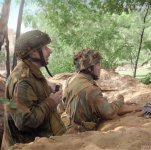
Major William "Jock" Neill (left) commanding 'C' Company, 1st Battalion Border Regiment, and Lieutenant John McCartney, commanding No. 28 Medium Machine Gun Platoon. Major Neill was wounded in both arms and a leg but was able to continue fighting. Oosterbeek, 21 September 1944.

Major Neills account when he was wounded, as printed in “Honour for All”, by Allan A. Machie, 1946.

“On D-plus-three the Germans brought up an 88 mm self-propelled gun with a score of infantrymen creeping behind it. We had no artillery, not even light guns, and only a few Piats anti-tank rifles, so I grabbed a Bren gun and got behind a tree, hoping to pick off the crew as the self-propelled gun advanced on us. Suddenly the gun trained round toward me and fired. The shell hit the tree behind which I was standing and the blast knocked me five feet into the air. When I hit the ground I found I had four shrapnel wounds, two in my left leg and one in each arm. But while I had distracted the attention of the gun crew one of my men had slipped around it with his Piat gun and slammed his bombs into it. The gun stopped and the men behind it retreated. I wrapped dressings around my wounds, which were not deep, and crawled back to my slit trench.”

Photo: IWM (BU 1102)

 
2d657098d85eef0e349d6884de4d86654e24b5aa.jpg


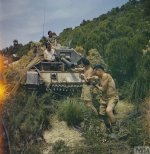
November 18, 1952. Navy Lieutenant Royce Williams is flying his F9F-5 Panther off the USS Oriskany near North Korea when seven Soviet MiG-15s appear out of the clouds. Two of his fellow pilots are ordered back to the carrier. His wingman chases the first MiG he hits. Now it's just Williams against six Soviet jets, alone over the Sea of Japan.
For the next 35 minutes, the longest dogfight in U.S. Navy history, he fights for his life. He shoots down four MiGs. Runs out of ammunition. Loses hydraulics. When he finally makes it back to his carrier, his own task force opens fire on him, mistaking him for an enemy aircraft. He lands anyway. A shipmate circles every bullet hole on his Panther with a grease pencil. He counts 263.
Then the government tells him to never speak of it again. The Soviets were not officially in the Korean War, and revealing the truth could have started World War III. Williams is quietly given a Silver Star and ordered to keep his mouth shut. He does. For over 50 years. He doesn't tell his wife. He doesn't tell his brother, who is also a naval aviator. He meets President Eisenhower weeks later and says nothing.
The secret only came out after Soviet war records were declassified following the collapse of the USSR. His Silver Star was upgraded to a Navy Cross in 2023. In February 2026, Williams was informed he would finally receive the Medal of Honor, 73 years after the fight. Congress passed legislation in the 2026 National Defense Authorization Act to waive the five-year statute of limitations, clearing the path for recognition.
When asked how he managed to shoot down four MiGs alone, his answer was simple: "I have a God that did it for me"
 
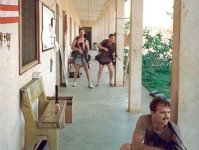
Short-shorts? Check
Combat flip-flops? Check
Can of Coke and a 3-DCell Maglite for the guy on night watch? Check.

How to secure an American Embassy and residence in Sierra Leone in 1997, Special Forces Style, when the locals get squirrely with their politics.

A "small detachment" (hard to find any reliable numbers) of US Army Special Forces Advisors were in town on an advisory mission (too late) for the elected President and government when the local army switched sides and joined the rebels. they secured the embassy compound and attached residences, set up an LZ to begin evacuations, and successfully told the locals to piss off for 4 days while Marine helicopters from the USS Kearsarge evacuated 454 Americans and over 2000 vulnerable non-combatants from other nations.

y0tm18nlwl1i1.jpeg
 
Short-shorts? Check
Combat flip-flops? Check
Can of Coke and a 3-DCell Maglite for the guy on night watch? Check.

How to secure an American Embassy and residence in Sierra Leone in 1997, Special Forces Style, when the locals get squirrely with their politics.

A "small detachment" (hard to find any reliable numbers) of US Army Special Forces Advisors were in town on an advisory mission (too late) for the elected President and government when the local army switched sides and joined the rebels. they secured the embassy compound and attached residences, set up an LZ to begin evacuations, and successfully told the locals to piss off for 4 days while Marine helicopters from the USS Kearsarge evacuated 454 Americans and over 2000 vulnerable non-combatants from other nations.

View attachment 1242620
The most fortunate thing for them is that they didnt have Mrs. Clinton in charge of their safety like the crew had at Bengazi
 
Back
Top Bottom