Precision/F-class Reloading Steps

If the op is involved in F Class, he better get his head around what his competitors are doing if he wants to be competitive one day.

Trevor mentioned that neck turning may not be worth the time and effort for some. I don't really think its time and effort as much as it is the acquisition of suitable hardware.

I've gone to considerable lengths over the years having components made that I could not purchase in the quality and accuracy I expected.

Now that I have what I want, I turn necks very quickly and its a low effort process for me anyway.

I would suggest that anyone considering neck turning for large quantities to focus on ways to use power tools and not the little T handle gizmo we usually get thrown into a neck turning kit. The T handle is fine for a few cases, but will wear you down over hundreds.

If there is a downside to neck turning, its really just your time, but I see it as beneficial even in the worst case where the rifle has a sloppy chamber. Again, this is in the scope of F Class and other high precision games.

You may not see that it helps you (even if it does in the aggregate), but it wont hurt you if you only do a minimal clean up. At least your neck tension will be more stable... And lots of guys feel neck tension is critical to low SDs...

Sure lots of guys don't think neck tension matters at all, but I have no faith in a man who clings to the lowest possible rung on the ladder and looks for ways to justify his resistance to climbing higher. That belief can be classically defined as unconscious incompetence.
 
Last edited:

I use a powered set up and it turns cases fast and easy. This is FIRED brass (I think 3 or 4 firings by now) that has already been turned.... so for those who don't understand that brass flows, hopefully, this video will show that it most certainly does.. and outside neck turning on a routine basis is a good idea to maintain proper clearances. And the chamber in this barrel is SAAMI... I don't run tight neck chambers

I wish all my competitors believed in doing the least amount of work and believe it can allow for the highest level of performance.

YMMV

Jerry
 
Last edited:
My point is that at the beginning the focus should be on the basics, using good quality components and equipment. That will get you the majority of your performance.

Starting to reload is a big hurdle. There's a lot of conflicting information, everyone's process is different, and there's a big learning curve to it.

The more complicated you make a process, and more inputs you add, the steeper the learning curve becomes and the more potentially confusing it can be.

Is neck turning necessary? No, not if you don't have a tight neck chamber. Can it add precision? Some say it does, some say it doesn't. Same with SD/ES. It's certainly worth exploring at some point in the process, if your needs downrange desire it.

Personally, I would recommend avoiding steps for now that add marginal, if any benefit. Focus on the basics. Learn exactly how those basic steps contribute to internal and external ballistics. Once you get a good handle on that, from there branch out and explore additional steps, to see what advantages they may or may not provide.

But if you start doing every alleged important process and nuance at once, it's going to be hard to separate the wheat from the chaff, and troubleshooting problems could become confusing.

Anyways, just food for thought. I'm just some stranger on the internet, and this advice is worth what you paid for it.
 
...neck turning with a tight neck has clear benefits for both neck tension and concentricity as well as lengthen the bullet guidance into the rifling. This is highly advantageous with short throats.

Interested to understand the “mechanics” to support these conclusions. Thanks.
 
Interested to understand the “mechanics” to support these conclusions. Thanks.

Think of it this way... Your chamber has perfect concentricity between the body and neck, since it is entirely machined with a single reamer.

Brass fired in your chamber will blow out to fit, therefore will have perfect concentricity between the neck and body... As long as your ejector spring is not so strong that it dents your necks at ejection... that's why bench rest guys cut the ejector spring to weaken it BTW.

So you take your perfectly concentric fired case and size the neck.

If you have a sloppy neck, you will need to reduce your neck diameter by at least 0.012" and maybe more, then run an expander through it on the way out or in a separate operation. That's two opportunities to induce runout from what started as a perfectly concentric piece of brass.

Now a guy with a tight neck and turned neck brass needs to reduce the neck diameter by 0.002 to 0.003" with no need to run an expander ball after.

Question... Which guy is going to have more runout, the guy who reduced his neck diameter by 0.012 and then expanded it or the guy who reduced his neck diameter by 0.002"???

As for neck tension... Well the more you work your brass, the more you are work hardening it. Wall thickness of un-turned brass necks are never even regardless of brand. The variation in material thickness translates to variations in neck tension. Therefore concentric and consistent turned brass will have more consistent neck tension than un-turned brass.

Then we need to understand how the bullet enters the rifling... Some cartridges like a 6BR are known for accuracy, but its not because of anything special about the case dimensions.... Its the throat design. Because the case is so short, the chambering reamers have been designed for the bullet to stick out of the case... So they have a long throat. That throat aligns the bullet with the rifling and ensures that the bullet enters the rifling straight. In this case, the neck does not meaningfully influence bullet alignment to the rifling, so guys may opt not to neck turn and find success in the result of bullet alignment from the long free bore.

A cartridge with a typically short throat, like a 308 running 155s has almost no bearing surface protruding from the front of the case. The bullet alignment to the bore is entirely driven by the brass. When running these light bullets, a tight neck is highly beneficial because it can be used to align the bullet to the rifling just like the free bore does with long bullets in a long free bore.

Savvy?
 
Last edited:
Think of it this way... Your chamber has perfect concentricity between the body and neck, since it is entirely machined with a single reamer.

Brass fired in your chamber will blow out to fit, therefore will have perfect concentricity between the neck and body... As long as your ejector spring is not so strong that it dents your necks at ejection... that's why bench rest guys cut the ejector spring to weaken it BTW.

So you take your perfectly concentric fired case and size the neck.

If you have a sloppy neck, you will need to reduce your neck diameter by at least 0.012" and maybe more, then run an expander through it on the way out or in a separate operation. That's two opportunities to induce runout from what started as a perfectly concentric piece of brass.

Now a guy with a tight neck and turned neck brass needs to reduce the neck diameter by 0.002 to 0.003" with no need to run an expander ball after.

Question... Which guy is going to have more runout, the guy who reduced his neck diameter by 0.012 and then expanded it or the guy who reduced his neck diameter by 0.002"???

As for neck tension... Well the more you work your brass, the more you are work hardening it. Wall thickness of un-turned brass necks are never even regardless of brand. The variation in material thickness translates to variations in neck tension. Therefore concentric and consistent turned brass will have more consistent neck tension than un-turned brass.

Then we need to understand how the bullet enters the rifling... Some cartridges like a 6BR are known for accuracy, but its not because of anything special about the case dimensions.... Its the throat design. Because the case is so short, the chambering reamers have been designed for the bullet to stick out of the case... So they have a long throat. That throat aligns the bullet with the rifling and ensures that the bullet enters the rifling straight. In this case, the neck does not meaningfully influence bullet alignment to the rifling, so guys may opt not to neck turn and find success in the result of bullet alignment from the long free bore.

A cartridge with a typically short throat, like a 308 running 155s has almost no bearing surface protruding from the front of the case. The bullet alignment to the bore is entirely driven by the brass. When running these light bullets, a tight neck is highly beneficial because it can be used to align the bullet to the rifling just like the free bore does with long bullets in a long free bore.
Savvy?


I thought perhaps there was something that I hadn’t perked on already, but doesn’t look like it.... I have several reamers designed for tight necks so have been messing with them for years. My understanding is:
That turning brass primarily accomplishes one thing, which is uniforming neck wall thickness. Associated benefits include mitigating any potential run-out from neck walls that may be thicker on one side; and potentially reducing neck tension. (IME neck tension on the low side improves consistency over high neck tension). EDIT/ADD : Also, using an outside neck turn tool with a cutter angle that matches the shoulder angle will remove a sliver of brass from the NK/Shoulder junction, and since brass will flow, may mitigate to a small degree, the formation of “donuts”.
That bullet alignment to the bore is not dependent on the clearance between the outside of the neck wall and the chamber...because there is radial clearance regardless. There are a lot of very consistent shooting rifles that do not run tight necks. EDIT/ADD: You will notice in the chamber cut-a-way below, that there is clearance between the neck wall and chamber. This reamer would have cut the chamber-neck to have .002” clearance between a loaded round and the chamber wall.
That the primary benefit of running a tight neck is the longevity of the brass as there is less movement to induce work hardening. I am told that some SRBR shooters make up a single set of brass and discard it about the same time they change out the barrel?

It is IME important that the loaded round is concentric AKNA “no runout”. It is held to alignment with the bore by the overall close fit of the chamber when held against the boltface (and doubtfully “falls” to the bottom of the chamber). In many instances, precision rigs are loaded with rounds that have no more than .002” headspace. Not too much can go amok as that tapered shoulder slides into place. In my most accurate rigs, I have removed the ejector pin to insure the base of the cartridge is flat to the boltface...and as a side benefit, the empty can be removed by hand which eliminates the potential for brass to get dinged.

I have removed the expander button from my bushing resizer dies. The resizer bushing floats a little to insure necks are not pulled out of alignment. My Wilson seater dies are mostly made from blanks cut by the same reamer that was used to chamber the barrel.


Here is a pic of a chamber cut-a-way that shows how a loaded cartridge “fits” when chambered (note: this one is not quite all the way forward to emphasize headspace ...and note there is no rifling cut yet).
[/
 
Last edited:
I will stick with what I said and how I said it and disagree with your minimization of these factors.

You said: That bullet alignment to the bore is not dependent on the clearance between the outside of the neck wall and the chamber...because there is radial clearance regardless.

I don't follow your train of though at all on this. If the neck fit is snug, how can it not align the bullet to the bore?

A well cleared neck will have no influence but a tight neck will absolutely influence bullet alignment to the bore.

Tony Boyer would go to such lengths as to sand paper the neck of each case to achieve what he felt was a perfect fit for this very reason. So perfect that sizing was not required. Just change the primer, powder and seat another bullet.
 
Last edited:

There should ALWAYS be some space between the loaded cartridge neck and the wall of the chamber... ALWAYS!!!!

The amount of clearance will vary depending on the discipline and level of cleaniness that can be maintained. Dimensions of the case will be adjusted to suit the chamber dimension. The other way around really doesn't make a whole lot of sense wrt to precision shooting... but they exist and many just don't understand what happens to the brass under pressure.

The THROAT of ANY chamber offered by SAAMI and any reamer spec I have ever seen shows this diameter to be wider then the bullet diameter. The amount of clearance can vary but it is wider. And don't worry, we have been down the rabbit hole of bullet bearing surface and throat 'fitting'.... bad, real bad.

Bullet alignment is created when the leaving bullet's bearing surface engraves fully in the rifling TRUE to the bore.... BEFORE all of the bearing surface leaves the case neck. The distance between the exposed bullet bearing surface to the start of the rifling really doesn't matter a whole bunch IF you control the other loading parameters and the bullet alignment occurs upon firing

Case alignment happens at the REAR of the case... not the front.... especially in any game where the ammo can see weather.

Hope this helps..

Jerry
 
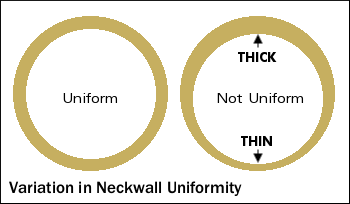
This photo thanks 6mmBr demonstrates why we turn necks.
neckwall4x350.png


neck turning give consistent neck tension an uneven neck will have neck tension which will changed upon firing as the thin side of the neck will expand at a greater rate then the thick side. The bullet will then start off axis and you will have inconsistent results.

This get compounded (unless you marked the high side) the next time you load the round, the thick side could be facing a different direction 3-6-9-12. you will always be chasing unexplained flyers.

The expanding mandrel, two versions the pull through with expander button or pin gauge / mandrel... it is well documented the pull through expanding crushes accuracy. I don't think anyone is advocating this method of expansion. The pin or mandrel expanding gives you more even tension around the entire neck.

I have harped on this before but it comes down to the discipline you are shooting if you are hunting or minute of pop can than your accuracy requirements do not need all these detailed steps. If you compete, you will see the benefits of making each round the exact same as the next.

Cheers
Trevor
 
There should ALWAYS be some space between the loaded cartridge neck and the wall of the chamber... ALWAYS!!!!

The amount of clearance will vary depending on the discipline and level of cleaniness that can be maintained. Dimensions of the case will be adjusted to suit the chamber dimension. The other way around really doesn't make a whole lot of sense wrt to precision shooting... but they exist and many just don't understand what happens to the brass under pressure.

The THROAT of ANY chamber offered by SAAMI and any reamer spec I have ever seen shows this diameter to be wider then the bullet diameter. The amount of clearance can vary but it is wider. And don't worry, we have been down the rabbit hole of bullet bearing surface and throat 'fitting'.... bad, real bad.

Bullet alignment is created when the leaving bullet's bearing surface engraves fully in the rifling TRUE to the bore.... BEFORE all of the bearing surface leaves the case neck. The distance between the exposed bullet bearing surface to the start of the rifling really doesn't matter a whole bunch IF you control the other loading parameters and the bullet alignment occurs upon firing

Case alignment happens at the REAR of the case... not the front.... especially in any game where the ammo can see weather.

Hope this helps..

Jerry

I can explain it for you, but I cant understand it for you.

I'm done here.
 
I come from a different shooting discipline, Target Rifle shot off my elbows supporting the rifle only with a jacket and sling. All I can say is a lot of you guys are handling your brass several times doing a lot of operations to get a loaded round. How many times do you want to crank that press handle to make a round? Some of you are running that thing 4 times. In the TR game we use match chambers that do not have tight necks. The reason behind this is that in some countries that we shoot in, reloading is not an option and ammo is issued either before the first relay of the day or in the case of Bisley, just before your relay each time.
For my handloaded ammo that I use here and in the US, I use Lapua brass. I have somewhere between 1800-2000 pieces of it. This brass is weight sorted to within .5 gr batches. This same lot of brass has been used in the last 6-7 barrels that I have shot out. Up until two years ago I didn't even anneal my brass, and never neck turned. I may have discarded 30-40 pieces of brass out of this batch because the primer pockets were getting lose over the years.
Now I anneal my brass every couple of years. I use spray lube because I find it to be very uniformed. Since my brass never touches the ground of even the shooting mat, I don't bother the clean the brass before sizing (no damage to the dies or bushing and my #### has not fallen off, to date). I used Redding Type S bushing dies and bump the shoulder back .002. This operation also decaps the spent primer. Everything going through my Gracey Trimmer that cut to length and chamfers inside and out, even if it doesn't need to be trimmed it is quicker to run it through the trimmer than it is to measure each one to see if it needs to be trimmed. Once this is done into the tumbler it goes. Once cleaned the brass goes back into the MTM 50 boxes primer pocket up. A quick glance will let you know if there might be a flake of media in the flash hole, that I just poke out. I do not clean primer pockets unless there is a big hunk of crud in them. I find cleaning primer pockets to be a waste of time and I doubt that time spent will gain me a extra V Bull at 1000 yards. Primers are seated on the press using a LEE auto prime ll.
Powder is dumped with an RCBS charge master then moved and reweighed on an Acculab scale. Targeted charge weight is -0.0/+.02 gr. Bullet is seated with a Redding competition seated .020 off the lands.
I have no idea how accurate my rifle is. I can not say with this loading method it shoots in the 1's or 2's at 100 yards. What I can tell you is that it will shoot less than 1 MOA at 100 yards when i shoot prone, off my elbows supported by a jacket and sling. Between the ammo, rifle and me being the driver, sometime I get lucky and win a match.

A lot goes into making good ammo, and a lot can be said about what you believe will make it shoot better. Yes there are guys that weigh primers and sort brass by volume, trim meplats, point bullets, neck turn and maybe even some that have their ammo blessed by the local padre before going out to the range. However in reality some of these step have zero return on your effort. And I will almost bet in a blind test you wouldn't be able to see a difference at 1000 yards.

Take it for what you will, but matches are not won at the loading bench, they are won or lost on the firing line when the wind starts blowing. I will put my money on a guy with a .5 MOA rifle/ammo that knows how to read the wind, rather than the guy with the .25 MOA rifle/ammo that doesn't have a clue once the wind starts blowing and fishtailing. Your ammo that produces groups in the 1's and 2's at 100 yards will end up being 4 MOA ammo if you can't master the wind.
 
Last edited:
With all this talk about about what you "need" to do in the reloading stages I thought I would share what I did to get groups under 3/8 moa in my new 223 Tikka Varmint. This rifle only had its trigger pull lightened. Nothing else was done.

1) got some once fired 223 Winchester brass from nephew - range pickup from police practice
2) deprimed
3) cleaned with stainless pins and dried.
4) neck sized using a Redding bushing die but did check to see if it would "fit" into chamber
5) trimmed to length
6) primed with four various primers types for testing groups 5 rounds per group per primer.
7) chose a powder charge under max from books with a powder I wanted to use because I stock it for other rifles - no ladder or OCW test done
8) seated bullet I wanted to use to book OAL to match magazine feeding 2.260"
9) shot groups at 100 meters and watched the group size per primer type.
10) chose primer that gave me the 3/8" moa group.
11) repeated to verify.

If you find a good node then then most of the picky steps detailed in the discussions above may not be needed. It also helps to know how to shoot!!
 
SteveB,
I beg you ask...how carefully was the powder charge weighed? And would you use this ammo to shoot a competition at 600-1000 yards? And one thing I do want to point out is that you still cycled your press 3 times. Once to decap, once to size and once to seat the bullet.

It is kind of a toss up if I am more about efficiency or if it is out of laziness or my lack of love for reloading. My uh-ha moment was the time I decapped 500 cases getting ready for the CFRC. At around case 495/500 I realized that I still had to size them. So 500 more times to cycle the press and 500 more after that to seat bullets.
 
SteveB,
My uh-ha moment was the time I decapped 500 cases getting ready for the CFRC. At around case 495/500 I realized that I still had to size them. So 500 more times to cycle the press and 500 more after that to seat bullets.

The new wave... wish i knew this 10yrs ago this is the 550. They have since moved to the 750 with 5 station head. on the 550 it cuts the number of strokes by a third even more efficient on the 750

 
Last edited:
Hi Maynard

I use an Autotrickler V3 and weigh to .02 grains for all my cartridges. You are right about the extra step but that is the way I do everything and wasn't concerned about saving a step on this. I like to keep primer debris away from my good presses and dies and use a cheap Lee press to de-prime only. Just me and my way.

I have bought this rifle (Tikka Varmint 223 1 in 8T) to see if it was accurate enough to compete at 300 and 500 meters to give a viable choice to someone who wanted get started in F-Class. In our group most of the guys have a 223 of some kind or the other and we been talking of a local 223 only match. The military in Chilliwack has restricted the Vokes range to a 223 only template and if that reopens then that maybe the only cartridge allowed.

It was just an experiment but from the results of this simple test the rifle and cartridge combo maybe viable.

It just amused me to load very simply with a few steps using range pickup brass and get such good results without having to do all the "must do stuff".

BTW, I do do all the "must do stuff" myself when loading my 6.5 x 284's for 900 meter shooting.
 
Hi SteveB

Thanks for the reply. And good on you for taking the time to test a factory rifle to assure people that it is a viable choice. Here in Ontario we have or did have a sub F-class called F-Class(M)anufactured.
Basically an off the shelf rifle that shoot against new shooters in their own class. I don't shoot F-Class so I am not really sure how well this is going. We also have the same problem here where Kingston has decided to go with the .223 safety template.

Trevor60,
I sold my 550 years ago because it just couldn't be tuned enough to make the quality ammo that I was trying to make, with the components that I was using. Looks like I took one step forward and 2 steps back.
 
Trevor60,
I sold my 550 years ago because it just couldn't be tuned enough to make the quality ammo that I was trying to make, with the components that I was using. Looks like I took one step forward and 2 steps back.

That was true before, but fast forward to 2018 and the advancements in CNC machining and guys taking a real look the the Dillon presses have turned in our favour.
A number of top F class shooters have changed to progressive presses and equaling the same consistency as single stage presses with the same level of accuracy.

Finding them now is the challenge. I would like to get back a 1/3rd of my time.

Trevor
 
Hi Maynard
We tried the manufactured class also but nobody was actually interested. For the past 5 plus years or so I have been focused on building the best combination of bullet, cartridge, scope and rifle to shoot F-Class to 900M/1000yards and believe I did that. However, now we mostly shoot 500m at our range because it is hard to get local people to come out and shoot 900 in the summer. Lately, I been looking for a combo that will give me approx. the same drift at 500 as my 900 rifles give at 900.

Our range has cancelled matches due to covid that have any out of town shooters. We can shoot with local guys but that is it. We are lucky though because we have been shooting period.

It does look like this Tikka Varmint maybe accurate enough to be a viable F-Class rifle to 500M. Will know tomorrow if the winds are down.
 
Hi Maynard
We tried the manufactured class also but nobody was actually interested. For the past 5 plus years or so I have been focused on building the best combination of bullet, cartridge, scope and rifle to shoot F-Class to 900M/1000yards and believe I did that. However, now we mostly shoot 500m at our range because it is hard to get local people to come out and shoot 900 in the summer. Lately, I been looking for a combo that will give me approx. the same drift at 500 as my 900 rifles give at 900.

Our range has cancelled matches due to covid that have any out of town shooters. We can shoot with local guys but that is it. We are lucky though because we have been shooting period.

It does look like this Tikka Varmint maybe accurate enough to be a viable F-Class rifle to 500M. Will know tomorrow if the winds are down.

I've shot with Maynard for many years using a 223 for F Class when the range was out to 600 yards.

I was using a custom 1:8 Sako in 223 running mostly 80 grain SMKs with great success at the time. I would imagine the rifle you described should produce similar ~ results today.

With the 1:8 twist, I don't think you will have much luck with anything heavier than that, but if you really want to get aggressive, you will need a 1:7 twist and a longer throat. Something that would set the 88 ELDs to at least 2.625". If you want to run the 90 grain ATips you can add about 0.025" to that, or just shoot it with 88s until the throat wears that far.

The key to low SDs with any cartridge, but particularly with something as small as a 223 is to seat the bullet so the base of the bearing surface is well ahead of the neck to shoulder donut area. Best to cut a piece of brass in half so you can get a good look at it and you can evaluate where different bullets sit.

Keep in mind that for a single shot, you can get more aggressive with extending the seating depth that we can with a mag fed rifle as feeding from a mag can re-align the bullet to the case causing runout that can mess with accuracy.

There's a group of guys near Ottawa that shoot the 223 out to 900 meters on a regular basis, but to my knowledge, none of them are seating out as far as I have described here. For that reason, they are not hitting the velocities that I am, so throat length is a key driver.
 
Last edited:
Back
Top Bottom