Question about AR15 being made full auto

I didn't say any NEA rifles were full-auto. I said the first few rifles they built slam-fired uncontrollably until they switched to semi-auto disconnectors. Which is a fact, not slander. And it's not meant as an indictment of NEA.

This is slander and not technically sound. A full auto disconnect by itself will not cause burst firing. The tail is cammed by a projection on an automatic three position selector to disengage it for firing bursts. You would need a three position selector installed and switch it to automatic to get a burst.
 
PS: for those who care, once upon a time I had access to some surplus M16 fire control groups. I installed them all into AR15 guns after machining the disconnector tail and they worked just fine without an auto-sear or DIAS and would not go F/A. If you ever do this, it's important not to forget to machine those disconnector tails off - regardless if you go the auto-sear route or not. What you might get is NOT controlled full-auto and is decidedly a bad idea.

My understanding is NEA learned the same lesson on their first few guns when they used to ship M16 fire control groups with AR15 notched hammers. I'm sure a few early testers were on the surprised side when they first loaded more than one in the mag.


This is also wrong.

A "notched hammer" is a semi-auto hammer that has a notch cut out on the front face, the purpose of which is to engage with a modified firing pin in a cut carrier to prevent burst firing in the event the disconnect does not grasp the upper inner notch.

The upper outer notch on an M16 automatic hammer is made to engage the auto sear which prevents the hammer from following the bolt on automatic fire. This is to prevent light strikes on burst.

The presence of an upper outer notch by itself will have no effect on firing in a semi automatic firearm. The upper outer notch has no effect on the disconnect.

Hammer_zps912b6635.png
 
Last edited:
The cam pin doesn't touch the upper (or it's not supposed to), it solely contacts the bolt/carrier. So I'm not sure what you mean.

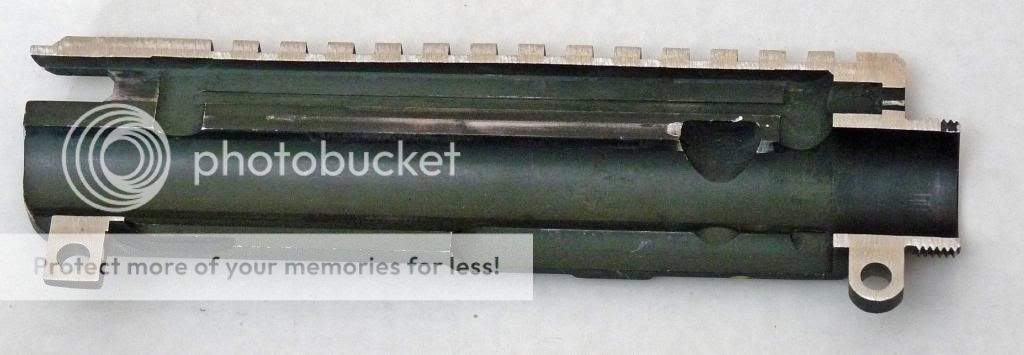
This is also incorrect. The cam pin makes an obvious wear mark in the upper receiver on the left side. It is the upper receiver that prevent the cam pin from rotating until the bolt is fully forward. The lump on the left side of the upper is there for a reason.

If the cam pin wears this groove deep enough in the upper receiver the bolt may be able to rotate sooner and may prevent closing. Firing out of battery happens when there is a mechanical malfunction such as a missing cam pin or also in the case of a cook off.
 
Last edited:
Frankly, I consider hammer follow a form of slam fire since the lugs are not fully rotated at ignition. Only about 50% rotated.

More wrong. I hate to pick on your posts, but there are some big holes in your understanding here.

The hammer following the carrier on semi-automatic would be termed a burst or doubling depending on the situation. This would be a failure of the disconnect to engage in the upper inner notch. Not called a slam fire.

An M16/AR15 firearm will not fire until the bolt is fully forward and locked - the firing pin cannot protrude unless the bolt is fully in the locked position. Anyone can see this simply by removing the BCG, pushing in the firing pin and locking and unlocking the bolt with your fingers.
 
This is also incorrect. The cam pin makes an obvious wear mark in the upper receiver on the left side. It is the upper receiver that prevent the cam pin from rotating until the bolt is fully forward. The lump on the left side of the upper is there for a reason.

You are right, the upper does guide the cam pin.

However, is the lump not there to allow for the clearance cut on the inside of the upper that allows the cam pin to rotate when it's forward enough that it should start turning? If it was designed to impact that area on purpose, one might expect ar uppers to wear out in that area far more commonly than they do.

The wear marks, from what I understand are incidental and not designed-in. And by that I mean that it's not necessarily supposed to wear in the spot that sometimes sees wear. While it's common, you don't always have wear in that area.
 
Yes that is what the lump is for.

All AR's have cam pin wear. The cam pin is always trying to rotate when pushing a cartridge from the magazine.

Eventually this wear will become excessive and the upper should be replaced. This is a critical inspection point.

This might be tens of thousands of rounds, or just a few thousand in an over powered shorty or piston gun.
 
Yes that is what the lump is for.
All AR's have cam pin wear. The cam pin is always trying to rotate when pushing a cartridge from the magazine.
Eventually this wear will become excessive and the upper should be replaced. This is a critical inspection point.
This might be tens of thousands of rounds, or just a few thousand in an over powered shorty or piston gun.

Thanks. I learned something :)
 
Nice to see the pompous ass on this forum. I never declared my "knowledge" on the AR-15 platform, and I can freely admit that I have only disassembled a couple of them and handled a total of 10 maybe. I have never fired one as shooting one at 50 yards indoors isn't my idea of a good time, and having a rifle that I can't take into the woods with me is useless. As is right now the AR is more fun to see how it works and the design ideas behind it than actually using one in canada.

Nothing like it's on the internet it must be true defense.
 
Slam fire happens when the firing pin protrudes enough to touch off a round on bolt closure. Whether that happens due to a stuck fwd pin or a following hammer is irrelevant.

As for the notched hammer thing, it's a red herring. If a disconnect or has a tail and the selector is on auto, you can get hammer follow and sometimes a malfunction burst happens.

I don't care if you agree or not. I've personally had it happen on multiple builds. And as for the NEA thing, it was documented here on the forum at the time when test guns were in circulation. NEA fixed the issue before retail guns were sold. I even personally talked to th owner about it. I don't slander people.
 
More wrong. I hate to pick on your posts, but there are some big holes in your understanding here.

The hammer following the carrier on semi-automatic would be termed a burst or doubling depending on the situation. This would be a failure of the disconnect to engage in the upper inner notch. Not called a slam fire.

An M16/AR15 firearm will not fire until the bolt is fully forward and locked - the firing pin cannot protrude unless the bolt is fully in the locked position. Anyone can see this simply by removing the BCG, pushing in the firing pin and locking and unlocking the bolt with your fingers.

Have you ever checked this with a non-fa exposed pin carrier?. Hammer follow projects the pin through most of the cycle with these carriers.
 
Slam fire happens when the firing pin protrudes enough to touch off a round on bolt closure. Whether that happens due to a stuck fwd pin or a following hammer is irrelevant.

They are two separate conditions. The manuals are quite clear.

As for the notched hammer thing, it's a red herring. If a disconnect or has a tail and the selector is on auto, you can get hammer follow and sometimes a malfunction burst happens.

If the disconnect has a tail and the selector is on auto - the firearm will fire on auto. The purpose of an auto sear in an AUTOMATIC WEAPON is to prevent the hammer following the bolt until it is fully forward to prevent light strikes on auto fire. A notched hammer will prevent this. It was introduced to prevent auto conversions by replacing the disconnect and selector.

I don't care if you agree or not. I've personally had it happen on multiple builds. And as for the NEA thing, it was documented here on the forum at the time when test guns were in circulation. NEA fixed the issue before retail guns were sold. I even personally talked to th owner about it. I don't slander people.

You said just the disconnect. That would not create the situation you described.

BTW I am a Colt Master Armourer and work on auto and semi auto AR15s for a living.
 
FYI, a slam fire is where the firearm is loaded, cocked and immediately fires. The trigger does not need to be held.

This situation was first noticed on the XM16E1. The investigation, causes and solutions are well known and documented in The Black Rifle on page 130.

For the hammer to follow the bolt, the trigger would have to be in the "pulled" position otherwise the trigger would engage in the lower notch. If the trigger is squeezed, the firearm fires, and the disconnect fails to engage the upper inner notch the hammer will follow the bolt up and may fire on or more rounds. This is called doubling or a burst. A light strike stoppage usually result within a few rounds in a burst achieved in this manner in a fire arm without an auto sear.

 
Back
Top Bottom