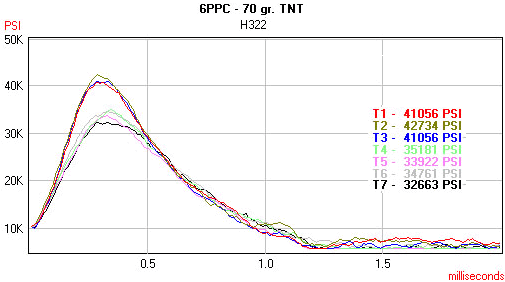
While chrono should not be used as the ONLY pressure indicator, it can still be VERY valuable in this role. Lets say you have a load with exactly the same components as in the manual, but your bullets chrono at 200 fps over the listed velocity for their max charge without any traditional pressure signs. Will you keep using this load 5 times to find out if the primer pocket will expand more than normal? Probably not...
If your load is producing 200fps over what the manual lists as a maximum charge, measuring the case head expansion will reveal that there is an issue. As well, difficult extraction, and extrusion will also very likely be present, both of which are good indicators that the chamber pressure is excessive.
And you can pretend that primer pocket expansion correlates with pressure and not individual brass lot hardness.
I have seen some softer lots of brass, and I do load them slightly milder, to allow decent brass life, even if that does mean that I am giving up a slight bit of velocity. I for one don't want to have a case give problems extracting while on a hunt, and I don't want a primer coming loose and allowing gases back into the action either. I also have no intentions of loading a case once,then throwing it away because the primer pocket is loose. I load to provide a safe, reliable load for my gun, and the brass that I am using.
Velocity is created by the total pressure under the curve that acts on the bullet while in the barrel. If you compare your load and rifle with the same components used in the pressure-tested reloading manuals, you'll get a very similarly shaped curve. If your velocity is higher than the manual, then your pressure curve is also shifted up, and the peak pressure is higher.
If you were using the exact same barrel , the exact same chamber, the exact lot of powder, brass, and bullets, your theory would be correct. The problem is that lots of powder vary, as do cases. I have seen a difference of over 100fps between two different lots of the same powder, so it is almost as if you are actually using a type of different powder. Variations in powder will change the shape of the curve, not only it's magnitude. I have also seen cases vary enough between lots to cause velocity differences of around 50fps, which introduces yet another variable. When you through in the barrel finish, you introduce yet another variable.
I guess that is why the people that print the manuals always include disclaimers, and always advice the reloader to start with a reduced charge, and to work up from there, while watching for pressure signs. The funny thing is, the disclaimers almost always use the term "signs of excess pressure", instead of simply printing "excess velocity". It would be so much easier to simply measure the velocity, but the manuals are not telling us to simply use velocity to judge whether a load is producing excess chamber pressure.