Question for expert reloaders.

Your example of moly illustrates my point. If you add moly to your bullets, you immediately see a decrease in velocity because there is a decrease in pressure! You need to add powder to regain that pressure and velocity that was lost.

The point that you are missing, is that if you use moly, you can add powder to not only regain the lost velocity, but to achieve even more velocity, with the same pressure compared to not using moly. Less friction, means more velocity with the same pressure. The same is true for a very smooth lapped barrel, compared to a rougher factory barrel.

Have you ever used a strain gauge on barrels with different ROT, types of rifling, number/diameter of lands and grooves, etc? The pressure variation caused by those factors is minute compared to the more obvious factors, like powder type and charge weight, barrel length, and bullet type/weight.

Companies like Lazzeroni use slower twist rates, because it allows them to achieve slightly more velocity with the same pressure. The difference is not huge, but it does exist.
 
The point that you are missing, is that if you use moly, you can add powder to not only regain the lost velocity, but to achieve even more velocity, with the same pressure compared to not using moly. Less friction, means more velocity with the same pressure. The same is true for a very smooth lapped barrel, compared to a rougher factory barrel.

But to a MUCH lesser extent. Again, the pressure vs. velocity continuum assumes one is USING LIKE BULLETS. This is the key to comparing your chronied velocity to the book velocity. If you're comparing to Hornady's moly-coated bullets from the book, then use moly-coated bullets in your testing.


Companies like Lazzeroni use slower twist rates, because it allows them to achieve slightly more velocity with the same pressure. The difference is not huge, but it does exist.

You're not kidding it's not huge. More like infinitesimally small... (what....20fps??) ;)
 
If you're comparing to Hornady's moly-coated bullets from the book, then use moly-coated bullets in your testing.

It doesn't matter if the difference in friction is due to the difference in bullets, or due to the difference in barrel finishes.
So how do you compensate for the difference in friction due to different barrel finishes?

You can pretend that a chronograph is the best indicator of pressure, I will stick with primer pocket expansion as my most trusted indicator of whether or not a load is safe in my gun.
 
NO. If you are changing to a longer bullet seated deeper in the case, you WILL increase pressure as well, as has been fairly well explained by Ron and stubblejumper already.

I think you misunderstood my question. I know that reducing case capacity will increase pressure.

I was asking if it would (normally) be possible to launch 2 bullets of different length, same weight, using the same powder (type, not amount) at (roughly) the same velocity.

Seating a longer bullet deeper in the case will increase the pressure, but it will also increase the velocity (since its the pressure that gives the bullet it's velocity). The same peak pressure will be achieved with less powder in the case of a longer bullet.

In theory, same pressure should push the bullets of the same weight at the same velocity, all else being equal. In reality, while the peak pressure might be the same, the pressure curve might be different resulting in different velocities. I guess what I'm really asking is if the area under the pressure curves in these two cases (short vs long bullet) would be significantly different, at the same peak pressures.

My head now hurts a little after reading this through.. :)

The longer bullet MAY also cause an increase in friction

I dont think this is the case. Force of friction is only affected by the friction coefficient of the surfaces and the force acting on them. Neither of these would change with a longer bullet. Surface area (bullet's bearing surface in this case) should have zero effect on friction, in theory anyway.


You can pretend that a chronograph is the best indicator of pressure, I will stick with primer pocket expansion as my most trusted indicator of whether or not a load is safe in my gun.

The problem i see with this method (As well as other conventional pressure "signs") is that you could be well above the max SAAMI pressure and see none of these signs. You could have a case head separation before you notice any difference in primer pocket size. I've seen it happen.

While chrono should not be used as the ONLY pressure indicator, it can still be VERY valuable in this role. Lets say you have a load with exactly the same components as in the manual, but your bullets chrono at 200 fps over the listed velocity for their max charge without any traditional pressure signs. Will you keep using this load 5 times to find out if the primer pocket will expand more than normal? Probably not...

I once loaded some odd 163gr bullets in .308 and they chronoed at ~2880 fps. The extracted cases showed ZERO signs of excessive pressure. The bolt was sticky, but i would not have noticed this if i fired them through a semi (which was the plan). If it wasn't for the chrony, i would probably end up with a blown semi.
 
Last edited:
I think you misunderstood my question. I know that reducing case capacity will increase pressure.

I was asking if it would (normally) be possible to launch 2 bullets of different length, same weight, using the same powder (type, not amount) at (roughly) the same velocity.
Yes, two bullets of the same weight can be both fired at safe pressure regardless of the shape of each bullet.

Seating a longer bullet deeper in the case will increase the pressure, but it will also increase the velocity (since its the pressure that gives the bullet it's velocity). The same peak pressure will be achieved with less powder in the case of a longer bullet.

If two bullets are of the same weight, but different shape it will require exactly the same amount of pressure to initially make them both move, provided that both bullets have the same distance from the front of the bearing surface to the lands. The effect of reduced case volume on pressure is a matter of the percentage of the case volume that has been reduced. For example, a .45 Auto cartridge is effected more if the bullet is seated down onto the powder column than is a .458 Winchester. The reduction in volume of the .458 might be 20%, but the reduction of volume of the .45 Auto might be 70%. Pressure however does not necessarily equate to velocity, and once pressure has reached a dangerous level, it might be that there is no observable increase in velocity.

In theory, same pressure should push the bullets of the same weight at the same velocity, all else being equal. In reality, while the peak pressure might be the same, the pressure curve might be different resulting in different velocities. I guess what I'm really asking is if the area under the pressure curves in these two cases (short vs long bullet) would be significantly different, at the same peak pressures.

My head now hurts a little after reading this through.. :)

If both bullets have the same muzzle velocity, the bullet with the longer bearing surface will generate more pressure at the muzzle. We see this represented in the data for the 180 and 190 gr SPBT Hornady bullets, the 190 has a shorter bearing surface, and requires a greater powder charge to achieve maximum safe pressure and velocity, which is the same pressure and velocity as the 180 despite that bullets lighter weight, but longer bearing surface.

I dont think this is the case. Force of friction is only affected by the friction coefficient of the surfaces and the force acting on them. Neither of these would change with a longer bullet. Surface area (bullet's bearing surface in this case) should have zero effect on friction, in theory anyway.

A bullet's bearing surface has a great effect on pressure as the previous example illustrates. Keep in mind that the lands penetrate and displace the surface of the bullet so the resistance to movement is not minimal. If you've ever stuck a bullet in your bore and have seen how much effort it takes to remove it, you'll understand. The longer the bearing surface the more resistance there is to movement.

The problem i see with this method (As well as other conventional pressure "signs") is that you could be well above the max SAAMI pressure and see none of these signs. You could have a case head separation before you notice any difference in primer pocket size. I've seen it happen.

While chrono should not be used as the ONLY pressure indicator, it can still be VERY valuable in this role. Lets say you have a load with exactly the same components as in the manual, but your bullets chrono at 200 fps over the listed velocity for their max charge without any traditional pressure signs. Will you keep using this load 5 times to find out if the primer pocket will expand more than normal? Probably not...

I once loaded some odd 163gr bullets in .308 and they chronoed at ~2880 fps. The extracted cases showed ZERO signs of excessive pressure. The bolt was sticky, but i would not have noticed this if i fired them through a semi (which was the plan). If it wasn't for the chrony, i would probably end up with a blown semi.

I generally agree with the above sentiments. If your loading manual indicates maximum safe pressure with a given set of components at a velocity of lets say 2700 fps; if your chronograph says 2700 but you are below the powder weight listed as maximum for those components, it would be unwise to increase you powder weight as your measured velocity suggests you have already reached the maximum safe pressure, regardless of whether or not there are visible pressure signs on the brass. To my way of thinking, when pressure signs like ejector marks become visible on the brass, you have already exceeded the safe pressure limits.
 
It doesn't matter if the difference in friction is due to the difference in bullets, or due to the difference in barrel finishes.
So how do you compensate for the difference in friction due to different barrel finishes?

You can pretend that a chronograph is the best indicator of pressure, I will stick with primer pocket expansion as my most trusted indicator of whether or not a load is safe in my gun.

And you can pretend that primer pocket expansion correlates with pressure and not individual brass lot hardness. I will stick to using what the professionals (both lab techs and professional researchers/writers) suggest- a chronograph compared to published, pressure-tested data. Then again, I'll be running the strain gauge on the 21.5" 7RM soon enough, which is an even more trustworthy metric.

Barrel finish has VERY little effect on pressure compared to moly vs. no moly on your bullets.
 
I dont think this is the case. Force of friction is only affected by the friction coefficient of the surfaces and the force acting on them. Neither of these would change with a longer bullet. Surface area (bullet's bearing surface in this case) should have zero effect on friction, in theory anyway.

No, the bearing surface absolutely affects friction and pressure. The bullet with longer bearing surface will cause pressure to be higher, assuming all else is equal.


The problem i see with this method (As well as other conventional pressure "signs") is that you could be well above the max SAAMI pressure and see none of these signs. You could have a case head separation before you notice any difference in primer pocket size. I've seen it happen.

While chrono should not be used as the ONLY pressure indicator, it can still be VERY valuable in this role. Lets say you have a load with exactly the same components as in the manual, but your bullets chrono at 200 fps over the listed velocity for their max charge without any traditional pressure signs. Will you keep using this load 5 times to find out if the primer pocket will expand more than normal? Probably not...

I once loaded some odd 163gr bullets in .308 and they chronoed at ~2880 fps. The extracted cases showed ZERO signs of excessive pressure. The bolt was sticky, but i would not have noticed this if i fired them through a semi (which was the plan). If it wasn't for the chrony, i would probably end up with a blown semi.

Exactly.
 
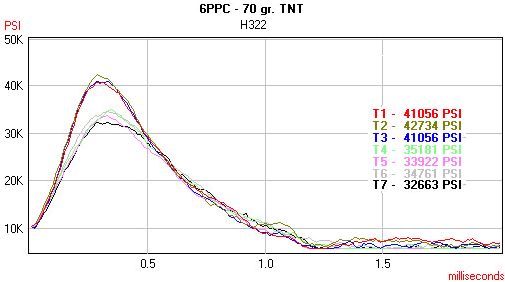
I think the thing that's tripping some of you guys up regarding pressure, is that you're thinking about pressure as PEAK pressure only, rather than total pressure acting on the bullet while in the barrel.

Peak pressure changes with different powders, bullets, bearing surface lengths, etc. At the end of the day, the total pressure exerted on the bullet (the area under the pressure curve) is what equals muzzle velocity.

Here's an illustration:
trace.gif


Velocity is created by the total pressure under the curve that acts on the bullet while in the barrel. If you compare your load and rifle with the same components used in the pressure-tested reloading manuals, you'll get a very similarly shaped curve. If your velocity is higher than the manual, then your pressure curve is also shifted up, and the peak pressure is higher.

Here's a link for those wanting to learn more about pressure testing and its effects on velocity.
http://www.shootingsoftware.com/pressure.htm
 
While chrono should not be used as the ONLY pressure indicator, it can still be VERY valuable in this role. Lets say you have a load with exactly the same components as in the manual, but your bullets chrono at 200 fps over the listed velocity for their max charge without any traditional pressure signs. Will you keep using this load 5 times to find out if the primer pocket will expand more than normal? Probably not...

If your load is producing 200fps over what the manual lists as a maximum charge, measuring the case head expansion will reveal that there is an issue. As well, difficult extraction, and extrusion will also very likely be present, both of which are good indicators that the chamber pressure is excessive.

And you can pretend that primer pocket expansion correlates with pressure and not individual brass lot hardness.

I have seen some softer lots of brass, and I do load them slightly milder, to allow decent brass life, even if that does mean that I am giving up a slight bit of velocity. I for one don't want to have a case give problems extracting while on a hunt, and I don't want a primer coming loose and allowing gases back into the action either. I also have no intentions of loading a case once,then throwing it away because the primer pocket is loose. I load to provide a safe, reliable load for my gun, and the brass that I am using.

Velocity is created by the total pressure under the curve that acts on the bullet while in the barrel. If you compare your load and rifle with the same components used in the pressure-tested reloading manuals, you'll get a very similarly shaped curve. If your velocity is higher than the manual, then your pressure curve is also shifted up, and the peak pressure is higher.

If you were using the exact same barrel , the exact same chamber, the exact lot of powder, brass, and bullets, your theory would be correct. The problem is that lots of powder vary, as do cases. I have seen a difference of over 100fps between two different lots of the same powder, so it is almost as if you are actually using a type of different powder. Variations in powder will change the shape of the curve, not only it's magnitude. I have also seen cases vary enough between lots to cause velocity differences of around 50fps, which introduces yet another variable. When you through in the barrel finish, you introduce yet another variable.

I guess that is why the people that print the manuals always include disclaimers, and always advice the reloader to start with a reduced charge, and to work up from there, while watching for pressure signs. The funny thing is, the disclaimers almost always use the term "signs of excess pressure", instead of simply printing "excess velocity". It would be so much easier to simply measure the velocity, but the manuals are not telling us to simply use velocity to judge whether a load is producing excess chamber pressure.

 
I have seen some softer lots of brass, and I do load them slightly milder, to allow decent brass life, even if that does mean that I am giving up a slight bit of velocity. I for one don't want to have a case give problems extracting while on a hunt, and I don't want a primer coming loose and allowing gases back into the action either. I also have no intentions of loading a case once,then throwing it away because the primer pocket is loose. I load to provide a safe, reliable load for my gun, and the brass that I am using.

Fair enough, but then you are changing your objective and criteria completely. You are now loading for brass life and reliability, not pressure.


If you were using the exact same barrel , the exact same chamber, the exact lot of powder, brass, and bullets, your theory would be correct. The problem is that lots of powder vary, as do cases. I have seen a difference of over 100fps between two different lots of the same powder, so it is almost as if you are actually using a type of different powder. Variations in powder will change the shape of the curve, not only it's magnitude. I have also seen cases vary enough between lots to cause velocity differences of around 50fps, which introduces yet another variable. When you through in the barrel finish, you introduce yet another variable.

I guess that is why the people that print the manuals always include disclaimers, and always advice the reloader to start with a reduced charge, and to work up from there, while watching for pressure signs. The funny thing is, the disclaimers almost always use the term "signs of excess pressure", instead of simply printing "excess velocity". It would be so much easier to simply measure the velocity, but the manuals are not telling us to simply use velocity to judge whether a load is producing excess chamber pressure.


Especially the old manuals that used copper crusher methods. The newer manuals are much less insistent on using brass and primer to check for pressure. They will talk about backing off if velocity exceeds what is shown in the manual. Another reason that they included the clauses to check for primer and brass signs, is that not everybody owns a chrony, but everybody can look at their spent brass.

Again, I'm not suggesting that any method, short of actual pressure-testing equipment is perfect or fool-proof. But ballistic lab techs, professional writers, etc, have said that velocity is the most accurate metric we have, when compared against published data.

There are variables involved in measuring velocity and comparing to the data, but there is even more variation and uncertainty in using brass and primers to gauge pressure (headspace, primer cup hardness, brass hardness, primer pocket size consistency, excessive size in the firing pin hole causing cratered primers, excessive chamber dimensions, etc).

Either way, both methods should probably be used, but I'll put more stock in the chrony and manual data, while you put more stock in brass indicators. That's fine by me. :)
 
Fair enough, but then you are changing your objective and criteria completely. You are now loading for brass life and reliability, not pressure.

Lets not forget personal safety. The shooter's safety depends on the brass case containing the gases produced when the round is fired. Regardless of what pressure the action can supposedly withstand safely, if the case leaks or ruptures, the load is not safe in the firearm.

I do own a chronograph, and I do use it during load development, but I stop working up a load at the first sign of excess pressure, and I won't use any load that shows any pressure signs, regardless of what the velocity reading is.
 
you're SERIOUS about 50( FIFTY GRAINS) OF 748- my SPEER shows 48.5 for a TOP END with a 150 grain bullet- that makes you about a GRAIN AND A HALF over
 
Lets not forget personal safety. The shooter's safety depends on the brass case containing the gases produced when the round is fired. Regardless of what pressure the action can supposedly withstand safely, if the case leaks or ruptures, the load is not safe in the firearm.

I do own a chronograph, and I do use it during load development, but I stop working up a load at the first sign of excess pressure, and I won't use any load that shows any pressure signs, regardless of what the velocity reading is.

Brass quality is very good these days. Catastrophic brass failures are rare indeed, unless of course you exceed the recommended max pressure for your cartridge and rifle, or if you use brass that is obviously worn out (imminent case head separation, etc) ;)

That is just your way of doing it. I have seen rifles that gave cratered primers, regardless of using min or max loads, because the bolt face had a sloppy firing pin hole that was excessively large. I've also seen rifles that flattened primers repeatedly because the chamber had excessive headspace and a sloppy chamber. Ejector marks on the headstamp isn't uncommon with min loads using a soft lot of brass. None of these things are signs of dangerous pressure, but are indicative of other problems/conditions. I trust my chrony and published data in cases like this ;)
 
you're SERIOUS about 50( FIFTY GRAINS) OF 748- my SPEER shows 48.5 for a TOP END with a 150 grain bullet- that makes you about a GRAIN AND A HALF over

My own manuals show a max load of 48.5gr to 51 gr, with a 150gr bullet.
 
That is just your way of doing it. I have seen rifles that gave cratered primers, regardless of using min or max loads, because the bolt face had a sloppy firing pin hole that was excessively large. I've also seen rifles that flattened primers repeatedly because the chamber had excessive headspace and a sloppy chamber. Ejector marks on the headstamp isn't uncommon with min loads using a soft lot of brass. None of these things are signs of dangerous pressure, but are indicative of other problems/conditions. I trust my chrony and published data in cases like this

I never rely on the flatness primers as a sign of pressure, and cratering is usually caused by a loose firing pin/boltface fit.

However, excessive case head expansion, and loose primer pockets, ofter only a few firings, indicate that the load produces too much pressure for the brass/rifle.
 
Oversized chamber/bolt face will also do it...

Unlike the rest of the cartridge case, the case head diameter immediately surrounding the primer, does not expand radially against the barrel or the bolt head for support. In fact, the bolt faces on the mauser actions are open, and are not even capable of supporting the case head in the radial direction. As such an oversized chamber or bolt head will not result in increased case head expansion in the radial direction, which is the dimension that determines the fit of the primer.
 
Load 'em to the cannelure. Trace isn't loaded to different pressures than ball. The bullet is longer to make room for the trace element. Mind you, you won't be able to shoot 'em on a range.


 
Unlike the rest of the cartridge case, the case head diameter immediately surrounding the primer, does not expand radially against the barrel or the bolt head for support. In fact, the bolt faces on the mauser actions are open, and are not even capable of supporting the case head in the radial direction. As such an oversized chamber or bolt head will not result in increased case head expansion in the radial direction, which is the dimension that determines the fit of the primer.

Sure it will. What do you think keeps it from "over-expanding" and rupturing on the first firing? If it expands over time, then it is subject to pressure upon firing, and is being contained by the chamber and bolt face.
 
Back
Top Bottom