Recipe?? Federal Match King .308 Win 175gr. BTHP

GundamZero

CGN frequent flyer
Rating - 99.5%
208   1   1
Location
Toronto
I am looking into starting reloading. I did not buy a setup yet, still researching and learning.

I read some advice that I should find a load my rifle likes and replicate it.

My .308 rifle likes Federal Gold Match King .308 Win 175gr. BTHP

and

My 45/70 likes Federal HammerDown 45-70 Gov't, 300 Gr, BSP

What components would I need. What powder / brass/ bullet and primer?

I would love to make a exact same round.
 
You won't be able to exactly replicate FGMM, as they use non-commercial powders.

Bullet: 175gr Sierra Matchking
Brass: Any good quality brand will work, I would NOT use federal brass, it is soft and won't last more then a couple of firings.
Powder: Varget is a good starting point, but there are lots of options.
Primer: really not that crucial, federal or CCI will work fine.

Proper load development technique should get you something pretty close, although exact velocity and group size may vary.
 
I do not use exact same components, but have exact same velocity with better results (in my case)
Long story short, did a load 4 years ago.
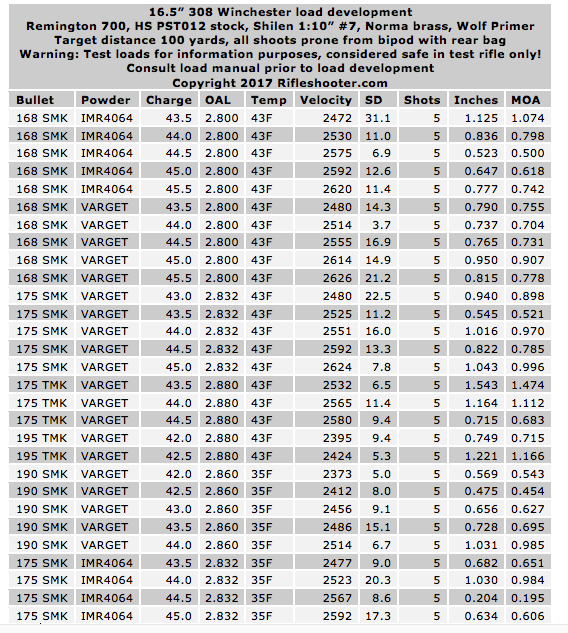
42.7gn of Varget gave me 2700fps with 175 SMK out of my 26’’, and keeping in 1/2 moa.
Fast forward 2-3 years later, purchased some 175GMM to test a new rifle for S&G, and decided to try it in my old .308 barrel. Was in the steady 5/8-3/4moa department, and exactly at 2700fps.

Never saw a .308 yet that didn’t like this recipe...
Lapua brass
175 SMK
42.7gn/43.0gn/43.3gn Varget load dev just to be sure but between 42,7/43,0 is often the sweet spot
CCI BR2
 
fWNDT9l.png
 
Get a reloading book and start from there.

Try to figure out a list of gears you need for reloading and understand why you need each items would help you on the theory.
 
If you come across the exact recipe let me know. I usually hate factory ammo. But the FGMM has always shot good for me. It's good stuff!
4064
Varget
4895 gets me close.
 
Its not unheard of for match ammo with a military history to use canister powders. Think 42-43 grains of IMR 4064.

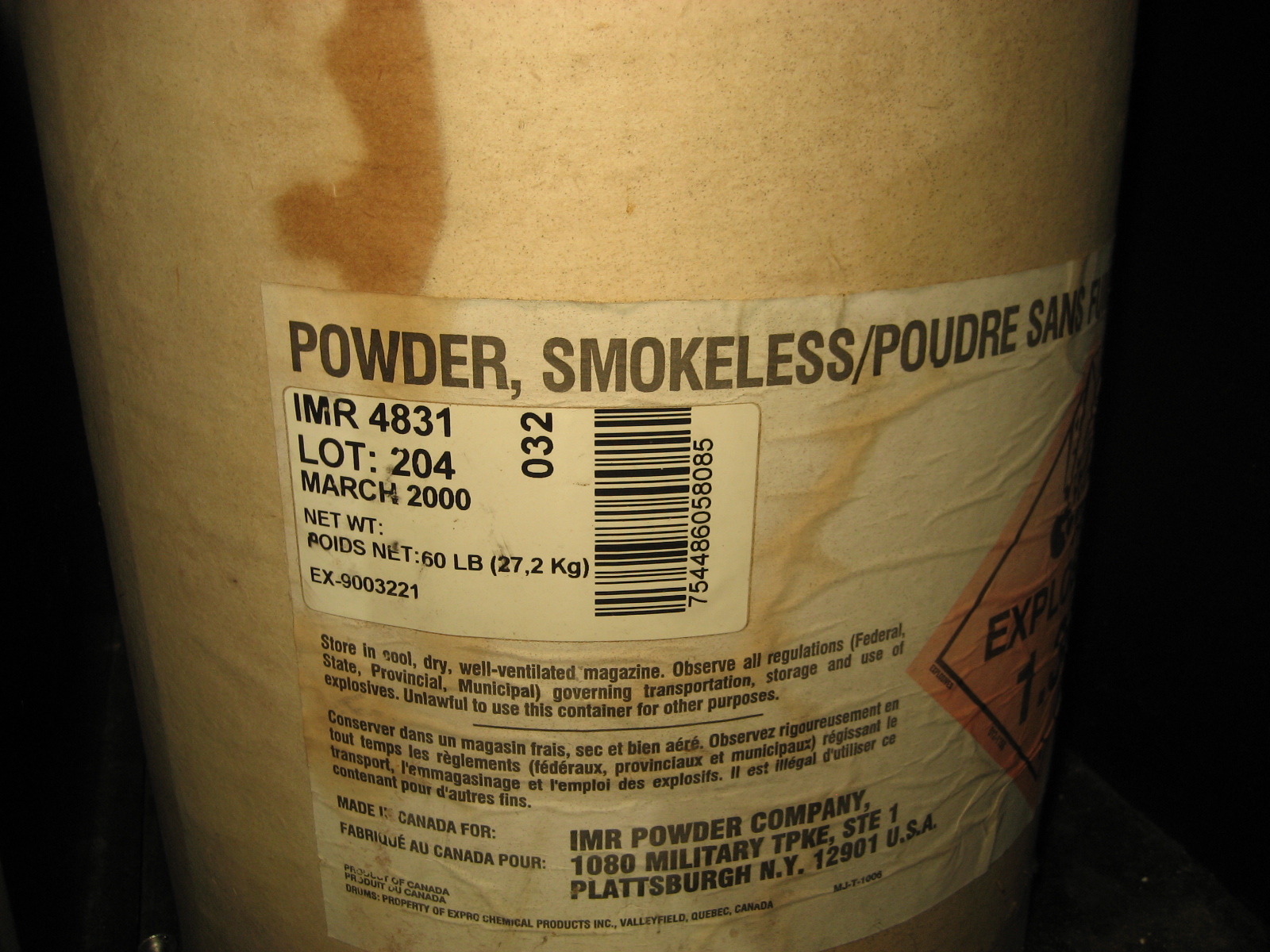
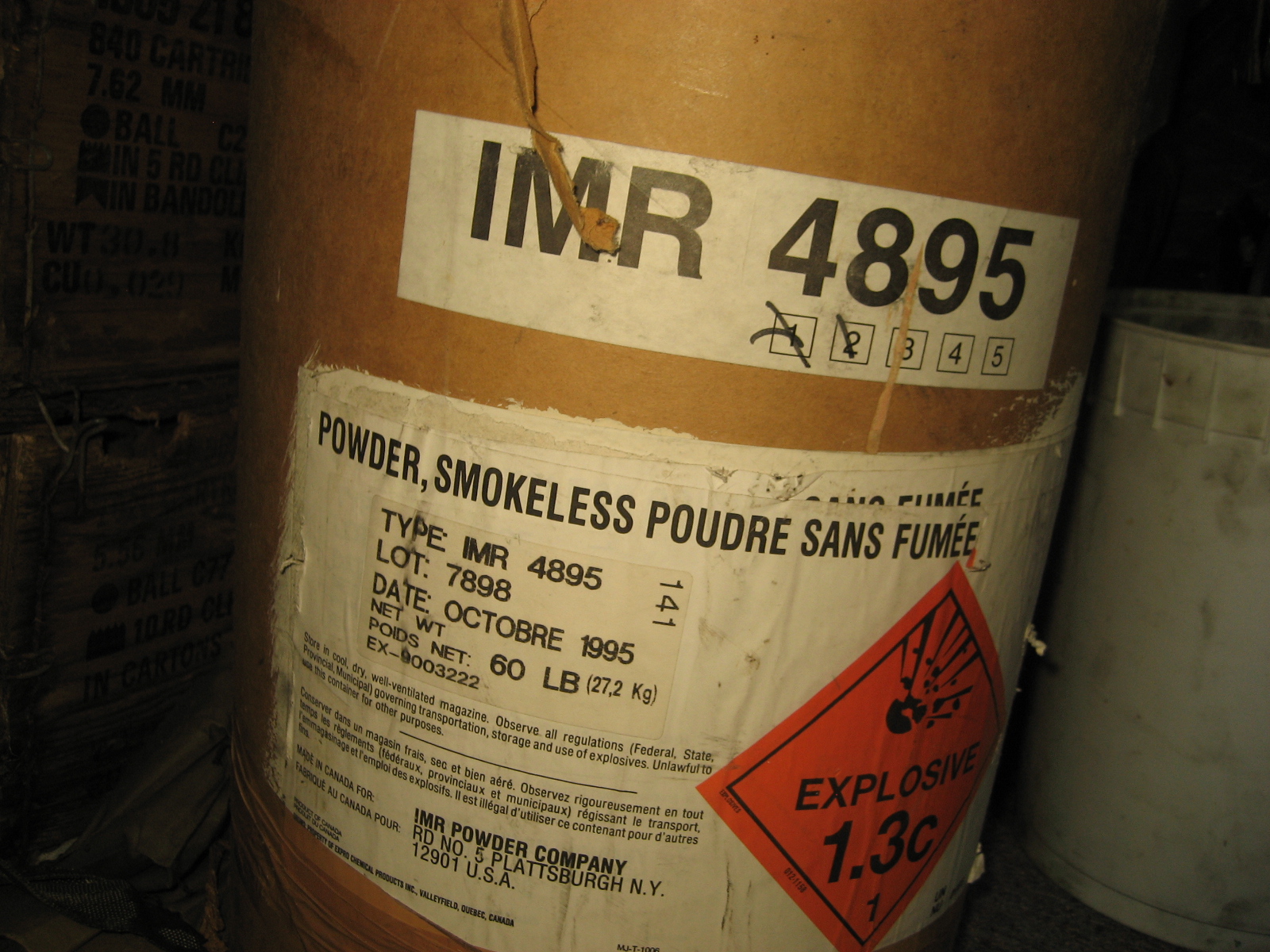
The factories buy powders like 4064 and 4895 by the ton. Each lot number comes with a spec sheet. Some lots are a bit fast. Some are a bit slow. And some are quite a bit faster or slower. It comes in 45 or 60 pound drums, like this:
BVHMH3v.jpg


It is 4831, but unlikely to be the same speed as the 4831 we buy at the local shop. The spec sheet will show how fast or slow it is.

YLUu6On.jpg


When the factory is planning a run of, say, 180 gr 308, they will ask the powder maker what is available in the quantity they need. They would prefer to buy all the powder in a single lot number.

The powder company might say "we have 6000 pounds of slow 4895" The name "4895" does not make it a canister powder. Each lot is tested, and a lot that meets the 'canister" spec is put aside for commercial packaging. For rifle, the ammo is loaded to specified velocity, so all that is required is a bit of load development to figure out what powder charge of that particular lot number yields the desired velocity. With the appropriate powder, it does not matter if the powder is a bit fast or slow, the target velocity can be reached within the pressure limits. Factory velocity is not at max.

I don't recall how the rifle powders were referred to, other than fast or slow. I do know that some powder lots were so fast or so slow that they over lapped the fast or slow version of the next powder.

I do recall that Red Dot was used for a lot of shotgun loading, and we had a choice of Red Dot 1, 2, 3 or 4. 1 was fast. 4 was the slow version. For shotguns it was more important to match the speed of the powder to the loading, as it was a way to control the wad column height.

They op should buy quality brass (Lapua is good) quality primers (I use CCI Match) and an appropriate powder (Varget or 4895 or 4064 or N140 or 150) and do a quick survey of powder charges. Something will stand out. The Federal ammo has proved that his rifle works. It is not difficult to get the Sierra 175 to shoot well. An excellent bullet choice.

 
Last edited:
Ganderite, in my limited experience With 308s (3 personal ones and 5 of friends), it is true that they ALL shot 175 SMKs well.

In my experience also, Federal GMM always shot on the slower end of the charts, and 42.7-43.0 gn of Varget got me close to GMM velocities in 2 rifles I have tested.
And in all 8 rifles tested, 42.7-43.0 we’re all sub 3/4moa accurate. Some like my match .308 shoots sub 1/2 with that load.

To me, when someone starts shooting .308 locally and ask me advice, I often point them towards 175 SMK and do a mini load dev from 42.7 to 43.3 of Varget. Find their at least 3/4 moa load within this, and if their hearts desire velocity, to get some testing done afterwards for
The higher node.

It’s nice to have a nice repeatable recipe you can fall back on if you want to go out and just plink really accurately.
 
I agree that certain loads tend to work well in many rifles.

My job used to include finding such a load.

The load I selected was always a bit mild because it had to work in the tightest rifle it would ever get used in. In those days the 308 target rifles often had barrels that were 0.3065". The Sierra bullet (as i recall) 0.3084"
 
The factories buy powders like 4064 and 4895 by the ton. Each lot number comes with a spec sheet. Some lots are a bit fast. Some are a bit slow. And some are quite a bit faster or slower. It comes in 45 or 60 pound drums, like this:
BVHMH3v.jpg


It is 4831, but unlikely to be the same speed as the 4831 we buy at the local shop. The spec sheet will show how fast or slow it is.

YLUu6On.jpg


When the factory is planning a run of, say, 180 gr 308, they will ask the powder maker what is available in the quantity they need. They would prefer to buy all the powder in a single lot number.

The powder company might say "we have 6000 pounds of slow 4895" The name "4895" does not make it a canister powder. Each lot is tested, and a lot that meets the 'canister" spec is put aside for commercial packaging. For rifle, the ammo is loaded to specified velocity, so all that is required is a bit of load development to figure out what powder charge of that particular lot number yields the desired velocity. With the appropriate powder, it does not matter if the powder is a bit fast or slow, the target velocity can be reached within the pressure limits. Factory velocity is not at max.

I don't recall how the rifle powders were referred to, other than fast or slow. I do know that some powder lots were so fast or so slow that they over lapped the fast or slow version of the next powder.

I do recall that Red Dot was used for a lot of shotgun loading, and we had a choice of Red Dot 1, 2, 3 or 4. 1 was fast. 4 was the slow version. For shotguns it was more important to match the speed of the powder to the loading, as it was a way to control the wad column height.

They op should buy quality brass (Lapua is good) quality primers (I use CCI Match) and an appropriate powder (Varget or 4895 or 4064 or N140 or 150) and do a quick survey of powder charges. Something will stand out. The Federal ammo has proved that his rifle works. It is not difficult to get the Sierra 175 to shoot well. An excellent bullet choice.


What I would do with a barrel like that of IMR-4895 And to answer the OP, it’s my go to for 308 and 223 at the moment. My favorite primers are Sellier & Bellot, and my favorite projectiles are Nosler. The fact they keep their load data so up to date and accessible is awesome and was of great help when I was just starting out reloading. Makes it a lot easier to try their products when you can look up those recipes at the store when you find a box of projectiles that are in stock. As far as brass new is so much easier but I learned a ton resizing random range brass.

 
I read and written this load down that the us army was using in oversees sandbox.
Imr 4064 41.745g/ 175g Sierra/ fed match case/gold medal match primer.
They were using varget before but load was to hot and causing issues other there
 
That 41.745 grains of IMR 4064 - any chance that is a typo? I have nothing that will weigh to .01 of a grain, let alone .001 of a grain - my scale does .1 grain - I suppose I could read the tip of the balance half way between two marks and call that .05? - would imagine they had to be cutting pieces of IMR 4064 kernels to achieve .001? - why I suspect (hope) that was a typo?
 
I read and written this load down that the us army was using in oversees sandbox.
Imr 4064 41.745g/ 175g Sierra/ fed match case/gold medal match primer.
They were using varget before but load was to hot and causing issues other there

The load may have been 4064, but it would not be a canister lot of 4064. The a non-canister powder could have been like slow 3031 or fast 4350. 41.7 suggests a fast lot. But it does tell you that you can make good ammo with 4064. It would fill the case nicely.
 
Last edited:
As what I read and written down as 41.745. For people like us 41.7 or 41.8 probably would not matter much. Especially way I shoot.
Never missed the barn from the inside but I have missed a few times when iam been on the outside
 
Back
Top Bottom