Record Keeping

Ian Robertson

CGN Ultra frequent flyer
Rating - 100%
16   0   0
Location
Nepean ON
I have been reloading for over 40 years and this simple thing has always escaped me. I would print labels to put in with the ammo and all kinds of different things. Finally the light bulb came on. I printed sheets with all the specs I need to be filled in. Three to a page so there is lots of room to write. Each batch gets a batch number based on the date and a number in order, ie 20151226-006. The actual ammo gets a sticker with only the batch number and the calibre. I am not keeping the different calibres separate at this point but I may consider this in the future. I have a pile of different calibres and load many thousands per year for many different guns. If I shot all of a batch I would cross it out in my book or keep track of quantity left. I really load only so I can shoot, it is not a big hobby to me but I do it a lot with casting etc.

If anyone wants a pdf of the sheet I created let me know your email and I will get it off to you. Of course all this could be computerized by making a fillable pdf and a bunch of other different ways. I may do this, I have plenty of computers kicking around.
 
That's a bit more than I do. On my computer I have a excel sheet with all the calibres I shoot and all the loads I have tried in them. Once I find a load I like, I simply make that the standard load for that calibre. No need to guess that way as I know that every time I pick up a certain calibre unless it is a test load (in which case it gets fired within a day or two and the results recorded), it will be the standard load I have decided on.
 
I find the big issue these days is to keep a standard load. Can't get my usual powder so I use something different etc. I like to keep an ammo can of the different pistol stuff on hand and then there is all the rifle stuff as well. I load about fifteen different calibres (at a quick count) and many of them have several different loads depending on the job at hand. 223savage, give me your email.

 
Where I lose it is keeping track of cases. Load a batch, shoot half of it, and then reload the spent cases from the original batch - it doesn't take long to end up with 6 containers of the same caliber brass.
 
x2 I can't keep track of how many firings ive done.. But I know ive gone through 1900 projectiles with 250 cases...

As much as I can, I try to get the tedious grunt work of brass prep (the cleaning, sizing, trimming, deburring, chamfering, priming...) done to my ENTIRE set at the same time. It may take a couple sessions over a couple days to complete the entire process, but I like to complete any particular procedure to ALL my cases at the same time. This typically happens over a couple evenings during the week.

Once my cases are prepped and primed and ready to go, I can just grab what I need to load up for an individual session. Spent cases get dumped into a container to wait for the rest of the set to be fired, and then it starts all over again. When I begin the next round of brass prep, I make a note that the set of brass has been fired one more time.

The only downside is that I have to keep pretty close tabs on my remaining supply of prepped brass, so I don't end up running out before a weekend I'm planning to shoot.
 
As much as I can, I try to get the tedious grunt work of brass prep (the cleaning, sizing, trimming, deburring, chamfering, priming...) done to my ENTIRE set at the same time. It may take a couple sessions over a couple days to complete the entire process, but I like to complete any particular procedure to ALL my cases at the same time. This typically happens over a couple evenings during the week.

Once my cases are prepped and primed and ready to go, I can just grab what I need to load up for an individual session. Spent cases get dumped into a container to wait for the rest of the set to be fired, and then it starts all over again. When I begin the next round of brass prep, I make a note that the set of brass has been fired one more time.

The only downside is that I have to keep pretty close tabs on my remaining supply of prepped brass, so I don't end up running out before a weekend I'm planning to shoot.

That was the biggest reason I would clean what I shot and reload for the next trip... I think once I start to add new brass I'll prep and leave them in 50 round containers. Doesn't matter if there is 1 or 40 left I won't start prepping until they all are ready to be done. I guess this will limit me to 50 round wet tumbles unless the brass is all the same firing (with same headstamp).
 
I tried different containers labeling boxes etc ..nothing seems to be workable and easy..

As much as I can, I try to get the tedious grunt work of brass prep (the cleaning, sizing, trimming, deburring, chamfering, priming...) done to my ENTIRE set at the same time. It may take a couple sessions over a couple days to complete the entire process, but I like to complete any particular procedure to ALL my cases at the same time. This typically happens over a couple evenings during the week.

Once my cases are prepped and primed and ready to go, I can just grab what I need to load up for an individual session. Spent cases get dumped into a container to wait for the rest of the set to be fired, and then it starts all over again. When I begin the next round of brass prep, I make a note that the set of brass has been fired one more time.

The only downside is that I have to keep pretty close tabs on my remaining supply of prepped brass, so I don't end up running out before a weekend I'm planning to shoot.

This is what I'm starting to do one cartridge type at a time. Easier to do the more brass you have. Gotta ease up on the gun purchases and focus on feeding the ones I already have. Brass for four different chamberings has been on the list for close to a year now so could be time to stock up.
 
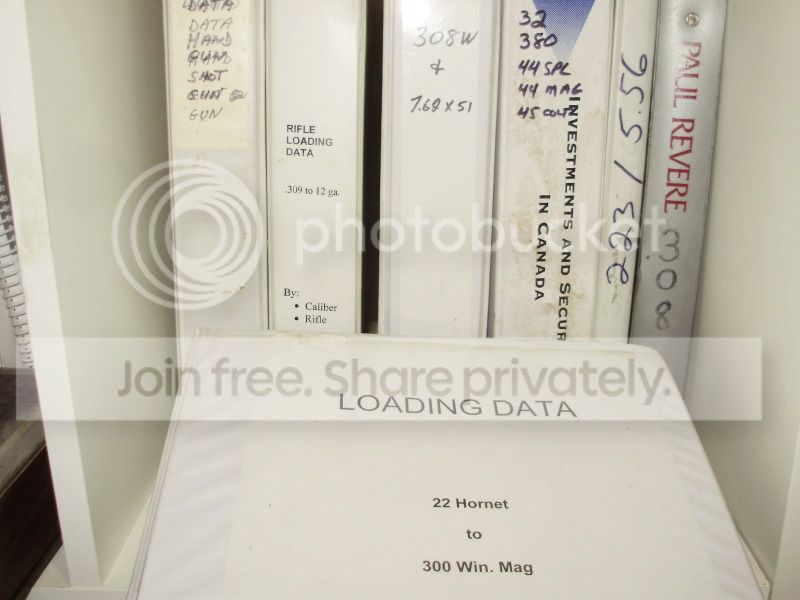
I have record a round count (and component configuration) of every round or batch of rounds I've reloaded since the mid 80's in a binder. Every caliber has it's own page and if I have more than one gun in that caliber (such as the 4 45-70's), they each have their own page. Some rounds are duplicates and never change but if I do change a component or volume I make a notation of the change, this way If I get a brainwave for a new load I can check back more than 20 yrs in some cases to see if I've already tried it or something similar.

I must have 15 thou brass sitting on benches beside my chair in the loading area in all sizes of containers from 5 gal pails (.38 sp & 45LC) to 5 lb coffee tins (mostly rifle), all only caliber specific, unless there is a gun that I know requires specially treated brass (length, neck sized only etc.) I just take as needed from their respective pails. No consideration as to number of times they individually get used, they are used until they tell me they are done (cracks). I have never had a case head separation in 45 yrs of rifle reloading. I usually find 3 or 4 pistol caliber cracked cases a year but can only remember a total of 3 or 4 rifle case neck's cracking over the years.
 
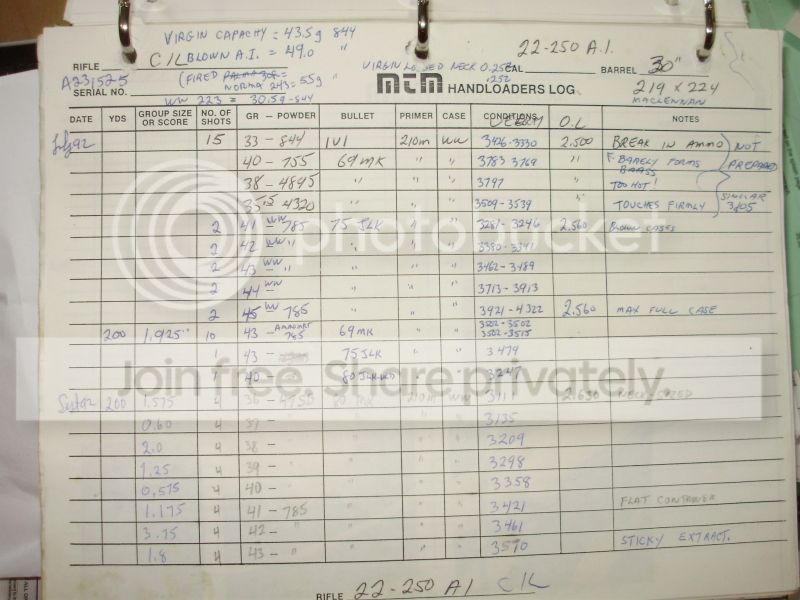
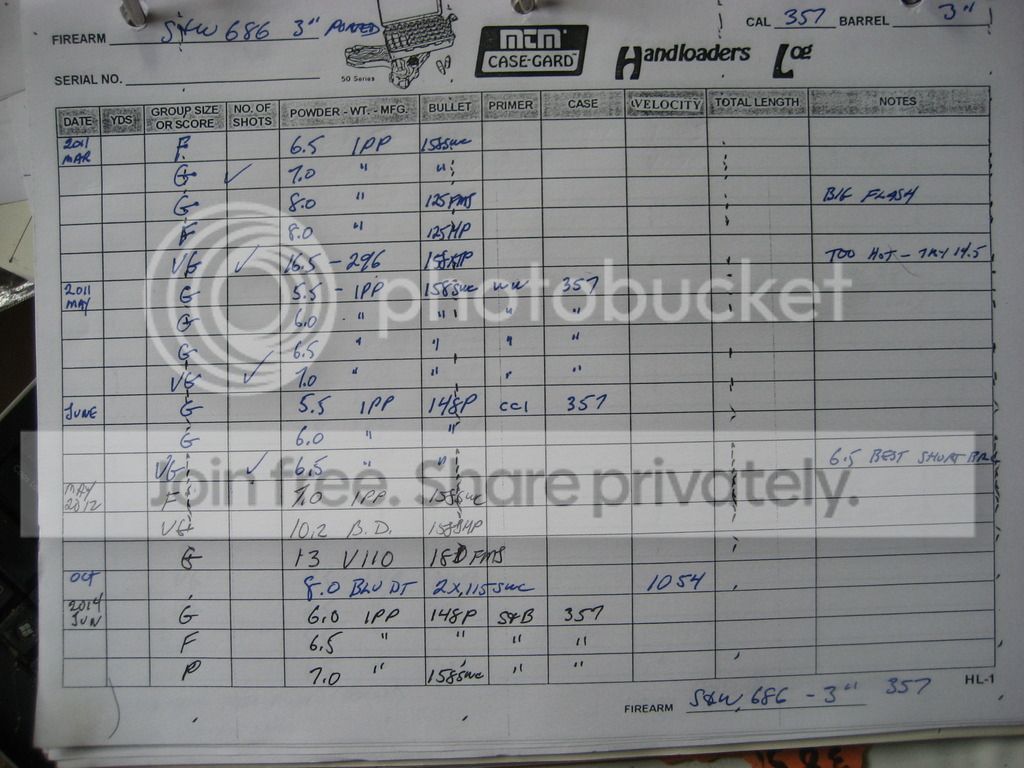
I'm using the MTM reloaders log and have been for years and have developed many loads for different calibers using this log book. It can be a real pain to sit down after a reloading session and record things like powder weight and type bullet make weight and type, case sizing, case length and bullet seating depth. I have missed vital info or neglected to write that info down only to forget that info when it's time to test that load. Now I take my time and have those shot targets organized with the reloading data so I can compare to previous tests. I also keep a running tab on how many rounds through each rifle. All this info is kept in a large binder and in my range bag.
I also keep a summery of these tests so I dont reproduce the same tests at a later date.
 
I load ammo into 50 round plastic boxes and label them with a strip of masking tape and a felt marker. I have plastic bins of 50 round boxes with some ammo left in them, and now realize that I have forgotten an important detail ( is if FL or neck sized) that I knew at the time I made and tested the ammo. I should design an Avery printed label to capture all the info.

The loading data get recorded in a binder. The binder has a page(s) for each gun. That is, the data is recorded by gun, not by caliber, because each gun reacts differently. Some binders are devoted to a single caliber, if I have a lot of guns in that caliber.

logbook2-1.jpg


For rifles, the log page would include the group size at a given distance. I prefer to test rifles at 500 yards, but sometimes only at 300.
logbook1-1.jpg


For pistols, I record the 20 yrad group as P, F, G, VG or VVG.
IMG_1348.jpg
 
Last edited:
I should that while my case situation is a bit of a mess, I use the PointBlank software to track loads. It does a great job - I print out the load data, fold it up, and stick it in with the cartridges. It also has a feature to input target data, but I use OTarget for that purpose.
 
hmm is there no app for that yet? I'm gonna scour the net and see whats available.

I don't trust technology, haha. A big magnet, or "software compatibility" is too much of a liability. The fellas that can pull load data up from 45 years ago seem to get around the firmware update, so that's the way I've started doing it. I've printed forms onto Write in the rain paper for added security.

Regarding the OP's batch information. I'm intrigued. My work life boils down to organizing project numbers (13-1447-0003, 1530421, etc) so I might try the batch approach.
 
Back
Top Bottom