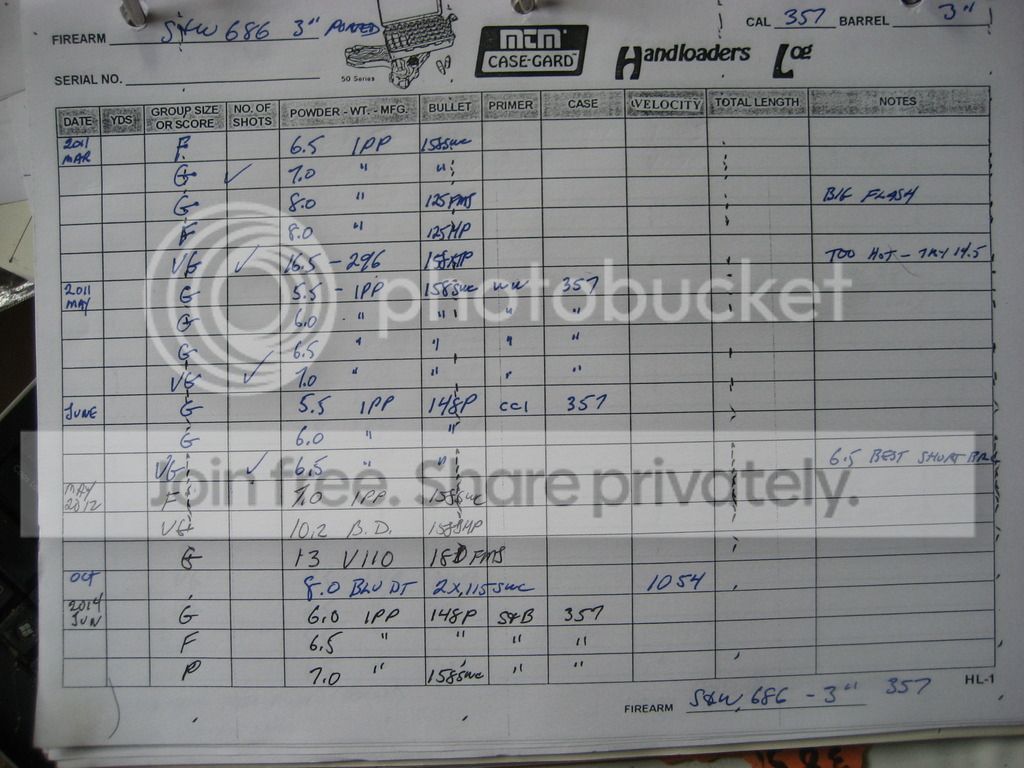
bearhunter, yes we certainly do each have our own methods and I do know who Ganderite is and some of his background and he knows who I am. I have also been know to do a bit of accurate work. My point was and still is that there is nothing more versatile than a pen. Even a stat that my seem unimportant today could be very important tomorrow. Why be constricted by a form or software that is not easily changed? I went looking through all the apps but I did not look at the pay versions. Every version I looked at seemed to be more a copy of the various loading manuals out there. I have no use for this and want a way to record my data my way. Problem with many "systems" is that they they will control you and you will not control them. There are many fine examples around us of the system controlling the user, not the other way around as it should be. I still am not sure why you started off by mentioning me. All I said was you could do a lot of varied record keeping with just a pen, as you seem to confirm above!
I agree completely. That's why I use the methods I do. Computer generated methods are fine for some things. It's when you decide to work outside the box. Usually I politely decline to let people look at my notebooks. Some people believe that because I have taken the time to write it down that it's all safe. It isn't and some of it was purely for educational purposes such as Kaboom tests on an Arisaka/K98/M96 and Remington 700 barreled actions. I could only Kaboom the K98 and M96Swede. The other two are still functioning rifles and still in use.
There are notes and stats and there are notes and stats. I mentioned that I really get in depth on the things that interest me. I tried to build a pressure rifle on one occasion It was unsuccessful. Didn't ruin anything after a lot of time machining components but I couldn't get consistent readings on anything. I even tried using an electronic load cell with a digital readout. Still to much variation to be dependable.
Records are very important. The thing is you need to know what you are recording, why you are recording it and how it all pertains to what you are trying to achieve with that particular rifle.
Let me give you an example. At one time not to long ago I had six heavy barrel varmit rifles that were factory made by six different manufacturers. CZ, Winchester, Remington, Savage, Ruger, Cooper. My Tikka has a different configuration with a #2 barrel form. I did include it in the test though so I guess that makes seven.
The purpose of the test was to take several different rifles, chambered for the same cartridge with similar depth leades and build on recipe that would be good for all with Hornaday VMax bullets. I wanted to try to make up loads for each of the 50-55-60 grain variants. I was hoping to be able to get away from weighing cases for consistency and stick with a similar OAL for all loaded rounds. Each of the rounds would have similar trajectories in each rifle and still be within suggested safe zones or slightly over max.
I did find a load for each that was acceptable form most of my purposes. It wasn't a wonder load or a hot load. It was a standard load used by the military of BLC2. It was for the 55grain A Max and used a magnum primer. Funny thing is, that same powder using the same charge was acceptable for all of the rifles. It was most accurate in the rifle I least expected it to be. All shot groups at 100yds at well below an inch so like I said that recipe is acceptable for most purposes.
Everyone of those rifles of which the only one I retain is the Tikka were capable of better consistent accuracy with custom loads.
It took weeks to get this all shot and down on paper. The main reason for taking so long was getting the right temperature and light conditions for all of the testing. Each rifle was shot around 500 times for verification with each load. When I say weeks, it took from mid May to mid September. I completely filled 7 notebooks by the time it was all done.
Even for me that is a lot of shooting. Biggest problem being it was all off the bench and two of the rifles were using the same scope. By the way, all of the rifles were scoped with 4-10 Leupolds VXIII. The only difference were the bases and rings. Most were Leupold but the CZ and Tikka required proprietary bases/rings.
What the testing did for me is verify that the commercial manufacturers have done their homework and likely far more extensively than I have. For me this was a revelation because it tells me that the factory velocities are a great place to start and that there are other concerns to worry about for extreme accuracy than some magic load recipe.
Like I said, each to his/her own. I record all mechanical changes from tweeking the torque settings on the receiver screws (yes it can make a huge difference) to scope changes/settings and trigger adjustments. Those usually go into a chapter of their own at the back of the book.
It's all about having fun. Sometimes we get to confirm what has already been confirmed albeit at great cost of money/time/materials. If you have something that works for you don't mess with it unless it no longer works. That's where the records come in the handiest.