Refinishing an Enfield... OK?

m3conversion

Member
Rating - 100%
53   0   0
Location
Calgary, AB
I just bought an no1 mk3 SHTLE (B.S.A. 1918), and I was contemplating giving it a bit of a refresher.

The wood seems a bit dingy and seems to have marks from the shaping process, the blueing is quite faded on some parts. There seems to be a piece of metal missing from just behind the nose cap and one of the barrel bands has been partially weakened from rust. Some of the screw heads are quite marred from use. There's cosmoline (I assume) baked onto some of the parts. The safety is missing and the butt pad has lots of little dings and scrapes.

What's the consensus on refinishing these Enfields? I assume going too far in the process might remove some of the collectors value, but is some refinishing ok?

Can I polish and then cold blue some parts?
Can I strip the finish from the stock and redo it? (linseed oil?)
Anyone know a good source for replacement parts?

Pics:
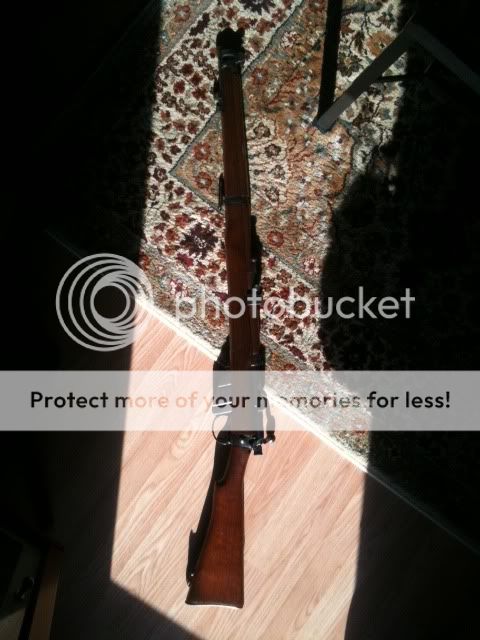
8.jpg

4.jpg

1.jpg

2.jpg

3.jpg

6.jpg

7.jpg

5.jpg

10.jpg

9.jpg
 
Leave the metal as-is. I wouldn't do anything to the wood beyond trying to raise any dents with steam and then going over it with steel wool and linseed oil. You could try Marstar or Trade Ex for a replacement safety and screws.
 
Refinishing

Is the date 1913 or 1918? It almost looks like a 3 and not an 8. If you have a pre-WWI (1913) SMLE, many people attach a premium to these pre-war rifles. The nose cap, trigger guard and cocking piece are early versions.

A replacement of something such as a barrel band with the SAME type would be considered acceptable for a collector's piece by most people. However major replacements or repairs, and especially stripping the finish off the wood and refinishing the wood will cut the value in about half. Some judicious cleaning of the metal and wood is acceptable, but the key word here is judicious. If you start at it with steel wool and sandpaper, then you are going to destroy much of the value.

Keep in mind that History is attached to these rifles. They went through four years of war, with mud and harsh conditions in the trenches. Those dings and scratches were honorably earned.

If you think you are going to make it look like new, forget it. Those collectors can spot a refinish job across the room at a major gun show, and the gun collecting fraternity is a relatively small one where many of the major collectors are friends and know each other. They will tell each other about the "refinished" Enfield fast enough.

So, some clean up and minor parts replaced - acceptable. A major clean up and refinish - no. And absolutely keep your hands off the cold blue!
.
 
kCold blue is great for touching up scratches, or for bluing.the end.of a fresh cut screw. Otherwise it is usualy the kiss of death for a collectable firearm. However, we are not talking fine antique collectable here. Your rifle does have some value, but nothing special about it. Believe it or not, it will retain more "collectability" if you just clean it up and make any repairs or replacements to get it in good working order. An original finish that is worn is more desirable to collectors than a pretty refinish. If you just have to blacken the metal, consider using high temp exhaust manifold paint. It will make things look spiffy, is durable enough for regular use and can be removed with.paint stripper further on up the road. The wood will benefit from a scrub with extra.fine steel wool.and boiled linseed oil. Dents and dings can be steamed out. Don't use sandpaper.
As for cost, it is easy to spend $300 on parts and finish to end up with a fine $250 rifle.
 
I guess what you have to answer is what is the intended and future use of this rifle? Did you buy it because it's a collectible, or did you buy it because its a Lee Enfield, renowned for it's durability and reliability? If you plan on flipping this gun in a couple years, don't bother refinishing it. If you plan on using it for the next 50 years and wish to pass it on the your children or grandchildren, I think it has more value as Dad's gun or Grampa's gun that it does as a semi-collectible, run of the mill Enfield.
If you do decide to refinish it, Boiled Linseed Oil is garbage as far as refinishing anything that is intended to be used. It is soft and permits moisture into the wood. Use 100% Pure Tung Oil and you will get an impermeable, durable and beautiful finish. Hand rub 8-10 coats and your run of the mill Enfield will not only last forever, but will have a beautiful finish to boot.

Well, that's my .02

Edit:
Linkiness for you pleasure:
http://www.leevalley.com/en/wood/page.aspx?p=20049&cat=1,190,42942
 
If it were my rifle, I'd do the following.

1. Disassemble and check for rust/pitting under the wood
2. Clean the wood with Murphy's Oil Soap. Gently!
3. The metal almost looks like it has glue or varathane on it. Especially the nose cap and magazine. I'd clean that off.
4. Replace the missing parts. Leave the slightly damaged parts as long as they function. (That dinged butt plate is from decades of square bashing!)
5. Linseed Oil for the stock and oil the usual spots on the metal.


Note: If that is varnish on the wood, I'd definitely strip it and refinish with Linseed as that is the correct finish.
 
i swear by tung oil i used it when i refinished my .303 but what even i do to it dont matter the value was already taken when it was sporterized. i would leave it just the way it is unless you can get original parts for it as for the dings and bangs leave em that is history
 
I have one just like yours. It's an Smle mkIII with a weird = sign beside the III. I decided to leave it original with the exception of the magazine. Mine looked like ass and I gave it a light stripping and re-blue. The metal didn't take the blueing very well and it came out looking period correct. Flukey luck. If you decide to re-do the oil finish, post some pics. I'm contemplating doing the same.
 
I think all are correct, If you're going to restore it, that's what it'll be restored and will lessen it's value. However if you're going to use it as a range gun I say go for it!:D Buy and or find the bits/ odds and sods you need as you come across them. Nothing more fun to me than going to the gun show to see if that "whatever" is there, and what joy when it is, and if you where able to haggle a fair price...well it just doesn't get any better IMHO. Tung oil may indeed be "better" but Enfields furniture was oiled both at the factory and in the field with "Raw Linseed" oil, which btw, looks and {more importantly to me} FEELS different. Besides Linseed oil has to be rubbed in time and time again, excess lovingly cleared from the stock only to prep for another coat. Anytime I get to fondle my Enfield it's a good day:D........Did I just get weird there for a minute?:p
 
You did well to leave it alone.

I have one just like yours. It's an Smle mkIII with a weird = sign beside the III. I decided to leave it original with the exception of the magazine. Mine looked like ass and I gave it a light stripping and re-blue. The metal didn't take the blueing very well and it came out looking period correct. Flukey luck. If you decide to re-do the oil finish, post some pics. I'm contemplating doing the same.

It is a good thing you did leave it alone. The "weird = sign" has a significance. It cancels out the *, and denotes that your rifle was reworked and upgraded after WWI, back to the original Number 1 Mark III standards.

A lot of these were done in India, during the late 1920s and early 1930s. I have one, a 1918 NRF rifle that was reworked and stamped like that. On the left side of the butt socket, low down near the cross screw that holds the trigger guard on, it is stamped "RFI 1929". The barrel is stamped "PR" for the Punjab Volunteer Rifles and the magazine is stamped 'RR" for the Rangoon Volunteer Rifles." Some retained the original makers name, and some were scrubbed a bit. Mine has the NRF markings on the rear of the action ground off when it was reworked.

These "two bar" rifles are scarce, and not really easy to find. It's a keeper, and should command a premium over the ordinary SMLE.
.
 
Thanks for your help guys! I had pretty much assumed this would be the response I would get. I'll probably just end up cleaning the wood and metal and then see how satisfied I am with it. I do want to find the missing pieces though. Doesn't seem like I can make things worse by putting them back :)

I'll post some pictures after cleaning and then we can compare the difference. I really don't know if it's be varnished, but there's definitely something on the nose cap and magazine. Lots of cosmoline in the trigger area too.

Also, it looks a lot more like an 8 in person but I'm not completely sure. If it is an eight, the marking is definitely more faint on one side.
 
Last edited:
Its your freaken' gun. You dont need to ask permission on the internet if you want to refinish. Knock yourself out.

Im about to commit "blasphemy" by having a a Winchester 94 armour coated.

He wasnt asking permission, he wanted to know if he would devalue his piece.

He was informed yes he would.

As for your Wincester 94, go ahead, we need people to butcher some so the originals are worth more....lol but I wont scold you for it.
 
He wasnt asking permission, he wanted to know if he would devalue his piece.

He was informed yes he would.

As for your Wincester 94, go ahead, we need people to butcher some so the originals are worth more....lol but I wont scold you for it.

Actually, I would leave it alone, except the finish is so damn terrible it rusts just looking at it. Winchester screwed the pooch on that gun. Im anal about proper maintenance but this gun has me defeated. Might as well armour coat it and use it for what its meant for.
 
I just "freshened" my 1950 LongBranch target rifle. I carefully stripped it down, cleaned the metal and used CIRCA 1850/OOOO steel wool on the wood. The original bluing was of course not touched, nor was the wood sanded..........the result was worthwhile. As for replacing the worn parts, I'd say go for it, so long as you take the time to search and obtain a replacement that mirrors the style & mfg code/stamp as your original parts. It appears from your picts, this piece hasn't seen sandpaper used on it previously.....always nice to see !
 
Could that "missing piece of metal" be the piling/stacking swivel? They were deleted in service but you could always fit one if you wanted to. You will also need the screw.

I would have no problem steaming out the dents in the wood (avoiding any stampings) and giving it a few coats of linseed or Tung oil, (your preference, but linseed was what they used.) You DO want to kill any live rust. the finest grade of steel wool should remoive the rust without affecting any remaining finish. It definetly needs to be stripped down to catch any corrosion under the wood.
 
Back
Top Bottom