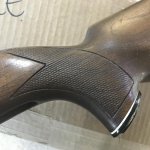
Refreshing existing checkering

DGY

CGN Ultra frequent flyer
Rating - 98.2%
55   1   0
Good day all! I’m refinishing an old sporterized Mauser stock and I want to recut/refresh the existing checkering and wanting to know what is the best approach to do so? I don’t have checkering tools yet and I want to know what would I need! I read that for this, one could/can use a single line cutter, thoughts?
All advices are welcome !
Cheers
 
I am facing similar - never done anything like that yet. Had read there are two angles of cutter used - 60 degree and 90 degree - so need, probably, to start with correct angle cutter? I have an older Parker Hale stock - well worn, but can still see the lines - I am quite sure it was old school British "flat top" checkering, so likely different than yours, if yours has or had "pointy" checkering in there.
 
From what I was told by an old-timer who re-did a bunch of my English guns & rifles, who, sadly, is now no longer with us, start the first line with a single-point cutter to get the first line in, then use a dual-point cutter, which will follow the first line you've made / re-cut, ONLY if the pitch exactly matches your dual-point cutter, which, he said, he never saw on an English hand-chequered firearm. Kinda goes along with this:

https://www.brownells.com/guntech/recutting-checkering-on-gun-stocks/detail.htm?lid=10575
 
So here is the entire thing I’m working on…. Inherited small ring mauser 98 8x57 from my dad, he bought it he was 16 and now he’s 80. I sent the bbl action to Gary Flach to get inspected(head space etc) and installed a new double set trigger assembly, the rifle use to sport one but the set trigger was gone! Then he modified the bolt handle to a nice butter knife handle!

Then I decided to put a cross bolt and rework the stock a little!
I ordered a classic red recoil pad and spacers to finish it up!!
Just need to find a good old 4x German #1 reticle German scope to top it up when I’m done!
https://photos.app.goo.gl/D7RT9RxrcpHEh5mS9
 
We might be using different words - as mentioned, I know next to nothing about doing this. I think your checkering in your picture might once have had "pointy" tops to it. The picture below is what I am referring to - is on a Parker Hale rifle, like 1950 or so - action is a military 98 with thumb cut-out - receiver is stamped "Safari De Luxe". I do not think these were ever "pointy" tops, even when new??

57BE039F-0A24-4666-8AE3-ADEBD651498B_1_201_a.jpg
 

Attachments

  • 57BE039F-0A24-4666-8AE3-ADEBD651498B_1_201_a.jpg
    57BE039F-0A24-4666-8AE3-ADEBD651498B_1_201_a.jpg
    73.1 KB · Views: 372
I see KV Woodcarving Supplies (in Canada) is out of stock on the Dem-Bart master set.
They don't even have single handled separate cutters.
I'm not sure where you could get them beside in the US.

8JLU5st.jpg


If you do find a set thinking I would start with 60°.
See how that looks.
Using a 90° might take away from the "flat checkering" look too much.
 
From what I was told by an old-timer who re-did a bunch of my English guns & rifles, who, sadly, is now no longer with us, start the first line with a single-point cutter to get the first line in, then use a dual-point cutter, which will follow the first line you've made / re-cut, ONLY if the pitch exactly matches your dual-point cutter, which, he said, he never saw on an English hand-chequered firearm. Kinda goes along with this:

https://www.brownells.com/guntech/recutting-checkering-on-gun-stocks/detail.htm?lid=10575

Great info!! So single line cutter has to be from what they say!
 
We might be using different words - as mentioned, I know next to nothing about doing this. I think your checkering in your picture might once have had "pointy" tops to it. The picture below is what I am referring to - is on a Parker Hale rifle, like 1950 or so - action is a military 98 with thumb cut-out - receiver is stamped "Safari De Luxe". I do not think these were ever "pointy" tops, even when new??

View attachment 566213

You are right, if I looked carefully in some area that were not worn, you can clearly see the diamond tops!
 
I see KV Woodcarving Supplies (in Canada) is out of stock on the Dem-Bart master set.
They don't even have single handled separate cutters.
I'm not sure where you could get them beside in the US.

8JLU5st.jpg


If you do find a set thinking I would start with 60°.
See how that looks.
Using a 90° might take away from the "flat checkering" look too much.

Yeah I think it might be a USA purchase!
Or maybe a used set….
 
I found a useful tool is the "Jointer" made by Gunline. Its a long single line cutter with coarser teeth than a regular checkering cutter. Its easier to keep lines straight because of the cutters length and the coarse teeth are easier to clean any old gummy stock oil out of than a regular checkering cutter. Be careful with a long cutter coming up to borders - its easy to run the cutter over the border because of the curvature of the stock.
 
My Le Fever Nitro 20 gauge double has the flat checkering gun dates back to 1936. I use a little True Oil brushed in to harden up the checkering and use a single line cutter to clean things up . I read some where that Dembart is out of business
 
Last edited:
That was definitely english style flat top .Use a toothbrush and paint remover to clean out the grooves.60 or 90 degree cutters will widen the channels .You can make your own tools if look at Monty Kennedys book on checkering.I will try and send you some pictures from the book.
 
Not the best pic, but here's one of my early attempts at restoring some worn out flat checkering with just a 60° straight cutter.
I tried to follow the lines that were visible without making too many new ones. Lots of the lines I couldn't make out at all.
Not perfect by any means, but I'm okay with that.

jwgs3Eq.jpg
 
I have done enough "salvage" checkering, to be able to tell you, you should get your best 'Zen' feelings on, get set up in a comfortable and well lit area, and take your time at it, or you may regret ever having started! :p

As someone suggested in another thread on the subject, you could pay him a hundred bucks, and he'd kick you in the family jewels, it'll be cheaper in the long run, and less painful! LOL!

Trying to cut too much, too deep, and too fast, were the bugaboos. Best results came from carefully following the line, and as it became deeper and more cleaned up, move to the next, and repeat as require over the whole area to be done, paying particular attention to the ends of the cut lines, as over-runs are hard to hide. Figure on going over the whole pattern three or four times, rather than taking the line to depth before moving to the next one.

As per above, a multi line cutter, is only good if it exactly matches the existing lines. Otherwise, with each line being pushed over away or nearer than the original spacing, you will eventually reach a point where the cutter is trying to cut across the tops of the diamonds, and it'll leave a pretty ugly scar.

Kennedy's book shows a couple different styles of home made cutter. Another option, if you are at all handy as a metalworker, might be to head over to Youtube, look up a fella named Clickspring, and watch his video on making your own files from scratch.

A couple tools I found really handy, were three square and four square needle files. I bought the cheapest coarsest ones I could find. Three Square files are triangular, equal to a 60 degree angle. The Four Square files, are actually Square, and 90 degree angle. I broke the tapered tips off the ones I used for starting a line and for creeping up on the end of the pattern edge. With either three or four cutting surfaces at your disposal, they lasted a fair while before they got bunged up or dull, at which point, I just snapped off the last wee bit, and carried on.

 
I have a couple rifles with checkering that I'd like to refresh well rifle stocks a Parker Hale number for Mark 1 Sporter beautiful rifle a cooey 750 rabbit engraving and another unknown, strange like it was carved from a tree and dried wrong, probably my dad's work haha
 
Back
Top Bottom