Reloading for a semi auto

The rotational swipe on the base of the case is caused by the bolt rotating while the case is still gripping the chamber walls. The amount of pressure is governed by the location of the gas port and the diameter of the hole in the barrel. By adjusting the gas port you lower the amount of gas trying to open the bolt. Many reloaders adjust the gas port so the empty case falls at a given clock position on the ground. The amount of gas will determine if the case is thrown forward or to the rear from the 3:00 position on the ground.

You can still get swipe marks on the case in bolt action rifles, caused by overpressure. How can you tell if this isn't the case here?
 
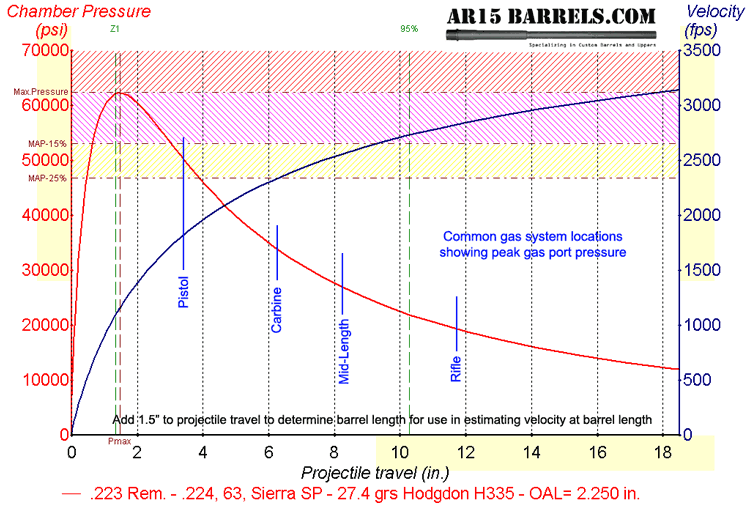
Port pressure is governed by the location of the gas port and the burning rate of the powder. Meaning the slower the powder the higher the port pressure.

On the AR15 16 inch carbine I built I used a mid length gas system. This greatly reduces the pounding the rifle takes when fired and why they also make adjustable gas blocks.

223plot.gif
 
I understand how adjusting the gas block, and therefore the pressure, changes how vigorously the action is cycled, but how does that change bolt swipe? By the time the gas reaches the gas port, the brass has already flowed into the ejector channel.
 
You can still get swipe marks on the case in bolt action rifles, caused by overpressure. How can you tell if this isn't the case here?

Go back and read my postings, there is a reason why the military uses harder brass in their ammo

Soft brass begins to flow at lower pressures and a good reason to measure base expansion just above the extractor groove.

Simple Trick for Monitoring Pressure of Your Rifle Reloads
http://www.hodgdonreloading.com/reloading-education/tips-and-tricks/simple-trick-monitoring-pressure-your-rifle-reloads

The above is a ballpark pressure guess just like looking at your primers because of the difference in brass hardness in the base.
 
I understand how adjusting the gas block, and therefore the pressure, changes how vigorously the action is cycled, but how does that change bolt swipe? By the time the gas reaches the gas port, the brass has already flowed into the ejector channel.

You need to carefully read what I have posted here already, that question has already been answered, and your making my two dyslexic typing finger very tired by not reading.
 
You need to carefully read what I have posted here already, that question has already been answered, and your making my two dyslexic typing finger very tired by not reading.

Maybe you should try re-reading what I wrote; I am talking about ejector swipe, not a ring around the case head.

How can adjusting the gas block stop brass from flowing into the ejector. Answer: It won't.
 
The rotational swipe on the base of the case is caused by the bolt rotating while the case is still gripping the chamber walls. The amount of pressure is governed by the location of the gas port and the diameter of the hole in the barrel. By adjusting the gas port you lower the amount of gas trying to open the bolt. Many reloaders adjust the gas port so the empty case falls at a given clock position on the ground. The amount of gas will determine if the case is thrown forward or to the rear from the 3:00 position on the ground.

On the M1 Garand the gas port is located at the end of the barrel and the bullet has left the barrel before the op and bolt even begins to moves.

If the case is over resized with too much air space between the rear of the case (head clearance) the case is slammed back into the bolt face and leave a imprint of the ejector.

If the brass is softer it can flow into the ejector hole creating a even bigger swipe mark.

Below is a Lapua case fired in a bolt action and the brass flowed into the ejector. This is a very clear sign the load is to hot causing brass flow into the ejector and over 70,000 psi. The only brass harder than Lapua is military brass and if the case was as soft as Federal brass the brass flow would been far more.


index_zpsaiocbozg.jpeg

Like I said you did not read all my posts I provided or read my very first post or the link I provided.

Case-Head Swipe
https://www.shootingillustrated.com/articles/2011/4/12/case-head-swipe/
How can adjusting the gas block stop brass from flowing into the ejector. Answer: It won't.
"When a high- or over-pressure load is fired in a bolt-action rifle, cartridge brass flows into the ejector recess. The result is a bright mark on the cartridge-case head.

With CHS, the marks come from the ejector and extractor cutouts in the bolt face. It can be an indication of high pressure, that your rifle is not timed for the load you're shooting, or both. When a cartridge is fired in an AR, the case expands and fuses itself to the chamber until pressure drops and it springs back to near-unfired size. As the bullet passes down the barrel, it is followed by gas pressure. When the bullet passes the gas port, gas vents into the port where it is diverted to the gas key on the bolt carrier. Pressure remains high and gases are diverted until the bullet exits the barrel.How can adjusting the gas block stop brass from flowing into the ejector. Answer: It won't.

The time it takes the bullet to travel from gas port to muzzle exit is called "dwell time." Carbine- and rifle-length barrels have different length gas tubes to optimize dwell time. If too much pressure passes through the gas tube, or if the dwell time is too long, the bolt carrier starts rearward travel before the case lets go of the chamber. As gas forces the bolt carrier back, the bolt begins to rotate and move forward in the bolt carrier while the cartridge case is still under pressure and being pushed back against the bolt face. This premature rotation causes CHS. In essence, the edges of the ejector and extractor cutouts in the bolt face scrape the hot and malleable case head, creating bright marks and even burrs. In a perfect world, the bolt lugs won't start to unlock (rotate) until the bullet has left the muzzle and the case has released its hold inside the chamber."


Bottom line, the over gassed bolt rotates while the rear of the case is being forced by chamber pressure hard into the bolt face. And this causes the swipe mark, and if the load is too hot more brass flows into the ejector and you have a more pronounced swipe.


Hey guys, just curious about previous experience with reloading for a semi. I'm getting obvious pressure signs in my brass, or at least what I thought was pressure signs. (rings around brass by primer pocket, primer flattening and in some cases ejector marks).

I normally thought this was a slam dunk pressure signs, but where I am having a problem deciphering is that the this loaded ammo is super accurate(sub moa) and I'm getting the EXACT same pressure signs on factory ammo/brass. I'm wondering if my XCR is just hard on the brass... ... Also food for thought my powder charge is way lower than the max specified by the powder manufacturer(IMR) and only .8 gr higher than recommended by the hornady manual(which is still lower than some other manuals)

Thoughts?

You admitted you don't know much about semi-autos, so why are you getting bent out of shape on a subject you know little about.

Not an expert on semi autos, but how can the gas setting cause high pressure signs in the brass? Peak pressure is reached when the bullet is only a couple of inches down the barrel, how does adjusting a port at the end of the barrel affect pressure?

If you had read everything I posted you wouldn't be asking all these questions. The links I posted were not my opinion and are a well known fact. (if you read about it)

Maybe you should try re-reading what I wrote; I am talking about ejector swipe, not a ring around the case head.

How can adjusting the gas block stop brass from flowing into the ejector. Answer: It won't.


My best guess since it happens with factory ammo is the rifle is over gassed or he is using soft brass or both. I hope the OP reads this information more carefully than you did.

Have a nice day.
 
Last edited:
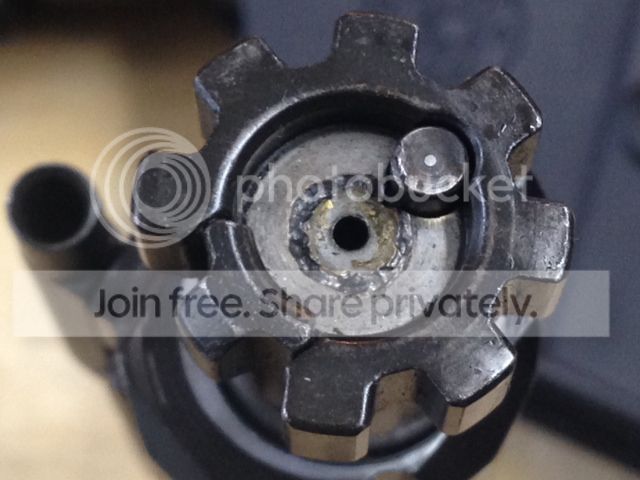
going over all of this with a fine tooth pick and comb to try and figure this out... food for thought I took apart my rifle today for a good cleaning and took a picture of the bolt face...


That outer ring on the bolt is what is causing the imprint on the brass. I'm thinking I may have had some loads in the past when I was working up that were too hot and may need a new bolt? The rifle still functions completely fine but im thinking the rounds are too hot that ive loaded previously and now the bolt is indenting all of the brass i use...

Thoughts?
 
Are those pits at the 12:00 and 2:00 position on the bolt face in your photo?

If the primer ruptured at the edge it could be from high pressure or excessive shoulder bump letting the primer back out too far out of the primer pocket.

Do the spent primers look like mushrooms, meaning bulged around the outer edge.

Use a Q-Tip and rub around the edge of the ejector cutout, if the cotton pulls off you have sharp edges that are grabbing the rear of the case and causing the swipe mark.

If the ejector cutout has a bur you can stone the edges with a fine stone yourself and fix the problem.


NOTE, your Photobucket account is not set on private, I clicked on your photo above and could see all your photos.

P.S. Your Remington 700 locking lugs are not making very good contact, don't feel too bad they also look like my 700 lugs.
 
Last edited:
Are those pits at the 12:00 and 2:00 position on the bolt face in your photo?

If the primer ruptured at the edge it could be from high pressure or excessive shoulder bump letting the primer back out too far out of the primer pocket.

Do the spent primers look like mushrooms, meaning bulged around the outer edge.

Use a Q-Tip and rub around the edge of the ejector cutout, if the cotton pulls off you have sharp edges that are grabbing the rear of the case and causing the swipe mark.

If the ejector cutout has a bur you can stone the edges with a fine stone yourself and fix the problem.


NOTE, your Photobucket account is not set on private, I clicked on your photo above and could see all your photos.

P.S. Your Remington 700 locking lugs are not making very good contact, don't feel too bad they also look like my 700 lugs.

Yes they are pits. I'm beginning to think I loaded a couple rounds too hot and it damaged the bolt. the outside circle indentation on the bolt is what is mainly marking the factory brass i fire, so im thinking its just a damaged bolt. Thoughts?

Also thanks for the tip on photobucket...
 
Yes they are pits. I'm beginning to think I loaded a couple rounds too hot and it damaged the bolt. the outside circle indentation on the bolt is what is mainly marking the factory brass i fire, so im thinking its just a damaged bolt. Thoughts?

Also thanks for the tip on photobucket...

The pits on the bolt face are from gas leakage from either the primer rupturing at the outer edge or leakage around the primer.

So again, you said you are getting the same signs with factory ammo so my guess is soft brass in the base of the case.

Buy some military type 7.62 ammo or load some Lake City 7.62 ammo and see what happens. Also remember that Lake City and other military cases are thicker and should be loaded with two grains less powder than the manual for the same pressure.

Bottom line, shoot some cases with harder brass and check the results, you are not the only person who has had this very same problem. Soft brass in my AR15 does the same thing. ;)
 
The pits on the bolt face are from gas leakage from either the primer rupturing at the outer edge or leakage around the primer.

So again, you said you are getting the same signs with factory ammo so my guess is soft brass in the base of the case.

Buy some military type 7.62 ammo or load some Lake City 7.62 ammo and see what happens. Also remember that Lake City and other military cases are thicker and should be loaded with two grains less powder than the manual for the same pressure.

Bottom line, shoot some cases with harder brass and check the results, you are not the only person who has had this very same problem. Soft brass in my AR15 does the same thing. ;)

Fair enough! Thank you so much for your input. I haven't been swaging the brass I've been reaming it so I'm thinking that may play a role too, couple that with the match primers I think I may have my culprit...

Thanks again!
 
Fair enough! Thank you so much for your input. I haven't been swaging the brass I've been reaming it so I'm thinking that may play a role too, couple that with the match primers I think I may have my culprit...

Thanks again!

I use the reamer made for the RCBS case prep station below, it only removes the crimp and bevels the mouth of the primer pocket. And it does not touch the inside walls of the primer pocket.

RCBS Trim Mate Case Prep Center Military Crimp Remover Large
http://ads.midwayusa.com/product/594559/rcbs-trim-mate-case-prep-center-military-crimp-remover-large?cm_mmc=pf_ci_google-_-Reloading+-+Metallic+Reloading+Equipment+(Not+Presses)-_-RCBS-_-594559&gclid=CJDj7aClzdACFQxMDQodgMALqw

I then use pin gauges to check the diameter of the primer pocket to make sure it is at least .0005 smaller than primer diameter.

And if the primer feels loose during seating I check it with the Lee depriming tool that is used with the Lee Loader. And if I can move the primer with just finger pressure the case goes in the scrap brass bucket. I just hold the base in one hand and push with my index finger on the same hand. If the primer moves at all the case is scrap.

p-199.jpg


The above may sound like a lot of work "BUT" I also load or my sons AR15 and dad isn't going to be blamed for a etched bolt face.

Below, image from ar15.com by someone who didn't check for oversize and loose primer pockets.

photo2.jpg
 
Back
Top Bottom