












































You are using an out of date browser. It may not display this or other websites correctly.
You should upgrade or use an alternative browser.
You should upgrade or use an alternative browser.
Reloads didn't fire??
- Thread starter Suther
- Start date

Those all look like weak primer strikes to me. Why don't you check the firing pin protrusion?
How does one check such a thing?

How does one check such a thing?
Yes. This.
And if it's bad, how do I fix it?


Yes. This.
And if it's bad, how do I fix it?
Twist the cocking piece on the rear of the bolt so it drops into the cam. That will push the firing pin out the front of the bolt. Use the depth feature on your caliper and measure to the tip of the firing pin, and the boltface. The difference is the protrusion. On a normal Savage it is adjustable, I don't think it is on an Axis.
Twist the cocking piece on the rear of the bolt so it drops into the cam. That will push the firing pin out the front of the bolt. Use the depth feature on your caliper and measure to the tip of the firing pin, and the boltface. The difference is the protrusion. On a normal Savage it is adjustable, I don't think it is on an Axis.
When/if you do this Suther, it would be interesting to see some pics. Just for interest's sake.
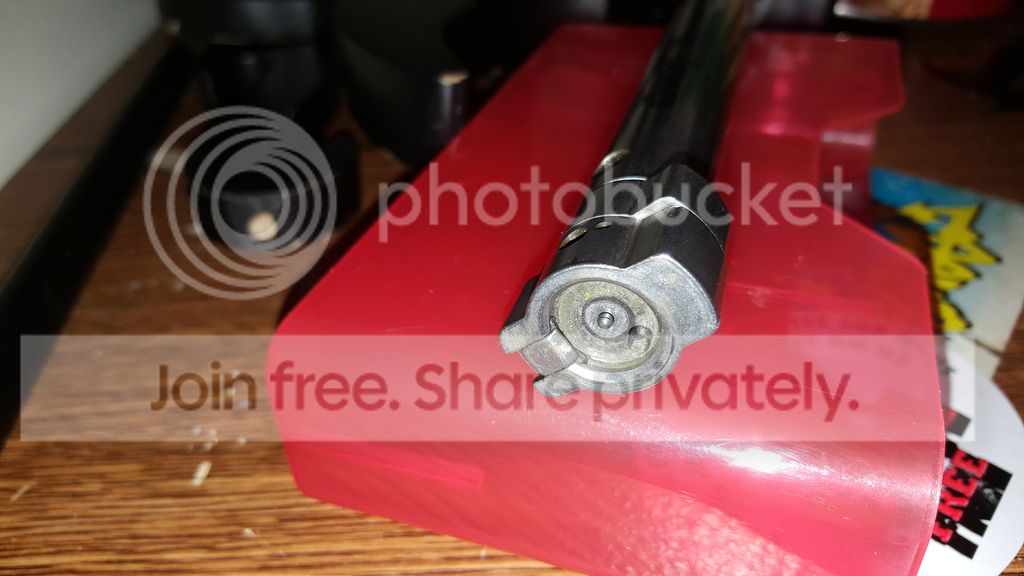
Checked pin protrusion. 0.119 to the bolt face, 0.055 to the top of the pin, for a total protrusion of .064. Here is what the bolt looks like with the pin out.
I have a biology final in a few hours, but when I get home, I am going to bust out the calipers and measure some cases, see how much difference there is between fired and sized cases...

I have a biology final in a few hours, but when I get home, I am going to bust out the calipers and measure some cases, see how much difference there is between fired and sized cases...
Last edited:
I had rounds fail to shoot when I was wet washing cases without first depriming. Also, letting dry isnt good enough, especially for a primed case. Water stays in and contaminates the primer/powder.
Now, I deprime first, then wet clean, then oven dry 200f for an hour. Never had an issue since.
Now, I deprime first, then wet clean, then oven dry 200f for an hour. Never had an issue since.
I had rounds fail to shoot when I was wet washing cases without first depriming. Also, letting dry isnt good enough, especially for a primed case. Water stays in and contaminates the primer/powder.
Now, I deprime first, then wet clean, then oven dry 200f for an hour. Never had an issue since.
Again, they were washed months ago. They were also swabbed inside with a qtip after drying in the sun for a few hours. Furthermore, the primers went off when hit with a hammer, so they were still functional.
I just bought a box of federal primers. I'm going to load up another 20 rds and see if they all fire next week... measurements of cases to come in a bit...
Okay, I've measured three cases, one twice-fired case, the last misfire I had, and a factory Remington 150gr core lokt.
......................................Factory Rem..........Misfired reload.........twice-fired case.......... Proper specs (as per Lyman 48th manual)
top of shoulder...................2.172....................2.150......................2.160................................2.156
Bottom of shoulder.............1.960....................1.945......................1.945................................1.948
The factory Rem case has somewhat rounded edges to the shoulder, whereas my sized cases have a more distinct transition so my measurements on the Rem might be less-than-perfect.
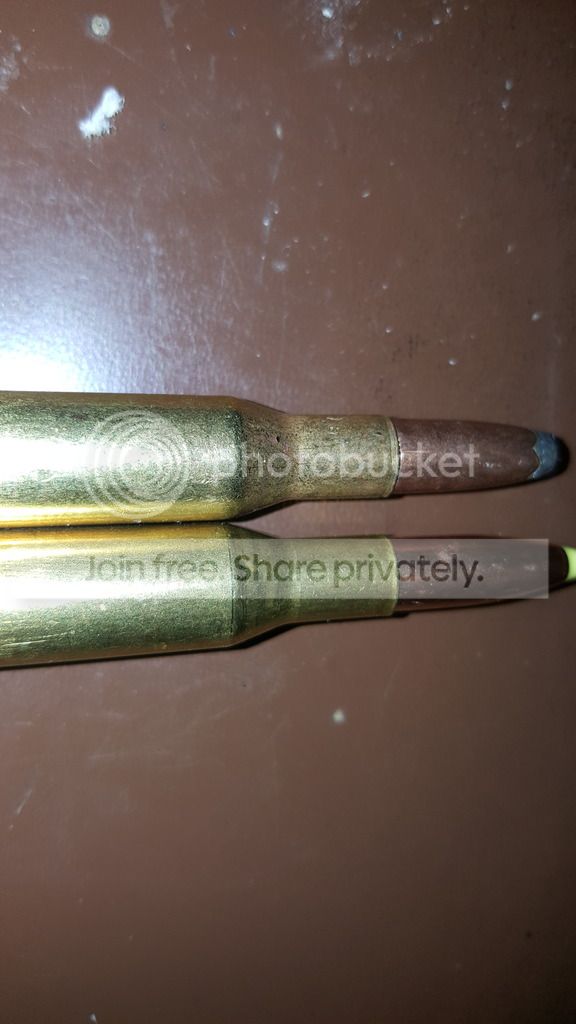
Would 6 thousandths in shoulder length be enough to cause missfires (difference between specs in the Lyman manual, and the sized cases)? Or do these numbers look like normally sized cases and should be fine?
......................................Factory Rem..........Misfired reload.........twice-fired case.......... Proper specs (as per Lyman 48th manual)
top of shoulder...................2.172....................2.150......................2.160................................2.156
Bottom of shoulder.............1.960....................1.945......................1.945................................1.948
The factory Rem case has somewhat rounded edges to the shoulder, whereas my sized cases have a more distinct transition so my measurements on the Rem might be less-than-perfect.

Would 6 thousandths in shoulder length be enough to cause missfires (difference between specs in the Lyman manual, and the sized cases)? Or do these numbers look like normally sized cases and should be fine?
Well - The headspace datum is somewhere in between the top and bottom shoulder measurements. To answer your question, 6 thou could make the difference. That's why I suggested you partially resize some cases to get them snug in the chamber. The theory is here that your chamber may be on the long side, and/or you're oversizing the cases.
Rifles close on the field gauge and still fire.
Can you elaborate on what you mean by this statement? (I understand what you are saying, I don't get what it implies though)
It implies that sizing your cases a bit too much is very unlikely to be the cause of your misfires. Your firing pin will reach the primer of even the most freakishly short cartridges and then some. The comment about the field gauge is pointing out that even a rifle with dangerous head space still goes bang.
Primer misfires are easy. Either they are junk , which occasionally happens, the reloader made them into junk, or they aren't getting hit hard enough.
Savages are famous for light strikes. (So
is Kimber) There's a reason why Wolf makes 36
pound springs for them. CCI are known for hard primers. Guys use them
for masking pressure signs all the time. Light strike meets hard primer and misfires result. It still fires most of them
which just shows how fine the line between almost working and barely working is.
Rip your bolt apart and clean it. Chances are it has the original sticky packing grease and some grime by now. Give it a chance to hit as hard as it can. Doesn't cost anything.
If that doesn't work, try some Federal primers. They are the softest thing around, and don't need to
be hit so hard. Besides, your rifle has already shown it will fire those in factory guise.
If that doesn't work get a new striker spring, or an extra strength spring if they exist for your rifle. A spring costs about the same as a couple boxes of primers and anyone can make a dud.
Primer misfires are easy. Either they are junk , which occasionally happens, the reloader made them into junk, or they aren't getting hit hard enough.
Savages are famous for light strikes. (So
is Kimber) There's a reason why Wolf makes 36
pound springs for them. CCI are known for hard primers. Guys use them
for masking pressure signs all the time. Light strike meets hard primer and misfires result. It still fires most of them
which just shows how fine the line between almost working and barely working is.
Rip your bolt apart and clean it. Chances are it has the original sticky packing grease and some grime by now. Give it a chance to hit as hard as it can. Doesn't cost anything.
If that doesn't work, try some Federal primers. They are the softest thing around, and don't need to
be hit so hard. Besides, your rifle has already shown it will fire those in factory guise.
If that doesn't work get a new striker spring, or an extra strength spring if they exist for your rifle. A spring costs about the same as a couple boxes of primers and anyone can make a dud.
It implies that sizing your cases a bit too much is very unlikely to be the cause of your misfires. Your firing pin will reach the primer of even the most freakishly short cartridges and then some. The comment about the field gauge is pointing out that even a rifle with dangerous head space still goes bang.
Primer misfires are easy. Either they are junk , which occasionally happens, the reloader made them into junk, or they aren't getting hit hard enough.
Savages are famous for light strikes. (So
is Kimber) There's a reason why Wolf makes 36
pound springs for them. CCI are known for hard primers. Guys use them
for masking pressure signs all the time. Light strike meets hard primer and misfires result. It still fires most of them
which just shows how fine the line between almost working and barely working is.
Rip your bolt apart and clean it. Chances are it has the original sticky packing grease and some grime by now. Give it a chance to hit as hard as it can. Doesn't cost anything.
If that doesn't work, try some Federal primers. They are the softest thing around, and don't need to
be hit so hard. Besides, your rifle has already shown it will fire those in factory guise.
If that doesn't work get a new striker spring, or an extra strength spring if they exist for your rifle. A spring costs about the same as a couple boxes of primers and anyone can make a dud.
Okay. Thanks for that explanation. Thats basically what I thought, but the additional detail you include about wolff selling springs, or guys using CCI primers to hide pressure signs really helps.
I have taken my 40 cases, and resized them and reprimed them with federal primers. I am leaning towards this fixing my issues, which means I'll leave the CCI primers to my 303. Eventually I want to trouble shoot this to the point of making it work with CCI primers, but right now I am more concerned with a reliable load for bear season.
While I am at it, I will disassemble my bolt and clean it out. I haven't ever done that with this rifle, so it certainly can't hurt. I am about to leave on a 12 day field study, so I won't be around for two weeks, but I'll report back with my results when I have some.
Again, I thank you for your assistance in this matter (and everyone else who helped), this is the sort of thing that makes CGN such an amazing place.





















