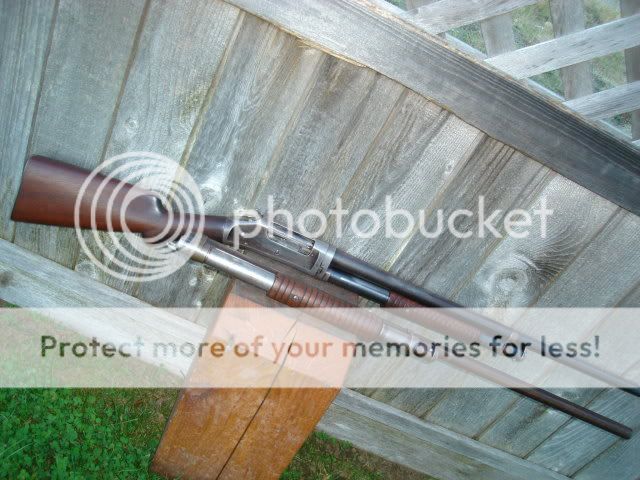
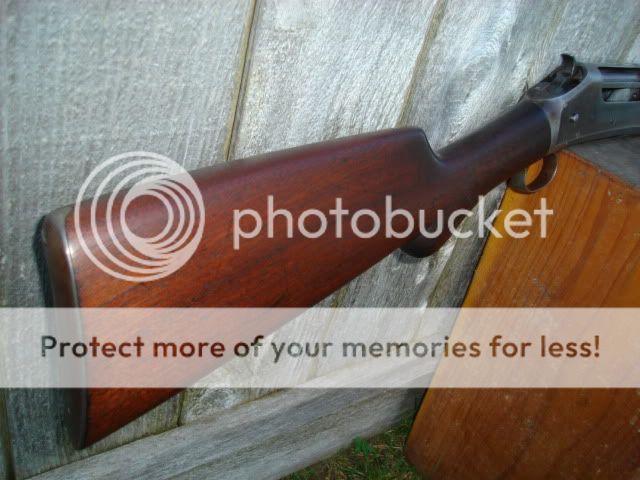
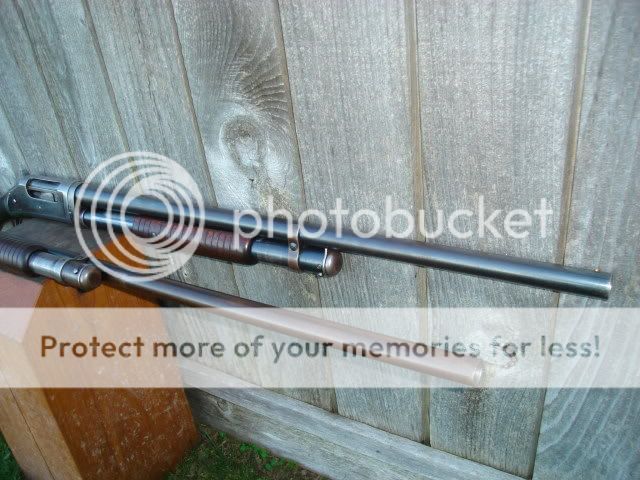
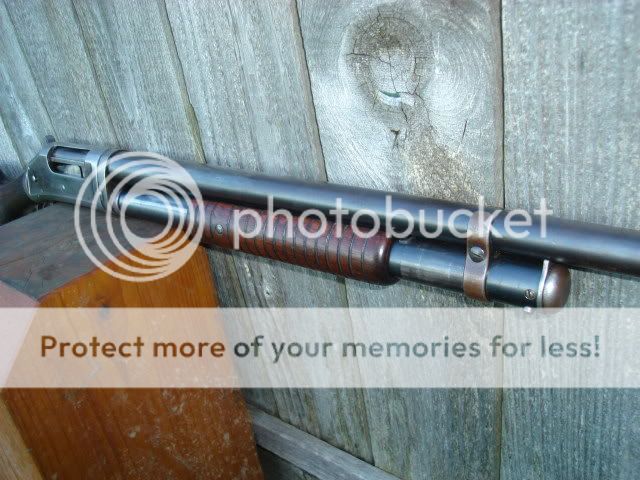
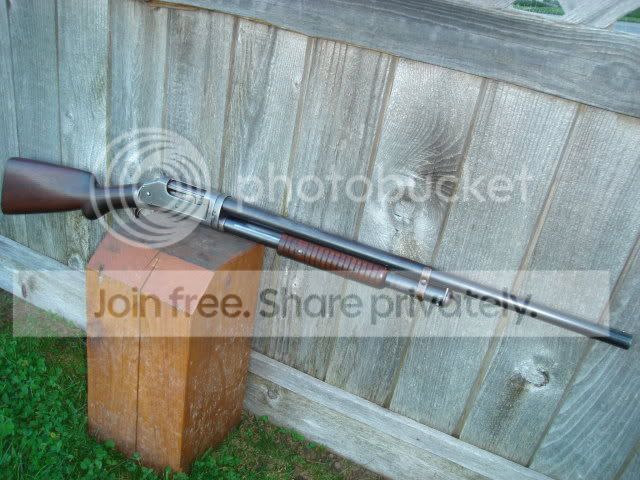
Restoring 1897 Winny.....

Wolfgang7

Regular
Rating - 100%
5   0   0
Location
Alberta, Canada
Hey all. I have an old 1897 Winchester 12 gauge, i think from about 1907. I am looking to make it a project to restore it. It's not in perfect shape but want to clean it up, make it look good and shoot it now and then. Does anyone have any suggestions or maybe know of a guide i can follow to do a basic restoration?? Thanks in advance! :)

 
It depends on what you want to do. If you simply want to clean it up a bit, such as refreshing the wood finish, you would need to learn how to remove the butt plate and through bolt for the butt stock. The forend disassembly requires a simple tool that can be obtained from numerous sources (think I got mine from Brownells, IIRC). From there, using paint stripper, sandpaper (judiciously), stain, and oil, it's not hard to put on a nice hand-rubbed finish.

However, if you want to also reblue the metal, it becomes a more significant project. In this case, you would need to completely disassemble the receiver and the barrel assembly. If this is your goal, I'd start with a DVD such as the one available from:

www.cowboysandindianstore.com

These kinds of instruction videos will provide a clear picture of the assembly/disassembly sequence. Rust bluing is covered in at least one recent thread here on CGN.

Above all, take lots of pictures. Before, during, and after. Then, post them here, so we can see all the fun you had!:D
 
^ thanks for that. Yes I plan on re-bluing as the metal needs it. The wood is actually in really good shape for its age. Its the take down model so its pretty loose where it breaks apart. I will search the bluing threads here and do more research. I also want to be weary of doing a "hack" restoration job and risk damaging either the gun itself or any value it may ever hold. Thanks for the reply I will share photos etc when I finally take action! :)
 
^ thanks for that. Yes I plan on re-bluing as the metal needs it. The wood is actually in really good shape for its age. Its the take down model so its pretty loose where it breaks apart. I will search the bluing threads here and do more research. I also want to be weary of doing a "hack" restoration job and risk damaging either the gun itself or any value it may ever hold. Thanks for the reply I will share photos etc when I finally take action! :)

Wolfgang. . . I don't want to tell you what to do with your own gun, but you did ask, so here goes. I have some time and maybe I can help a tad.

Some of what makes these old Winchester's maintain a following after all these years, is the originality of the firearm. Once you start, sanding, re-bluing, varnishing etc, etc, you've lost the soul from a 100 plus year old piece of history. After all, aren't we just keepers of these fine old firearms? It's highly doubtfull they'll ever be manufactured again.

The worn bluing on the receiver and rub spots on the stock and forearm are honest wear from years of service from a gun that has been held in high regard for long long time by generations of shooters. One reason they're becoming harder to find is someone just has just fix it up and try to make it look a little better to the novice eyes. What becomes sanded away and varnished and blued over, is done for. Now you have 2011 contraption.

Why not accept it for what it is, clean it, service it, rub a little high quality linseed oil on the wood work and rub it off with a cotton rag. A little TLC.

To tighten up the joint between the receiver and the receiver extension; go back and read Nabs posting on the Model 12 as I wrote a few words on how to adjust the barrel adjustment bushing on the takedown assembly. The 1897 has the same sytem.

Now before you go at it with the sand paper and bluing, I'm going to post a few photos of one of my 1897's. This one is all original from late 1900, early 1901 and is a factory two barrel set. A 26" factory choked "CYL" and 32" factory choked full. The old 1897 shoots and performs as it did over 110 years ago and it looks just as proud as can be in it's original, well earned, natural patina. Collectors and Dealers would just love to figure out how to duplicate this look. Only time and respectfull use and care will produce it. But, it's your gun and you are free to do what you want.

Win1897009.jpg


Win1897008.jpg


Win1897010.jpg


Win1897007.jpg


Win1897005.jpg


Win1897006-1.jpg
 
i picked up a 50's era 97 for really cheep because someone cut the barrel and added a poly choke there is no bluing what so ever left on it and i love it the only thing i would like to do is get the butt stock and fore stock back to matching
 
I don't want to put words in anyone's mouth, so Rod can correct me if I'm off base. But, what Rod says about not refinishing guns comes from the differences in "culture" between North American firearms collectors and those in Europe.

In North America, firearms were first and foremost, tools to protect one's self and his loved ones, and to put food on the table. Almost everyone had a firearm of some kind. These guns were often ordered through mail order and almost invariably came from manufacturers and retailers thousands of miles away. Guns that needed repair were fixed on the kitchen table with "binder twine and bailing wire". There were no gunsmiths nearby to do professional repairs or to restore finishes.

For this reason, the vast majority of old and historic pieces that remain with us today remain in their used state, with all the wear and the nicks, bumps, and gouges that they came by honestly. Collectors of North American firearms evolved in this environment and learned to access a gun based on it's near-original or diminished condition.

This contrasts with the "culture" in Europe, where large predators had long since been vanquished from populated areas and where food was virtually entirely obtained through domesticated sources. Here firearms and game animals were the purview of the rich and privileged. More to the point, firearms owners almost always lived within a few hundred miles of the original maker of the firearm, or even closer to a qualified smith. In Europe, when a gun needed repair, or simply got a little beat up looking, it was routinely sent back to the maker to be tuned up mechanically and to have the wood and metal finishes refreshed.

For the reasons above, knowledgeable collectors of fine American collectible firearms become skilled at spotting refinished guns. The highest collectors' valuations are reserved for guns that have never been refinished and that retain all the 'character' that they picked up over the years. This is such an important factor in American firearms collecting, that models that were built for military purposes, for example, are worth more if they were used in a war (or two, or three wars, in the case of an 1897 Trench gun) and sport battlefield repairs than if they never left the armory and are in 'mint' condition.

There is no doubt that you reduce the value of a highly collectible American gun by refinishing it. This applies more so to rare models and configurations. Those who know me well will tell you that the 1897 model is very near and dear to me. I own several - some more collectible than others. But, they're not all rare configurations, nor in particularly collectible condition.

So, I sympathize with and support Rod's aversion to permanently removing a gun from among the ranks of those in unadulterated condition. But I temper that position when it comes to examples that are not rare or of interest to a collector. I also get a great deal of enjoyment out of learning the art and skills of gun making, repair, and maintenance. I can see how others would enjoy it, too. I don't think it's necessary to preserve every single example, regardless of current condition - especially when reducing the pool of unaltered specimens helps drive up the value of mine!!:evil:
 
Thank you both for the input! i am still unsure how i want to approach this, but appreciate both standpoints.

i am aware this isn't a "high value collector item" at this point, just trying to get opinions on the best approach. thanks again! As i said when i finally take action i will definitely post some pics etc...... cheers :)
 
So anyway i pulled apart the 1897 and started cleaning it up a bit. I had put it back together and ran into a slight problem. The trigger won't release the hammer. i took the shotgun apart partially. I pulled the stock off, the the carrier and trigger assembly out. I didn't take the carrier assembly itself apart, but is it possible somehow the one spring has became disconnected from the hammer stirrup?? It seems that on the carrier part the stirrup is flopping around loose. Do i have to disassemble the whole carrier to fix this? Or could this even be my problem? This is my first time pulling it apart this much so this is all new to me!

Any help is appreciated! I was weary of taking the carrier apart more as the parts seem to get a little more intricate... anyway thanks in advance :)
 
Back
Top Bottom