Setup questions for reloading

HEY! You just git in line behind the rest of us! No jumping! :d

But would that not place you between her and me when I... Oh! Nevermind. :p


My suggestion to buy the single stage wasn't to do it first. It was to do it later on as a second press. Once you're into it you won't realize how handy it is to have a single for some side job that needs doing. Especially once you're reloading a few different calibers. For the amount you'll be reloading the progressive makes far more sense. You're on the right track there. Especailly since you're not reloading any rifle calibers yet. When you do unless it's something like 5.56 which you shoot from a black rifle in mass numbers consider buying the single stage THEN. Accurate rifle ammo loading is a whole other plate of pasta and most of us find it's easier and more clear to run off small batches of 50 at a time using a single stage and separating the operations. The big reason being that for this sort of loading EVERY charge is weighed for accuracy. The loads being dropped light from a powder dispenser and then the tray of powder is set on a scale and a powder trickler used to drop in a couple of flakes at a time until you are dead on the desired weight. Only then is the little dish dumped via funnel into the casing.

I know, I know. Too much too soon again :d But it'll make sense soon enough.

No no, this perfect makes sense. I was expecting the powder measure to be accurate on the press, but from what you're telling me it is not that accurate and one needs to validate the proper powder weight for every case. Damn... that will slow down the process quite a bit.

I guess I'll have to find out how much powder load variation translates to how much bullet velocity changes... keeping in mind it's out of a 19"3/4, 1:10 twist Cx4 barrel, I wonder... I might use a slow powder that burns for the whole length, don't have to use fast pistol powders designed for a 4" barrel... Ohhh... this might be FUN! I need to check the specs on that barrel... don't want to burn or blow it in my face, but the potential... :d


OK, you THINK you'll weigh the loaded ammo to see if it's right or not. But you'll end up missing some and opening others which are fine. When you're using a whopping great 3 to 5 gns of powder the variations in case and bullet weights add up or subtract more than the amount of powder. When your known GOOD loads vary by more than the powder weight how are you going to know if one round is a squib and another is a double? You won't, simple as that. There's just way too much variation in the weight of the brass cases and bullets. Even good handgun bullets vary in weight by a couple or three grains either side of the listed weight. And if you run mixed brand brass for your 9mm like so many of us do there's more variation than this between brands. So measuring for the weight of the powder in the loaded ammo is simply not going to work at all.

I see what you mean, I think. I wasn't thinking so much as making sure I had 5.5gr vs 5.4gr or 5.6gr load accuracy... it was mostly to make sure I didn't have an accidental 0.2gr squib or a 7.6gr hot load. And you're right: with that much variation in case and bullet weights there's no point in measuring the entire cartridge for powder weight (unless I measure them before the load also), the powder must be weighted separately. Using the extra station to check the powder actually dispensed by the press makes sense.

Although, thinking of it.. that's a non sequitur, but how much is a bullet accuracy affected by a 3gr variation in weight? Because I'm thinking that if this factor is significant, maybe I should weight each bullet and sort them by identical weights in any case before reloading them, to ensure a batch isn't just of a given powder load, but also of a known range of bullet weight.

I need to learn more: It might make perfect sense to control those variables for a professional sniper or for an Olympic athlete, and be completely superfluous and over-the-top measures for your average joe shooter like me. Caffeine hands...


The thing is that you WILL run into glitches. And one wrinkle with the Hornady being an auto indexing press is that it pulls the problem round away from the station you need to address. So you really gotta watch. And since it moves all the rest as well you need to keep track of those too. You can't easily back up the bus or index around a second time.

In a way there's much to be said for removing the auto index parts when you start out and index the shell plate manually. Then later when you have things nailed down and it's all running smoothly put the auto index parts back in. In the meantime running in full progressive with manual indexing is only slightly slower than the machine auto indexing for you. But it might be good for you while learning.

In particular always run a few solo cases around the machine to double check that things are running correctly at the beginning of a session before you start loading up in a full on progressive mode.

I've been meaning to install a small mirror and LED light to let me see down into the cases after the powder station. Haven't done it yet but it's still a good idea. Or in your case if you buy the AP you've got 5 die positions. And for handgun ammo you really only need 4 even with the bullet seating and factory taper crimp dies. So you have the option of using a powder checking die just after the powder drop die. It may be worth considering. You Tube "powder check die" to see what they are.

Those are great suggestions, particularly that powder check die (http://www.midwayusa.com/product/199393/hornady-powder-cop-die)! Thanks! :d
 
I cannot answer your questions regarding the stainless steel tumbler, but you want to have a sturdy bench. Normally the cases get resized relatively easy, but sometimes there is that stubborn bugger that you have to work out.
People have used benches such as the black and decker one, so if space is an issue it should be o.k. Just make sure that it will hold up to being twisted.
 
I'm also just starting to reload and I got the LnL press and will say if I was doing it again I would start with a single stage until you get going on large volumes if your doing pistol or something like AR stuff. If it's just for hunting rounds or precision long range shooting the single stage will be your best bet.
 
Last edited:
I'm also just starting to reload and I got the LnL press and will say if I was doing it again I would start with a single stage until you get going on large volumes if your doing pistol or something like AR stuff. If it's just for hunting rounds or precision long range shooting the single stage will your best bet.

Wise move you can do a lot with a good quality single
 
Wise move you can do a lot with a good quality single

+1
I'm also new to reloading and I picked up the Lee 50th Single Stage. So far I'm reloading 38spl, 9mm and starting on 223. For my bench I used an old computer desk and located my press over the leg with 3/4 pine board underneath for support.
 
I would suggest to build your own bench, it will be sturdier and very cost effective, of couse the bigger the bench is the better but I it's not always possible (mine is only 4 ft long). Progressive is great when you load pistol/.233 as you can reload about 400~500 rounds per hour, for rifle single stage is great but progressive will still work as well (I load 300WM on my progressive for general blinking)

Rotary wet tumbler is the way to go, less noise, no dust and very easy to use (just don't lose the pins)

917AE5DE-2A70-4D63-AA57-EAF63A007AA0_zpszf8lyw3b.jpg
 
I'll be the non-conformist....

Dillon 550. Almost as fast, but much cheaper than, the 650. You can still trick it out with lots of speed enhancing add-ons. Definitely faster than any single-stage. Manual indexing means you can use it as a single stage when required. Meaning take a pause to measure powder for those long distance load outs. Multiple calibers and easy change-outs. The warranty is super sweet by all accounts. No proprietary die threading....

Just my .02
 
For many folks a 650 Dillon is overkill. I feel that I can say that I shoot more than the average soul out there but even I can't shoot enough that I feel under gunned with my 550 Dillon.

If fact if I were to upgrade I think it would be to add a second 550 so I can have two setups running side by side. That way I could do all the large primer loading on one press and the small primer on the other. Changing calibers isn't a big deal. But swapping the primer setup over and re-tuning definitely doubles the switch over time.

If I were totally starting over I'd have to look closely at the Hornady AP vs Dillon 550 as being comparable in price. I really like the idea of the 5th position for a powder checking die. Something I can't do with my Dillon 550 because I'm seating and crimping in two separate positions.

But being as I'm already into the one Dillon it just makes sense to stick with Dillon for all my progressive reloading. That way my die carriers and shell plates are all common and can switch back and forth.

Grawfr said:
.....I see what you mean, I think. I wasn't thinking so much as making sure I had 5.5gr vs 5.4gr or 5.6gr load accuracy... it was mostly to make sure I didn't have an accidental 0.2gr squib or a 7.6gr hot load. And you're right: with that much variation in case and bullet weights there's no point in measuring the entire cartridge for powder weight (unless I measure them before the load also), the powder must be weighted separately. Using the extra station to check the powder actually dispensed by the press makes sense.

Although, thinking of it.. that's a non sequitur, but how much is a bullet accuracy affected by a 3gr variation in weight? Because I'm thinking that if this factor is significant, maybe I should weight each bullet and sort them by identical weights in any case before reloading them, to ensure a batch isn't just of a given powder load, but also of a known range of bullet weight.

I need to learn more: It might make perfect sense to control those variables for a professional sniper or for an Olympic athlete, and be completely superfluous and over-the-top measures for your average joe shooter like me. Caffeine hands...
It's only with rifle loading that you need/want to weight each and every charge. And even then it's only more important if you're after ammo which is as good or better than the better factory ammo.

For handgun "close enough" is close enough. Which is why hand gun ammo uses the volume droppers. Oh sure, when setting up we drop charges and then weigh them. But a .2gn variation is expected and tolerated on a drop by drop basis in handgun ammo. It is also why when you do a check to ensure it's dropping the right WEIGHT, within the allowable error, that you want to put 3 to 5 drops into the pan and then weigh that and divide by the number of drops you use. That averages out the drop to drop weight difference and you get a better idea of if it's a hair off or not.

Say you want to drop 4.0 gns of powder. You drop and put 4 loads into the scale pan and weigh it. The total is 16.4gns. For me that's enough of a difference over the expected 16 that I'll tweak the screw that controls the powder drop. Once it's down to 15.8 to 16.2 I'll call that good. But I'll repeat the 4 load drop weigh in a couple of times. If it's consistent then I'll put the scale away and load 200 to 300 rounds. I also fill my powder hopper about 2/3's full and when it's down to around 1/3 I top it back up to 2/3's again.

Testing of the drop weight early on showed me that with the powders I use that I can run over that middle 1/3 of the hopper without the drop weight changing by enough to notice. But until I got to that level of trust in my equipment I did check it when the hopper was 2/3 to 3/4 full and again at around half full and again at around the 1/3 mark where I wanted to fill it again.

And that's a good thing to do with your own setup until you know that your powder measure with a given powder will perform like that. If you find it's dropping lighter as the level goes down then fit it with a baffle or keep the level more consistent to control the variation. And if you start using a new powder with flakes that are significantly different in size or shape than a previous powder then here again check it at various levels in the hopper to get to know how the powder works in your hopper. Once you know you can adjust how you handle that powder in your hopper to ensure the least variation in the drop weight during a run.

Obviously in this case we're not talking weighing every load or even every few loads. Once I'm set up even with a new powder and I've tested the drop weight for multiple drops and a few single drops I'll go ahead and run a couple of hundred rounds. Then I'll weigh the drop weights again. If it's good I'll go ahead and run a couple of hundred more loads. The big variable in this seems to be how the "head pressure" of the powder in the hopper affects the weight of the loads being dropped. So I'll re-check the drop weight based on the height of the powder in the hopper. A really fluffy powder that uses a bigger volume per load means I might have to check in only 100 rounds. A sandy like powder that is running a small charge weight might let me load 300 rounds before the height change in the hopper is significant.

I know, "too much" again. But the message is that you can't trust your gear until you test it enough to know you can trust it. So when you're new do spot checks more frequently to double check the drop weight. But as you get to know the powder and powder measure you can run for longer between spot checks. Once you know it'll stay consistent when you keep the max and min levels within given limits you can go a lot longer between drop weight spot checks. I tend to run a spot check about every 300 rounds or at the start of a short session where I pick up from the last day or earlier that day.

Now all this is fine and good. And as you point out we don't really need EXACT loads for handguns. And there's going to be as much as a .2 to .3gn variation from drop to drop. But for handgun ammo unless a shooter is competing in hardcore bullseye competitions the variation at that amount really doesn't affect us by enough to notice. Or if we were shooting at more like 50 yards and longer with our handguns where bullet drop became significant then again we'd want a tighter weight control. But few of us shoot in these ways. So "close enough" is close enough for the typical hand gun shooting we do. And that means accepting a roughly 0.2gn variation from load to load. And that's about what the better powder measures will provide.
 
Thanks BC!

One thing to keep in mind: I'm not shooting a 9mm handgun, I'm shooting that bullet out of the 19-3/4" barrel on my Cx4, usually at 50 yards. That's why I was getting curious about managing accuracy and consistency by handloading the ammo. From the get go, it's got about 200 more fps than when coming out of a 5" barrel, and I know I do 3MOA already with Geco 124gr FMJ ammo. :)

That's also why I got wondering about using larger loads of a slower powder that has less peak pressure. I haven't found any useful info yet about this, but I'm getting ahead of myself anyhow. First, grasshopper needs to learn to crawl. :p
 
If you're going down this road you'll want to start checking everything. You're quite right that bullet drop becomes significant at that distance. And when that's the case it's critical to match the bullet's muzzle velocity and shape. The first step before you venture out of the available loading information will be to cut out other sources of differences. That means going with one brand of cases so the heads are all the same thickness which produces matched case volumes. So no more mixed range brass for you. Next is to buy and test weigh a few different brands and models of bullets to find the ones which vary the least.

After that it's not so much about peak pressure as it is about consistent pressure. And that might simply mean you want to find a powder with the smallest and most rounded shape to the granules so it meters the most consistently.

You can tell if these things which affect the bullet drop are the ones that are significant or not. If your groups tend to be oval shaped with the long axis of the oval being the vertical one then your aiming and hold is tighter than the ammo's consistency. That being shown by your tighter control over windage than the bullet drop variation is in elevation. But if you're getting nicely circular groups then it is you that is the limit and any bullet drop variation isn't that significant.

Two things I've learned from shooting longer distances with bench support or from using crossed sticks with my single shot old timey rifles is that support lets you shoot smaller groups. But that the human element still produces a mess at the other end. I find that the less I touch the gun and the more I rely on the bench, bags or sticks to support the gun the better "I" shoot. Ideally I'd perform my very best if I could clamp the rifle into a vise and pull the trigger with an old style cable release from a camera.... :d
 
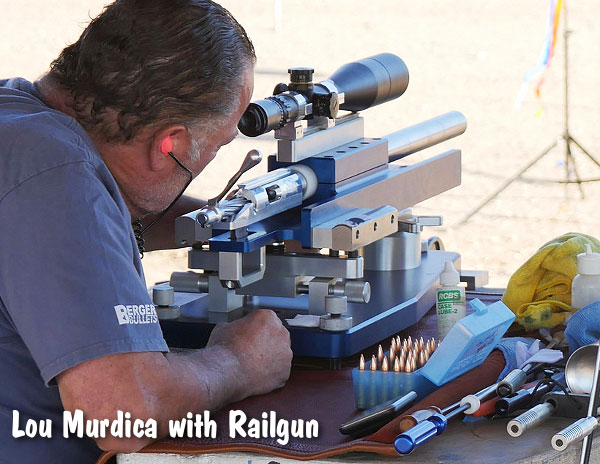
You're right about the supports, that's why those insane precision shooters use rail guns on sleds: they're not even touching the "rifle" anymore! :)

lougroup1503.jpg


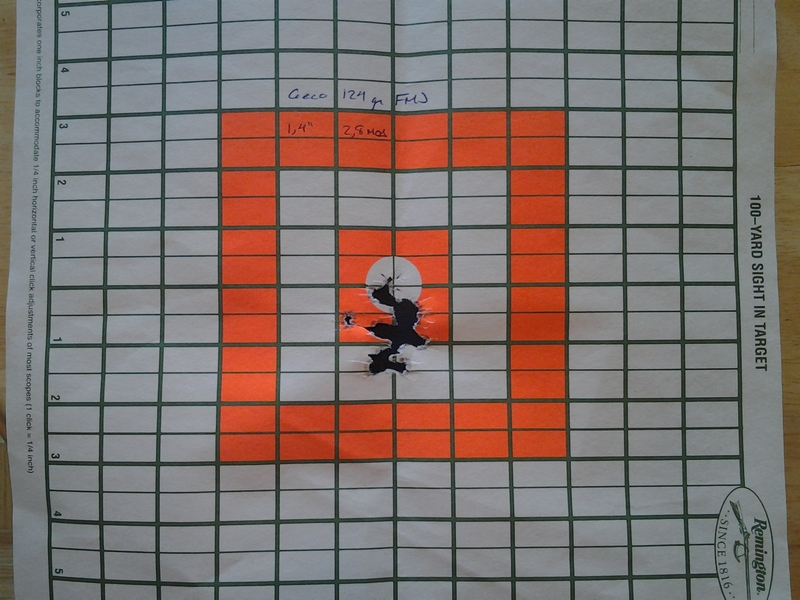
The image below was 20 holes (but I was counting only the best 18 of 20 for MOA measurement) from the Cx4 at 50 yrds, using Geco 124gr FMJ. I was using a front rest (Cadwell's The Rock) and a bag under the butt. Scope is a Vortex Crossfire II at 4x setting. Temperature was about 25C, light wind from the rear mostly, blood pressure at 120/80, caffeine at 35mg (just kidding!)

(assuming imgur still performs...)

zFXeFiM.jpg


Basically, this is the group that told me that there was no more point in trying to shoot with Winchester white box, Federal Am Eagle or CCI Blazer: I need consistent ammo. I just bought a couple boxes of Geco yesterday and it's gone up to over $0.52 per shot... thus the pressing desire to get into reloading this year. And I'm keeping that Geco brass, too. :)

I posted results for some 9mm ammo tests I did with the Cx4 if you're interested (it's in the Beretta Cx4 thread in the black/green forum). The gist of it is that I got anywhere from 3 MOA to 7+ MOA depending on the brand of ammunition used, under the same conditions.


(Edit non sequitur: currently trying to figure dies... size/decap, ok. Expand (or expand/powder through?), fine. But what's the advantages of a combined seat/taper/crimp vs having separate seat and taper/crimp dies? If I go the latter route, do I still have a free station to set up a powder cop? Fun fun fun! I think I found a LNL AP press in stock in Ottawa, got my eyes on a reasonable workbench (had to make sure it passes the doors), but haven't found the tumbler I want anywhere yet).
 
Last edited:
The target isn't showing.

One thing if you're after extreme accuracy with a 9mm is to take note that many bullets tend to start wobbling as they pass from supersonic down through transonic and to subsonic. At 50 yards you'd want to run the numbers through a ballistics program to find out if they are slowing down enough to pass through that transonic point. If they are and if you want better performance even out farther then you want to start thinking about either going lighter and faster to stay supersonic or go heavy and slow and start at subsonic speeds and then stay there.

Hornady's website has a nice external ballistics tool you can play with. The basic version is pretty basic and if you select the full on detailed version there's enough boxes to fill in to content even the most avidly OCD shooter. Mostly I've used it to just get a general idea on speeds and bullet drop and get a handle on how the BC figures into all this. Give it a try with your own loads. You may have to find a bullet that is roughly like what you have and use that BC value.

But then you get into the barrel twist rate and what it is happy with for a bullet weight for stabilizing. You also start having to wonder about the muzzle crown and just how precise they are making it on a pistol caliber carbine generally intended for closer in use.

Chasing accuracy in any gun is much like a chain used for holding up a cargo. Every link needs to be looked at and no one "link" is going to be the big answer.

For what you're after I'd also suggest that getting one of the really sensitive jewelry scales that reads down to .02gns (that's right, .001gm and .02grain sensitivity) and weighing each of the charges from a trickler for your more OCD days where you want to eliminate the ammo as a possible excuse is not out of the question. You will aslo be only lightly crimping that ammo so you don't reduce the size of the bullet by overly much and likely single loading the rounds so the light crimp does not allow the bullets to set back in the cases due to recoil forces from previous rounds.

And in the end if you're keen on following this path I'd suggest that there are guns which would be more suitable for such bench shooting than the Beretta. But you know that already. And I know it's fun to see just what you CAN get from a gun. Just keep in mind that you're working with some fairly serious built in limitations with both the round and the gun.

Oh, you might want to try some cast lead bullets too. I know that a few of my semi auto 9mm pistols shoot consistently much tighter with cast lead than with jacketed. Same with my revolvers shooting .38Spl when comparing cast and jacketed. Just one more "link" to try.... :d
 
Right click on the .jpg icon, open image in new tab. It was showing for me when I posted it, it's all gone weird for the last day. *shrug* (edit: now I see it again... no rhythm or logic to this!)

Good points you made... I suspect the bullets stay supersonic beyond 50 yrds because they start with about 1250fps velocity (I'm using Ballistics by the Inch as a guide for saying this: http://www.ballisticsbytheinch.com/9luger.html).

Right now the Cx4 is my love and joy, but you're correct: a semi-auto 9mm is not basically built for precision. Fun to be able to shoot 10 rounds before reloading, though. :)

I'm thinking of getting something else this summer, but what? So many choices... I know I want a non-restricted, I'd prefer a semi in a relatively common caliber (no wildcats), I wouldn't mind if it looked to Wendy like it should be banned on sight *grins*...

I love the looks of the M1/M14 milsurps and of the M1 carbine, but they're a bit hard to scope and anything milsurp simply isn't built for accuracy (unless you spend twice its value rebuilding and tuning it). A nice "real" level action to upgrade from the Henry Frontier in .22? Not 45-70 (no grizzlies around here), but .30-30 or even a pistol caliber? Lever carbines are FUN!

On the other hand, Vz58, Beretta MR-1, and KelTec RDB are all very interesting. The Rob Arms XCR and H&K SL-8 simply looks wicked as hell, but cost a mint and getting an SL8 adapted for AR-15 mags is a nightmare. And there's the rarer stuff, too.

Choices, Choices... :d
 
One of those Caldwell flip and and resetting rimfire steel targets a few boxes of rimfire ammo and my basic but great shooting Henry 001 and I'm a happy camper for a couple of hours.

Or take another Caldwell flip and handgun target, my Rossi 92 in .357 shooting mag brass with "Special" loads from my cowboy shooting and set it far enough away that I only get about two out of three hits and I can go through a couple of hundred rounds once again in total bliss. Lever guns really are fun. In fact I really enjoy just about any rifle that needs me to do something for each shot. Likely why my top loves from the safe are single shot rifles. An old "surplus" rolling block Swede action with a Shiloh Sharps barrel in .38-55 and more recently a Uberti high wall in the same caliber.

But I digress.....

You're obviously having fun and enjoying the challenge of this rifle and reloading to see if you can sharpen things up. Is it the best option? Obviously not. But you're producing grins and learning a lot about reloading and shooting. So far be it for me to say that anything you're doing is wrong in any way. It's just YOUR version of "right". And so will be the next one and the one after that regardless of which they are and why you select it.

Ain't life grand? :d

You done any trap shooting yet? If not I can seriously recommend it. I don't shoot trap nearly as often as I'd like. Too many other things going on. But when I do it's hugely fun to see that clay just turn to dust with a solid and well centered shot. It's about as far as you'll get from bench shooting other than buying a handgun and getting into the action games.

OK, the after dinner whiskey is making me babble from my fingers so I'll cut this somewhat short. You've got a lot to mull over for the reloading. My answers aren't the only ones. I'm sure someone else will toss in a thing or two that I've missed. Or their idea of "the right way". Soak it all in and go try it out and see which hits the nail on the head.
 
Back
Top Bottom
































































