Show Digging Up the Trenches, Sniper Question About "Reversed Projectiles"

:onCrack:f:P:2: "liquefied lead squirting through seams":confused: A bullet never "liquefies" on impact....unless of course your "firing" a squirt gun.:redface:

When a half dozen machine guns are firing a stream of bullets at the vision slits on your tank, what you get is lead "fragments" if you like the term better, squeezed like putty through the slits and through any cracks or joints in the armour too small to admit the whole bullet. The lead deforms to the shape of those cracks or joints as it is forced through. Hence the mask shown above. Spalling was not the problem IRRC as the armour used was too soft for that to occur.
 
It's an easy concept to grasp. For example, when you use a prick punch to mark a hole location on a piece of steel, it leaves a little crater, (DISPLACES STEEL TO THE SIDE) just as you would expect with a regular centerfire bullet fired point forwards.

Stanley-Tools-16-236-rw-146313-213230.jpg


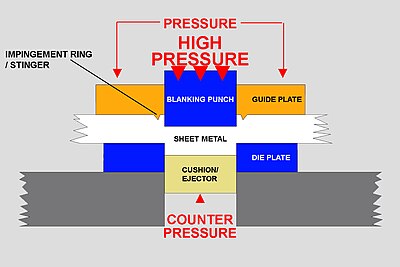
When the bullet is reversed, it imparts a force similar to that on a blanking die as shown,(PUSHES DISC OF STEEL FORWARD) of course there is no 'guide plate' etc.

400px-Fineblanking.jpg


WWI tanker helmets/facemasks.

Rats I see someone beat me to it - included additional pics of 2 different types below.

orig.jpg


brodiept2.jpg
 
Last edited:
Here we go, "Tanks and Trenches", there are dozens of stories saying the same thing, they were taking so many fragments they wouldn't have known what was spalling and what wasn't:

Lt Henriques, 15 Sept 1916: "A smash against at my front caused splinters to come in and the blood to pour down my face." "On turning round I saw my gunners on the floor. ..I now discovered that the sides weren't bullet proof."
Lt Hummam 16 Sept 1916 "I went to the port side gunners to see why their guns were silent. Both gunners were dead I believe, several bullets and small shells had penetrated our armour plate ... I came round to find myself lying on top of my corporal, his shins were sticking out in the air".
 
No B.S.
This odd physics occurence was firt noticed when a shaped charge was placed on a plate of steel and detonated. The shaped charge intionally had the makers name embedded deep in the surface of the charge. After detonation, the name of the maker was etched deeply into the steel plate.
The bullet placed in the shell backwards works for the same reason. the bullet base would be slightly concave and thus will pierce just a little more steel than if it was production intent.
That is how most modern modern armour piercing rounds work today (backed up with a little more speed and mass.).
 
Do you have a source for this info?
My sources sited above, the Hackley and Kent books, are the recognised sources on these ctgs.

Well Browning took the 1917 model, which was basically the same design since his 1910 prototype, and scaled it up to make the M2. Hence the same thing was done with the cartridge. The US never thought rimmed cartridges were very good in autoloaders, it would have been a step back to use the German round.
 
Back
Top Bottom