Some questions about modern Smith and Wessons

Astaziel

Member
Rating - 100%
9   0   1
I know I've made a lot of posts recently so I figured out I should condense all the questions I have left into a single post.

1. I already know that dry firing a revolver thousands of times will smooth out the burrs (if there are any) and polish the inner working to a certain point,
So is there any danger of damage to the firing pin/frame if you don't use snap caps? Since my new gun is a 686+ I would need to buy two packs to get a full cylinder so I want to make sure I absolutely need them before splurging more of my hard-earned money...

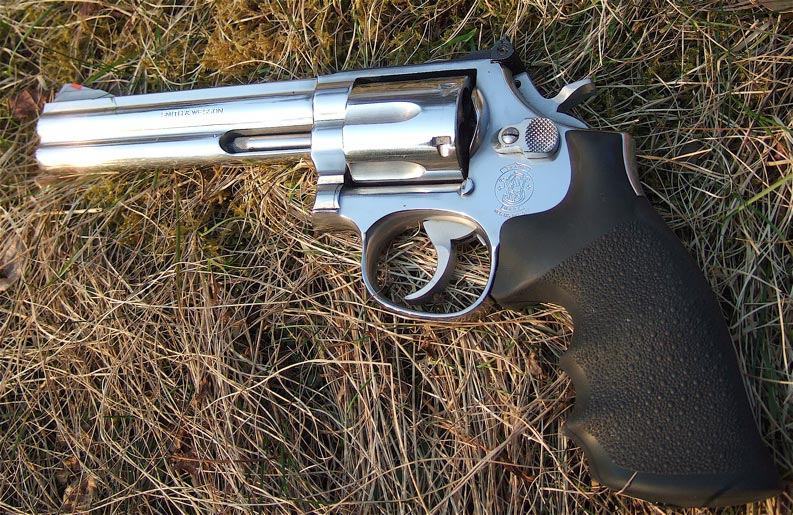
2. I would like to buff my gun to a mirror finish with some Mothers mag polish and I notices that the top of the barrel is sort of bead blasted, as I understand to prevent glare.
Should I protect this portion with masking tape while I buff the rest of the gun?
I will also protect the front of the cylinder, as I already know that this section of the gun has very close tolerances.

3.So I watched a lot of "DIY" polishing videos of the inner parts of the revolver. Would you say it's worth it?
I know that the hammer/SA trigger surfaces are NO-TOUCH as hammer push-off will occur if you mess the tolerances of these surfaces.
Other than that, I would LIGHTLY polish and buff the wear marks and contact surfaces with an Arkansas stone and mothers polish.
I've studied extensively the inner workings of s&w revolver and thus I am pretty confident I understand how they work.


Some of my sources:


There are some things I don't agree with this guide, such as touching the foot of the hammer (where the sear/hammer transition occurs in DA)
 
1) If you're going to dry-fire extensively I'd definitely invest in some snap caps.

2) Mother's works well. If you're polishing by hand there's no need to mask of any part of the revolver. Here's my now-sold 686 after polishing.
hwtJjAI.jpg


3) I wouldn't bother messing around with the internals on a brand new revolver. Dry fire (and shoot!) it a bunch to let it wear in.
 
Wow, that piece is beautiful, exactly the look I'm looking for!

The "natural polishing technique" does seem like a good option, I just thought it would be faster (and more fun!) to polish by hand the internals.
 
May I respectfully ask you why such opposition toward opening the sideplate?
It is easy to warp a sideplate if it’s not removed correctly. Personally I don’t think that S&W revolvers need a trigger job out of the box and you run the risk of messing things up. Dry firing and shooting the revolver has the double advantage of smoothing the action and giving you practice.
 
I understand your concern, but I must assure you that I am already proficient at tearing down guns, and that includes Smiths ;)
Although maybe I'll wait before playing with the internals, maybe it's fine how it is for now
 
Last edited:
1) Dry fire until the cows come home, snap caps are worthless.

2) I wouldn't polish the gun at all but if you're going to just do the whole thing.

3) Removing a sideplate and working on revolvers is stupid simple. Do you need to polish? Not really but I wouldn't be afraid to take it (or any other gun) apart. Bending the mainspring will lighten the trigger but afterwards the revolver might not ignite all primers. All my revolvers are Federal primers only.
 
It’s pretty tough to warp the side plate. One just has to take it off & replace it the correct way.
I find it helpful to dry fire with spent cases with spent primers. A light polish job on some of the S&W internals, & some attention to the mainspring could definitely improve the factory trigger.
There are some issues with polishing or smoothing of MIM parts now incorporated in S&W revolvers. Overall though, always cheerful to hear from dedicated revolver users. Everyone should own at least one revolver.
 
I just like the look of buffed steel that shines like a mirror.
Although I would rather not play with the mainspring for now as I always shoot whatever is cheapest, thus foreign primers abound!
 
If you're not actually going to shoot them, and you don't care about resale value, it doesn't matter. But just 'polishing' it will reduce the resale value, and just 'polishing' it might also make it more difficult to see your sights.
 
Yes I have heard that MIM can be finicky and won't polish to the same degree as the forged parts, at least not as easily.
But you don't need a mirror finish on the internals, you just want a smooth finish, correct?
On the bright side, I've heard that while forged parts are case hardened and thus the hardness is only "skin deep", MIM parts are hardened all the way trough.

There is just a little Je ne sais quoi about revolvers, an old world finesse that the now common "Plastik Fantastiks" just cannot equate.
Oh, and they look badass as f@ck too, almost forgot to mention that...
 
I have polished mine with mother's mag polish and it works really well (though I didn't get to the extent of the photo earlier in the thread... but I was also not aiming for a "mirror finish").

The only thing I've heard to by wary off as far as exterior polishing goes is not to overdue it on the cylinder face as you can open up the cylinder gap over time. Which is the most bothersome part to me because that's the part that gets the dirtiest constantly and needs the most cleaning.
 
Polish the rebounder and the part of the frame it slides on.

Auggie D.

Exactly.
I carried a S&W model 10 and used a S&W customized for PPC competition.
Now, a S&W is not a prodigy of technology and is quite on the rough side.
I polished the rebounder and the frame part it slides on.
I reduced the width of the main spring by file and tested it once in a while with primed cases until satisfied.
I'll never remove any material from the contact surfaces between the trigger and the hammer parts; these contact surfaces have to be parallel and the best way to achieve this is by firing the revolver.
The trigger pull will improve by itself.
If streaks on the faces of the hammer or trigger, a light polish of the insides where they rub.
By a light polish, I mean a light polish.
And by all means, don't pry on the side plate with a screwdriver to remove it. Tap the frame at the bottom of the grip (removed of course) until loose.
That what I believe all the colleagues above mean by "warping" : a little nick at the level of the top screw of the side-plate....very ugly.
 
Back
Top Bottom