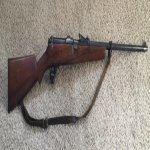
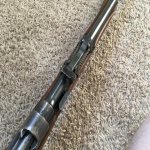
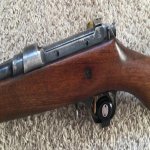
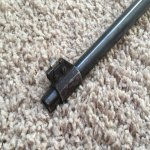
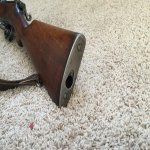
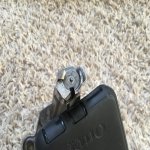
This is a very early Ross Mark II* complete with that yummy rear sight which offers the 5-yard range increments. You are a Lucky Guy; I took years and years to stumble across a similar one, albeit not quite so unblemished as yours.
You have the basics of rather a scarce rifle: barrel has not (as is so common) been bobbed by some bygone Bubba.
In this condition, throw it up to your shoulder and take a sight, quickly, and you will learn the basics of the great ergonomics of this seminal rifle.
Rifling in this model of the Ross was specially designed to withstand the horrible effects of the ammunition in use at that time (erosive early Cordite on top of violently-corrosive priming) and still stand up. I would clean the old girl out and then take her to the range, plop her down on a sandbag and see what she will do, being careful to use ammo with FLAT-based bullets (which generally means the cheap stuff). Often you can obtain surprising results with this combination. Don't be surprised if your casings show a lot of expansion at the FRONT: many of these had oversize chambers which were designed to cope with mud but the .303 is a RIMMED cartridge and so the normal caveats applying to rimless ammunition do not apply. This rifling was specially designed to give a very long life under conditions that we today regard as prohibitive; you just may end up with a decent target and you will have experienced what Canadians could make, 114 years ago. And you just might turn yourself into a genuine Ross Rifle aficionado!
A point regarding shooting the thing: it is designed with a floating barrel. Nothing should interfere with barrel vibrations, including that SLING. Sling should be mounted to the fore-end and NEVER touch the barrel.
As far as a restoration is concerned, keep your eyes and ears open. The parts you would need ARE out there. Sure, this rifle has holes from being mounted; that's why God invented Plug Screws, if you must conceal this part of the rifle's history. There are no proprietary or weird threads on a Ross: all are made to American standards and can be duplicated on good machines, even that Godawful left-hand 3-tpi buttress thread on the barrel (I checked at a local machine-shop and they allowed that they could duplicate it, but this town does have a lot of oilfield machine-work done.)
And be sure to check that you have the parts you require and be sure that you need them. My Mark II* is also a 1906 and the Butt Trap slides vertically for stowage.
This early series of Rosses has a Harris Magazine, so is designed for dump-loading rather than recharging from chargers as would be done with a Lee-Enfield. You hold 5 rounds above the rifle magazine, release your grip upon them, and flip the side lever up and down quickly with your right thumb. The rounds drop into the magazine and align themselves for feeding without even a single foul epithet. You then slap the bolt shut and take your aim. It is very fast, once you learn the trick.
Important things to consider: you have a very early rifle which is pretty much the way Sir Charles wanted it. The other 80 or so variants came after the Standing Small Arms Committee got their mitts on it. It is a proud piece of Canadian history and YOU OWN IT.
Be happy!