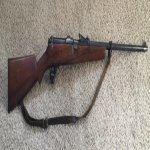
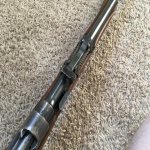
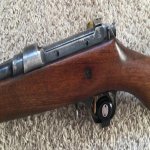
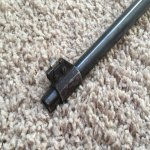
Sporterized Ross 1905 Restoration

Blastattack

CGN Ultra frequent flyer
Rating - 100%
145   0   0
Location
Winnipeg MB
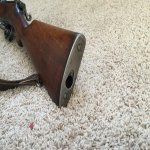
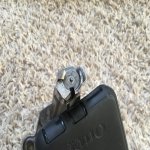
I’ve decided to restore this old beauty. I’ve cleaned her up and need to go the range to do some shooting. New stock and bands by the end of the year, hopefully.

I recently acquired this Ross 1905 as part of a package deal. Lovely gun, but not really my area of interest. What would y'all be willing to positively identify it for me, and provide a reasonable estimate of it's current market value?

It also came with a separate and complete second bolt. Not sure why, but both bolts seem perfectly fine.

At present to bore rates rather poorly, but I will try and clean it to see what happens.

IMG_0040.jpg
IMG_0041.jpg
IMG_0042.jpg
IMG_0043.jpg
IMG_0044.jpg
IMG_0045.jpg
IMG_0046.jpg
 

Attachments

  • IMG_0040.jpg
    IMG_0040.jpg
    61.9 KB · Views: 337
  • IMG_0041.jpg
    IMG_0041.jpg
    147.6 KB · Views: 333
  • IMG_0042.jpg
    IMG_0042.jpg
    78.4 KB · Views: 333
  • IMG_0043.jpg
    IMG_0043.jpg
    124.9 KB · Views: 334
  • IMG_0044.jpg
    IMG_0044.jpg
    120.5 KB · Views: 332
  • IMG_0045.jpg
    IMG_0045.jpg
    134.1 KB · Views: 334
  • IMG_0046.jpg
    IMG_0046.jpg
    82.7 KB · Views: 333
Last edited:
You'll get what a seller offers. Most buyers nowadays, they want to restore military surplus rifles to arsenal condition. Yours has been sporterized and has too many parts missing (starting with the buttplate trap). The supply chain broke when the 24-hour Ross Rifle Company's parts business closed in the last recession, or haven't been made since 1910-ish.
 
It's a Ross mkII* the first variant of 1905 Ross manufactured.

There is generally no such thing as a sporter that has all the unobtainable parts for restoration but yours actually has most. Bores are usually bad but a good bore is something I look for unless I just need parts. The biggest drawback to value is the reciever is drilled and tapped.

I'd say you would get anywhere from $200-400 depending on what the buyer wants out of it.
 
This is a very early Ross Mark II* complete with that yummy rear sight which offers the 5-yard range increments. You are a Lucky Guy; I took years and years to stumble across a similar one, albeit not quite so unblemished as yours.

You have the basics of rather a scarce rifle: barrel has not (as is so common) been bobbed by some bygone Bubba.

In this condition, throw it up to your shoulder and take a sight, quickly, and you will learn the basics of the great ergonomics of this seminal rifle.

Rifling in this model of the Ross was specially designed to withstand the horrible effects of the ammunition in use at that time (erosive early Cordite on top of violently-corrosive priming) and still stand up. I would clean the old girl out and then take her to the range, plop her down on a sandbag and see what she will do, being careful to use ammo with FLAT-based bullets (which generally means the cheap stuff). Often you can obtain surprising results with this combination. Don't be surprised if your casings show a lot of expansion at the FRONT: many of these had oversize chambers which were designed to cope with mud but the .303 is a RIMMED cartridge and so the normal caveats applying to rimless ammunition do not apply. This rifling was specially designed to give a very long life under conditions that we today regard as prohibitive; you just may end up with a decent target and you will have experienced what Canadians could make, 114 years ago. And you just might turn yourself into a genuine Ross Rifle aficionado!

A point regarding shooting the thing: it is designed with a floating barrel. Nothing should interfere with barrel vibrations, including that SLING. Sling should be mounted to the fore-end and NEVER touch the barrel.

As far as a restoration is concerned, keep your eyes and ears open. The parts you would need ARE out there. Sure, this rifle has holes from being mounted; that's why God invented Plug Screws, if you must conceal this part of the rifle's history. There are no proprietary or weird threads on a Ross: all are made to American standards and can be duplicated on good machines, even that Godawful left-hand 3-tpi buttress thread on the barrel (I checked at a local machine-shop and they allowed that they could duplicate it, but this town does have a lot of oilfield machine-work done.)

And be sure to check that you have the parts you require and be sure that you need them. My Mark II* is also a 1906 and the Butt Trap slides vertically for stowage.

This early series of Rosses has a Harris Magazine, so is designed for dump-loading rather than recharging from chargers as would be done with a Lee-Enfield. You hold 5 rounds above the rifle magazine, release your grip upon them, and flip the side lever up and down quickly with your right thumb. The rounds drop into the magazine and align themselves for feeding without even a single foul epithet. You then slap the bolt shut and take your aim. It is very fast, once you learn the trick.

Important things to consider: you have a very early rifle which is pretty much the way Sir Charles wanted it. The other 80 or so variants came after the Standing Small Arms Committee got their mitts on it. It is a proud piece of Canadian history and YOU OWN IT.

Be happy!

 
Since nobody has taken a stab at value, I will. I'm going to assume barrel is original length, which is an important consideration for restoration purposes. I'm also going to assume the barrel cleans up to good or better condition (clean it with solvent and a wire brush, then shoot it to get the rust out), then you're talking 400+ dollars. If neither of the above conditions are met, then you are talking 200 to 250$. The spare bolt could fetch 100$ if it is serviceable. (The question begs, why did the original owner have two bolts?)
 
This is a very early Ross Mark II* complete with that yummy rear sight which offers the 5-yard range increments. You are a Lucky Guy; I took years and years to stumble across a similar one, albeit not quite so unblemished as yours.

You have the basics of rather a scarce rifle: barrel has not (as is so common) been bobbed by some bygone Bubba.

In this condition, throw it up to your shoulder and take a sight, quickly, and you will learn the basics of the great ergonomics of this seminal rifle.

Rifling in this model of the Ross was specially designed to withstand the horrible effects of the ammunition in use at that time (erosive early Cordite on top of violently-corrosive priming) and still stand up. I would clean the old girl out and then take her to the range, plop her down on a sandbag and see what she will do, being careful to use ammo with FLAT-based bullets (which generally means the cheap stuff). Often you can obtain surprising results with this combination. Don't be surprised if your casings show a lot of expansion at the FRONT: many of these had oversize chambers which were designed to cope with mud but the .303 is a RIMMED cartridge and so the normal caveats applying to rimless ammunition do not apply. This rifling was specially designed to give a very long life under conditions that we today regard as prohibitive; you just may end up with a decent target and you will have experienced what Canadians could make, 114 years ago. And you just might turn yourself into a genuine Ross Rifle aficionado!

A point regarding shooting the thing: it is designed with a floating barrel. Nothing should interfere with barrel vibrations, including that SLING. Sling should be mounted to the fore-end and NEVER touch the barrel.

As far as a restoration is concerned, keep your eyes and ears open. The parts you would need ARE out there. Sure, this rifle has holes from being mounted; that's why God invented Plug Screws, if you must conceal this part of the rifle's history. There are no proprietary or weird threads on a Ross: all are made to American standards and can be duplicated on good machines, even that Godawful left-hand 3-tpi buttress thread on the barrel (I checked at a local machine-shop and they allowed that they could duplicate it, but this town does have a lot of oilfield machine-work done.)

And be sure to check that you have the parts you require and be sure that you need them. My Mark II* is also a 1906 and the Butt Trap slides vertically for stowage.

This early series of Rosses has a Harris Magazine, so is designed for dump-loading rather than recharging from chargers as would be done with a Lee-Enfield. You hold 5 rounds above the rifle magazine, release your grip upon them, and flip the side lever up and down quickly with your right thumb. The rounds drop into the magazine and align themselves for feeding without even a single foul epithet. You then slap the bolt shut and take your aim. It is very fast, once you learn the trick.

Important things to consider: you have a very early rifle which is pretty much the way Sir Charles wanted it. The other 80 or so variants came after the Standing Small Arms Committee got their mitts on it. It is a proud piece of Canadian history and YOU OWN IT.

Be happy!

It's great to hear from you Smellie! It was a stumble find, but something kept calling to me about it.

The rear sight is definitely interesting. Not sure how it works as the knurled knob thing doesn't rotate at this point. I'll have to disassemble to figure out why, and the barrel is indeed 28", as I understand it is supposed to be.

I've always been a fan of the Ross rifles, though never gave much attention to the 1905s. I'll clean the bore out and see how she looks. I have the remains of another 1905 stock, which very fortunately includes a rear barrel band, though from a later mark with the lower screw. I have a copy of The Ross Rifle Story (which I forgot about until now), and I'm assuming that this rifle is identified as a MKII* due to the rear sight and the fact that the mid-barrel band is secured with a cross screw, as opposed to a screw securing it from the bottom?

I wasn't looking for a restoration project, but I guess I may have found one. I'm in the process of restoring a Commercial Snider Enfield (also quite uncommon as I understand it), so this will be added to the list. The prices from the Ross Rifle Restoration seem reasonable, so restoration could make it on the books, provided the bore cleans up somewhat.
 
I've cleaned her up and looking to restore her. I've contacted Ross Rifle Restorations to assist me. The barrel isn't too bad, but it's also not great. I've yet to shoot her, but we'll see how she performs before doing any major work. The rear sight is unfrozen and cleaned. Pretty neat unit.
 
Back
Top Bottom