So, if you have a .5 MOA rifle (243, 75 grain bullet, 3,400 FPS, 1 grain = 75 FPS, a favorable set of assumptions) that never shoots fliers, and you're shooting on a perfect windless day, and if the rifle and cartridge are the sole source of random variation, and if your cases all have exactly the same capacity, and your bullets all have exactly the same mass, we can calculate the shape of your groups and see what influence better SD has:
At 500 yards, with a 15 FPS standard deviation, your groups would be ovals 3.2" tall and 2.5" wide.
Switching to a really terrible powder measure with a .25 grain standard deviation (extreme worst case assumption), your MV SD would increase to 24 FPS. Now your 500 yard groups are 4" tall and 2.5" wide. (I have tested the Perfect Powder Measure with Varget, and it gives a standard deviation of .11 grains. Under this condition, MV SD increases from 15 FPS to 17.1 FPS rather than 24 FPS.)
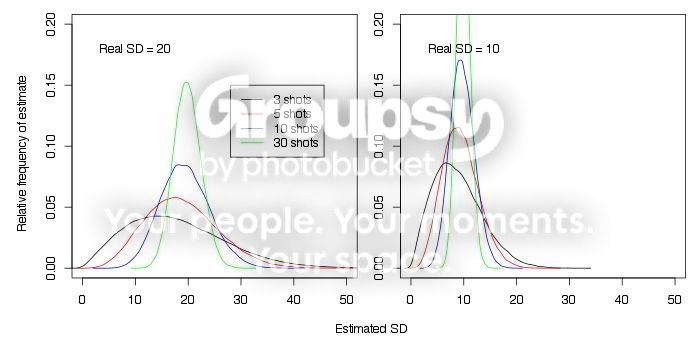
Without doing the math, I expect that you'd have to shoot hundreds of rounds to even statistically detect such a change.
And in real life, the change is much much less than that because all the cases don't have equal capacity, and all the bullets don't have the same weight or mass, and the major source of random variation is probably the shooter. As stated, in very round numbers 3 degrees F change in barrel temperature is about the same as .1 grain of powder. If you're not controlling your barrel temp to within 3 F, there is no point in worrying about .1 grain.