Standard Deviation for handloads

The lower the better. For precision rifle I can get the SD down to around 5-7fps, which is really good. For pistol I don't care as much, a stellar factory load might be 15-20fps and most of my handloads I strive for less than 20fps.


To get 5-7 fps deviation, you need a custom, tight chamber, turned necks on your casings and custom made bullets or at least match grade bullets. You should also use bench rest primers and temperature resistant powders that are suitable for your cartridge combo.

That being said, there are always a few exceptions. gushlak might just have one.

You should also settle for the most accurate load, rather than the fastest load.

Now, another thing that will effect the standard deviation readout on your chrony, is the amount of light hitting your screens. The standard diffusers are OK for most readings but not the best when it comes to close tolerances.

I cover my Chrony with a half sheet of 1/4 in plywood. I have two 12 volt bulbs that I hook up to an ATV battery to give me consistent lighting. Makes a huge difference.

Now, Chronys' can't be expected to give precision read outs. They just aren't made to be that accurate. They are built to a standard that makes them affordable to most shooters.

If you need to get a more accurate reading than 10-20fps, you will have to get the type of chronograph that has mesh screens. Very expensive and the screens need to be replaced on a regular basis.

10-20fps isn't likely to effect the accuracy of your rifle unless you plan on shooting past 500yds.

If your rifle is built as a standard hunting rig/configuration, 10-20fps deviation won't even be noticed. The difference in cost between a regular commercial grade hunting rifle and a custom rifle that will really notice a bit of velocity deviation is about 5-1.
 
Hey guys,

It's a sporterized Husky 9.3x57 shooting 270 gr. bullets. I had loads that had more powder, but this was the most accurate, so I stuck with it. I did have the diffusers on.

I was more just curious than interested in the most accurate results. Looks like I'll just keep doing what I'm doing and I should be alright.

Thanks guys,

Cory
 
This devition of fps in groups, with standard hunting rifles and normal loading procedures is hard to comprehend sometimes and I think something one shouldn't get hung up on it. In other words, it is hard to forecast.
I come to this conclusion after looking at my records of six different rifles in four calibres.
Taken over all, a spread of 20 fps is darn good.
I've been down to 13 with a 243, 100 gr Sierra bullet with 41 grains of a powder I'm sure you are all familiar with, Herters #100. Average vel was 2955.
All of my readings were with a Oehler 33 chronograph, with the screens 60 inches apart, making it definetely more accurate than all of the chronies with screens 12 inches apart.
Some things just seem unpredictable. In 30-06, 165 Hornady, 53 grs. of 4895 gave a vel of 2829, with a spread of 84.
Same 165 Hornady, 60 grs of Norma 204, gave a of vel 2912 and spread of 31.
Or, same 30-06, 180 gr Norma bullet and 59 grs of Norma 204, gave a velocity of 2810 fps and a spread of only 11!
A surprise was what I call a "light deer load." 30-06, 150 gr Hornady and 47 grains of 4895. This gave a vel of 2578, but a spread of 122!
That wasn't the worst spread I measured. That title goes to factory loaded IVI Imperial, 100 grain bullets in a 243. Five averaged only 2540 fps, but had a spread of 125 fps!!!
Summing up, I had a few hunting loads from 11 to 20, but 30-35 was more realistic. The best, meaning smallest spreads, were with some of my heaviest loads, that just happened to be over book loads, so don't anybody copy the loads I have stated here.
I never got any really good ones with the 308 and in a short barrelled 600 Remington, 150 gr Rem bullet and 48.5 of H335, averaged 2696, with a spread of 36.
The military averaged 2715 with a spread of 47 in the 600.
 
Hey everyone,

I've been fiddling with my Chrono and handloads lately and was wondering what I should aiming for as a S.D. between speeds. Right now my standard deviation is 14.89 FPS and am just curious if that's good, bad, normal?

Thanks guys,

Cory

Over 10 rounds below mid 20s and I am happy. Of course I have to like the groups. I don't compete but I do not want to be too ashamed to show my target to the guys at the range. :D

If it was for hunting I would not give a sheet about SD.

FYI, I have had the big cases down to the 10s or so and they did not group better than the 223 with SDs in the 25 range.
 
Just for information and discussion,
what i learned in statistics courses is that Standard deviation is meaningless if the sample has less than 30 values. So you need to get at least 30 speed measures to have a reliable standard deviation value.
 
Hey everyone,

I've been fiddling with my Chrono and handloads lately and was wondering what I should aiming for as a S.D. between speeds. Right now my standard deviation is 14.89 FPS and am just curious if that's good, bad, normal?

Thanks guys,

Cory

If your loads are reasonably homogenous (no significant outliers) then your SD is usually 1/2 the velocity range for the group you are firing. For your loads this will mean that your velocity range will be about 30 fps. For most purposes this will never demonstrate a significant accuracy difference. Low SD's and accuracy do not always go together. Assuming you are shooting a good rifle, properly bedded with good technique, the most important variable is barrel harmonics. You need to seek the fastest (safe) load that you are happy with, that has the least vertical spread (ideally measured at 300 yards minimum). Once you have this you can then turn to minimizing SD. For the most part this is done by careful charge wts, good quality components, and if you are a match shooter this includes neck turning, annealing, weighing bullets an cases...etc.
I have found that the closer you are to max case capacity the more likely you are to have low SD, but depending on the cartridge, bullet, powder the most accurate loads may occur at a lower case capacity and hence the SD may be higher, despite delivering a smaller group.
 
what i learned in statistics courses is that Standard deviation is meaningless if the sample has less than 30 values.
at n=30, the SD is accurate +-10% about half the time.
at n=10, the SD is meaningful enough to use. No need to blow through 30 rounds, this is not an exact science nor need it be.
 
When working up a load for my 338 Win Mag I was getting an ES of under 10 FPS in my 3 shot groups using H4831. This was just about constant no matter what the load. On the other hand my 223 although it shoots more accurately has na ES of 60 fps or more?? I would care more if the accuracy was suffering.

I am new to reloading so I'm still trying to figure out what is causes this ES in my 223.
 
When working up a load for my 338 Win Mag I was getting an ES of under 10 FPS in my 3 shot groups using H4831. This was just about constant no matter what the load. On the other hand my 223 although it shoots more accurately has na ES of 60 fps or more?? I would care more if the accuracy was suffering.

I am new to reloading so I'm still trying to figure out what is causes this ES in my 223.

In smaller cases variations related to powder charge have a much greater effect on SD than in a large case. As well all other factors related to SD (neck tension, interaction of primer type/powder type...etc) are magnified.
 
Now, Chronys' can't be expected to give precision read outs. They just aren't made to be that accurate. They are built to a standard that makes them affordable to most shooters.

If you need to get a more accurate reading than 10-20fps, you will have to get the type of chronograph that has mesh screens. Very expensive and the screens need to be replaced on a regular basis.

^^^ Exactly this.

Many people forget that the instrument can only measure so accurate, the device has an inherent error (I know not how much) which is mistaken to be caused by load. IMHO a repeatabilty of +-0.5% of the absolute velocity is about the best a person could expect from an affordable chrony. Don't get hung up on too small a number, its likely be beyond the abilities of the device to measure it.
 
Still need more info. 3 shot groups? 5 shot? SD and ES values are almost useless with 3 shot groups. You need to do at least 4 if not 5. Also, keep in mind that the chrony has a 0.5% error, so at 3000fps, that's +/- 15fps shot to shot. Any ES less than 30fps or SD less than 10 could be completely invalid due to the error.

I did a bunch of 223 reloading where I hand weighed all the charges to +/- 1 granular of Varget. I still got double digit ES and SDs.


Feel free to take a read through!
http://www.canadiangunnutz.com/forum/showthread.php?t=783590
 
Quote:
Originally Posted by bobpel
what i learned in statistics courses is that Standard deviation is meaningless if the sample has less than 30 values.

at n=30, the SD is accurate +-10% about half the time.
at n=10, the SD is meaningful enough to use. No need to blow through 30 rounds, this is not an exact science nor need it be.

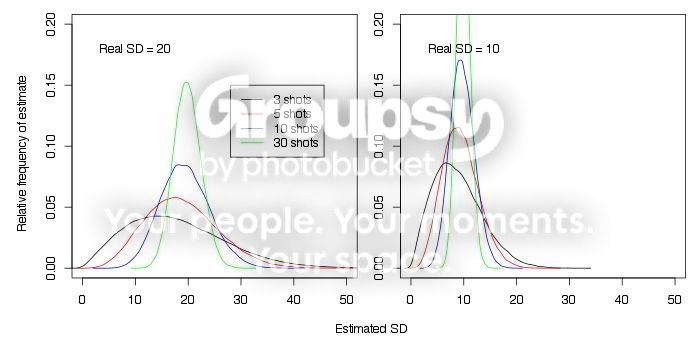
Here are the sampling error distributions of the standard deviation, when the true standard deviation is either 20 or 10, for estimates based on 3, 5, 10 and 30 shots. More data is always better, but true, you'll typically have it nailed down pretty well with ten shots.

SD.jpg


RG

<>< <>< <><

edit: the algorithm I used to approximate these distributions assumes that the equipment introduces no error, which of course is not true. Also, the calculations assume that the true distribution of velocities is normal (i.e., bell-curved).
 
It also explains why weighing individual charges may be a huge waste of time.

For most things, agreed. I get in the low teens (.223) off of a progressive press with short-grain powder.

Up to about 300 yards the slight velocity variances are an insignificant component of accuracy. At longer ranges, velocity uniformity becomes gradually more important.
 
For most things, agreed. I get in the low teens (.223) off of a progressive press with short-grain powder.

Up to about 300 yards the slight velocity variances are an insignificant component of accuracy. At longer ranges, velocity uniformity becomes gradually more important.

Denton Bramwell and John Barsness both did tests showing that even .1 to .2gr of variation in powder charges makes very little difference in precision. A 3 degree F change in barrel temperature can mean more variation than a .1gr change in powder. For example, and I am quoting Denton here:
So, if you have a .5 MOA rifle (243, 75 grain bullet, 3,400 FPS, 1 grain = 75 FPS, a favorable set of assumptions) that never shoots fliers, and you're shooting on a perfect windless day, and if the rifle and cartridge are the sole source of random variation, and if your cases all have exactly the same capacity, and your bullets all have exactly the same mass, we can calculate the shape of your groups and see what influence better SD has:

At 500 yards, with a 15 FPS standard deviation, your groups would be ovals 3.2" tall and 2.5" wide.

Switching to a really terrible powder measure with a .25 grain standard deviation (extreme worst case assumption), your MV SD would increase to 24 FPS. Now your 500 yard groups are 4" tall and 2.5" wide. (I have tested the Perfect Powder Measure with Varget, and it gives a standard deviation of .11 grains. Under this condition, MV SD increases from 15 FPS to 17.1 FPS rather than 24 FPS.)

Without doing the math, I expect that you'd have to shoot hundreds of rounds to even statistically detect such a change.

And in real life, the change is much much less than that because all the cases don't have equal capacity, and all the bullets don't have the same weight or mass, and the major source of random variation is probably the shooter. As stated, in very round numbers 3 degrees F change in barrel temperature is about the same as .1 grain of powder. If you're not controlling your barrel temp to within 3 F, there is no point in worrying about .1 grain.


I used to do things the "hard" way, but after much reading and thinking I am going to change my ways. I doubt I'll see any difference in performance.

 
Back
Top Bottom