Does anyone have experience with the Austrian Steyr-Mannlicher M95? Would it be good for plinking and hunting? Is it possible to buy the 8X56R ammo in bulk to try to keep the ammo cost down? I'm 16 and would love my first gun to be historical like this. My great-grandfathers were in the Austro-Hungarian army during WWI (one was an Ulhan) so I'd love to have a gun that they would've used.













































You are using an out of date browser. It may not display this or other websites correctly.
You should upgrade or use an alternative browser.
You should upgrade or use an alternative browser.
Steyr-Mannlicher M95/34 Carbine in 8x56R
- Thread starter PCB
- Start date
Ammo is available but not in surplus or bulk as far as I am aware. It won't be something you can head over to Canadian Tire and pick up either. You may in fact want to research reloading if you'd like a cheaper and reliable source.
As far as the rifles go, I've yet to hear anything bad about them. Austrians are known for their gunmaking, it should be as good as any other milsurp out there. Get the full length rifle if you want a truly authentic feel of what your relatives were carrying in the trenches. Mine carried Ross's, SMLE's and a few Mosin Nagants.
As far as the rifles go, I've yet to hear anything bad about them. Austrians are known for their gunmaking, it should be as good as any other milsurp out there. Get the full length rifle if you want a truly authentic feel of what your relatives were carrying in the trenches. Mine carried Ross's, SMLE's and a few Mosin Nagants.

samsplacci71
Regular
- Location
- Toronto area
These are usually found in very good condition. Great rifles. The short carbine though produces a big flame though, so be ready for some moderate recoil. The bolt is a straight pull mauser design, rather unique. Be careful with the bolt, it can accidentally become lodged in the action and is quite tricky to extracate!! Ammo is available but as Kennymo says, not available at your local CanTire.
samsplacci71
Regular
- Location
- Toronto area
So the cheapest option for ammo would still be reloading. Thanks Sam.
Correct. If you don't already know how to reload, but you happen to know someone who does, this is the best option. Reloading is not difficult, but you must be safe, thorough and methodical in your process. Unless I am mistaken, you will also require what is called an "enbloc clip". Similar in concept to the Gewher 88. This action requires a metal clip to hold the cartridges in place. You drop the whole 5 round "clip" into the open action from the top. http://en.wikipedia.org/wiki/Steyr-Mannlicher_M1895

Your grandpa did not use the 8x56R in the big one. The caliber on these rifles was originally 8x50R. In the 30's Bulgaria converted many WW1 rifles to a more modern and powerful cartridge that was similar...but definitely not the same. Most of the WW1 rifles were long. The Bulgarians also cut them into carbine sized in the 30s....which then meant changing the stocks!
They also changed the sights. So it really was a transformation.
The way I see it, its like the Enfield's in .308 - not much collectability in my books for a WW1 rifle. But these 8x56's were used in WW2 by Bulgaria and REMF's.
Try to find one in this original caliber - they are out there. I have one. Then you not only will have a rare rifle, but it will be 100% correct for the rifle he used in war.
Unfortunately 8x50R ammo is not available but you can reload them. The empty brass is available, and so are the dies. You can even make the brass from fired 7.62x54R (very common). Though doing this will require more time and $$$$.
If you don't have the time and $$$ now then shoot that 8x56 and have some fun. Keep your eye out for one that is original though! Later on when you have more time and moola you can get historical.
Sorry to bust your bubble...but at least you know now instead of being told a year later from someone else.
Good info here.
http://www.hungariae.com/Mann95.htm
They also changed the sights. So it really was a transformation.
The way I see it, its like the Enfield's in .308 - not much collectability in my books for a WW1 rifle. But these 8x56's were used in WW2 by Bulgaria and REMF's.
Try to find one in this original caliber - they are out there. I have one. Then you not only will have a rare rifle, but it will be 100% correct for the rifle he used in war.
Unfortunately 8x50R ammo is not available but you can reload them. The empty brass is available, and so are the dies. You can even make the brass from fired 7.62x54R (very common). Though doing this will require more time and $$$$.
If you don't have the time and $$$ now then shoot that 8x56 and have some fun. Keep your eye out for one that is original though! Later on when you have more time and moola you can get historical.
Sorry to bust your bubble...but at least you know now instead of being told a year later from someone else.
Good info here.
http://www.hungariae.com/Mann95.htm

The original 8x50R used a 244-grain RN bullet: just TRY finding them! As well as Austria-Hungary, the ammunition was used by the Kingdom of Bulgaria in their Model of 1903 rifles: identical to the Austro-Hungarian rifles except for the DATE on the left-hand Receiver Rail and the Royal Bulgarian crest on the Receiver Ring. Sporting ammunition was made in England for a short time, also.
There were none of these rifles built after the end of the Great War.
In the 1930/31 period, the successor states of Austria and Hungary both adopted a new cartridge, the 8x56R. Bulgaria followed suit, modifying their own older rifles to handle the new ammunition.
So the new ammunition, in the old rifles, was used by THREE countries.
Also in the 1930s, many of the older "long" rifles were modified into shorter, handier, "short rifles". This is what you have. They were completely rebuilt to "new" condition and then, when the War came, they were not used at the Front because every effort was made to keep rifles in the combat zone all using the same ammo: it was hard enough to supply 8x57.... without throwing in the supply problems of adding 8x50R, 8x56R and 7.35x52 and .303 (remember those 130,000 rifles they got at Dunkirk? They used them doing guard duty!).
These rifles were kept in storage for a long time and then released very late, accounting for the good condition of most of them. Prices have been kept low by the facts that most folks don't know much about them, that very little military ammunition ever was surplussed and that sporting ammunition was unavailable in Canada until a few months ago.
But they are genuine rifles which were used in the First World War and again in the Second. They ARE History.
Austria-Hungary had been a major industrial Power before the Great War, but the successor States were flat broke, hurt badly by the War (utterly horrendous casualties) and definitely were second-rate Powers. They just did not have the money to re-equip, so they did the next-best-thing: shortened all those old rifles, reamed out the barrels and rechambered for a new cartridge which required reaming the chamber large enough to get rid of any rust which might have been in there. The new bullet diameter was to be .330" rather than .323", weight was to be 208 rather than 244 grains and a Boat-Tailed design was adopted to extend range.
Trade-Ex has FMJ AND sporting bullets and brass, LEE makes dies (about $40 and they work okay: RCBS are more than double). To keep muzzle-flash and NOISE to a bearable level, load with the quickest powder you can get away with. These are a bit of a cannon, but they WILL drop your Moose (and likely gut, skin and quarter him with the same round!) if you hit him.
These are an excellent if little-known rifle, solid, reliable and very tough. Featuring Steyr quality workmanship on the best Poldi steel, they were the final straight-pull design to come from the Ritter Ferdinand von Mannlicher.
There: I have told you what little I know. Go blast a Moose! Post a good picture of the crater! Make a stew!
Have FUN! That's what it's all about.
PS: my family used Rosses and Lee-Enfields, dirk-and-broadsword in the old days.
There were none of these rifles built after the end of the Great War.
In the 1930/31 period, the successor states of Austria and Hungary both adopted a new cartridge, the 8x56R. Bulgaria followed suit, modifying their own older rifles to handle the new ammunition.
So the new ammunition, in the old rifles, was used by THREE countries.
Also in the 1930s, many of the older "long" rifles were modified into shorter, handier, "short rifles". This is what you have. They were completely rebuilt to "new" condition and then, when the War came, they were not used at the Front because every effort was made to keep rifles in the combat zone all using the same ammo: it was hard enough to supply 8x57.... without throwing in the supply problems of adding 8x50R, 8x56R and 7.35x52 and .303 (remember those 130,000 rifles they got at Dunkirk? They used them doing guard duty!).
These rifles were kept in storage for a long time and then released very late, accounting for the good condition of most of them. Prices have been kept low by the facts that most folks don't know much about them, that very little military ammunition ever was surplussed and that sporting ammunition was unavailable in Canada until a few months ago.
But they are genuine rifles which were used in the First World War and again in the Second. They ARE History.
Austria-Hungary had been a major industrial Power before the Great War, but the successor States were flat broke, hurt badly by the War (utterly horrendous casualties) and definitely were second-rate Powers. They just did not have the money to re-equip, so they did the next-best-thing: shortened all those old rifles, reamed out the barrels and rechambered for a new cartridge which required reaming the chamber large enough to get rid of any rust which might have been in there. The new bullet diameter was to be .330" rather than .323", weight was to be 208 rather than 244 grains and a Boat-Tailed design was adopted to extend range.
Trade-Ex has FMJ AND sporting bullets and brass, LEE makes dies (about $40 and they work okay: RCBS are more than double). To keep muzzle-flash and NOISE to a bearable level, load with the quickest powder you can get away with. These are a bit of a cannon, but they WILL drop your Moose (and likely gut, skin and quarter him with the same round!) if you hit him.
These are an excellent if little-known rifle, solid, reliable and very tough. Featuring Steyr quality workmanship on the best Poldi steel, they were the final straight-pull design to come from the Ritter Ferdinand von Mannlicher.
There: I have told you what little I know. Go blast a Moose! Post a good picture of the crater! Make a stew!
Have FUN! That's what it's all about.
PS: my family used Rosses and Lee-Enfields, dirk-and-broadsword in the old days.
The rifles were rechambered to 8x56r and many were cut down to carbine length. I've got one that went through both Vienna and budapest during WWI. Personally I am not so hung up on the original chambering, these rifles soldiered on long after 1918. Most of the 8x50r rifles seemed to come out of the Italian colonies and have Italian markings that aren't original but are part of history.
They make decent hunting rifles, but you must reload for that as there is no softpoint ammo on the market but components are easy to come buy. The carbine Are light and handy and the long rifles are very elegant. In excellent condition they are things of beauty.
Once you are 18 and get a rifle, shoot me a pm and I can send you a few clips to get you started.
They make decent hunting rifles, but you must reload for that as there is no softpoint ammo on the market but components are easy to come buy. The carbine Are light and handy and the long rifles are very elegant. In excellent condition they are things of beauty.
Once you are 18 and get a rifle, shoot me a pm and I can send you a few clips to get you started.

MauserMike
CGN Ultra frequent flyer
- Location
- SW Ontario
Is this 8x56R that I have here? Inherited a lot of such odds and ends from my dead friend's estate.
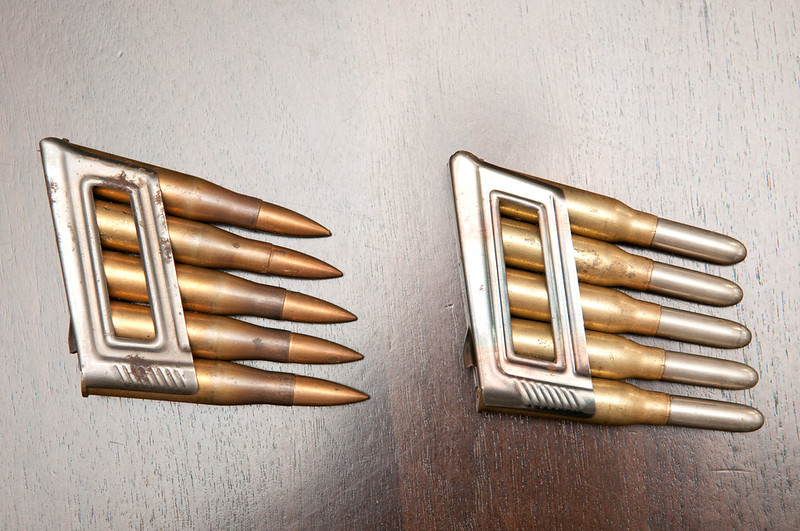
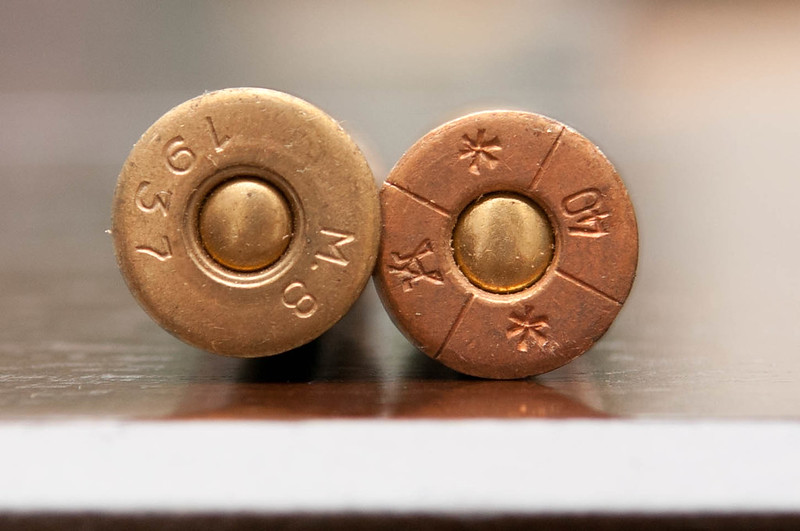
Spitzer bullet cartridge is the right headstamp.
Spitzer bullet cartridge is the right headstamp.

OP, get the rifle, have fun with it.
The Austrians tried repeatedly to update to a spitzer only to fall short due to budgetary reasons, they were alot later than most major militaries, but did come up with one nice round.

You can buy bulk Prvi from a few dealers, and get a reasonable price, but you will want some of the stripper-clips/en-bloc clips for sure. Watch out for the milsurp stuff, especially the Bulgarian stuff, very corrosive, you want to be sure to clean well after firing it.
The Austrians tried repeatedly to update to a spitzer only to fall short due to budgetary reasons, they were alot later than most major militaries, but did come up with one nice round.

You can buy bulk Prvi from a few dealers, and get a reasonable price, but you will want some of the stripper-clips/en-bloc clips for sure. Watch out for the milsurp stuff, especially the Bulgarian stuff, very corrosive, you want to be sure to clean well after firing it.
Google this site MANOWAR'S HUNGARIAN WEAPONS (http://www.hungariae.com/)
for more information.
for more information.
MauserMike
CGN Ultra frequent flyer
- Location
- SW Ontario
Cool. My great grandfather was in the Austrian Calvary in WWI.
You should consider the M95 long rifle if you want something authentic to that period.
You should consider the M95 long rifle if you want something authentic to that period.
Last edited:

MauserMike
CGN Ultra frequent flyer
- Location
- SW Ontario
Well I haven't been able to find one except for the long rifles. But the spirit of my comment was to say that the M95/34 is not a WWI configuration of that platform.






















