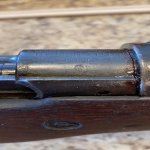
Tell me about these Enfields!

TheWhole9Yards

CGN frequent flyer
Rating - 100%
195   0   0
Location
Ontario
Just picked these up from a friend of a friend who sold off his collection. I’m a milsurp fan but far from an expert. I think I have an idea of what I bought, but I’d love to be corrected if I’m wrong. Also if possible I’d like to hear what you guys think they’re worth to confirm if I got the deal I thought I did.

From the top down:

No4MK2 - wiki tells me this is an “Irish contract” rifle

No4MK1* - long branch made in ‘42, I’ve been searching for a LB made wartime rifle for years!

M1917 - serial # comes up as june ‘18 production and I believe the red stripe makes this a lend lease rifle issued to the British Home Guard during 1940/1941.
 
Last edited:
Looks like an excellent score!!!! Might want to invest in snug fitting screw driver tips if you attempt to mess with the screws - do not want to cause damage / make them worse. Likely need to be stripped down to be cleaned - may need to find some reference material to tell you how to do that. Especially your LB 1942 - has possibility to be special - something about the date shown on receiver plus the date shown on some barrels - worth looking into once you know what all the markings are, in various places. As far as collector pieces go, probably do not want to sand or to try to make prettier - just an honest cleaning with reasonably correct stuff and a lube is likely fair. Try to resist temptation to make them into something they are not. Sounds contrary to some people, but "re-finishing" likely reduces the value to people who would pay premium dollar for those items. So do not "varnish" the wood; do not use "cold blue" on the metal parts - they are what they are. Not likely any of those stocks have seen linseed oil for decades - unless previous owner knew better - so another thing well worth to investigate to help clean and give that wood "a drink"... Of course, they are your property - can do what you want with them - just do not expect others to see value in the same things that you might have done??

So that you know regarding that rifle you think was "Irish Contract" - it might well be - but be aware that until recently they were still being bought and sold, still in the brown waxed paper wrapping as stored after production - so there are (or at least recently were) absolutely brand new, never unwrapped ones in the market - would never have been fired since leaving the factory. Keep that in mind as you evaluate value and prices.

For the M1917, I understand they were surplused off shortly after WWII - certainly were not very expensive - my Dad got his in 1948 and promptly did as was done to thousands of them - cut down the stock, shortened the barrel, etc. and made a very inexpensive, very decent "hunting rifle" while on the farm in Saskatchewan. I understand same was being done Newfoundland to B.C. in that time frame, so finding what looks like a complete one is pretty special, I think.

A very minor and "nit picky" thing. The first two rifles in your picture are not "enfields" - they are Lee-Enfields. The third rifle - the U.S. Model of 1917 - is often referred to as an "Enfield" rifle, along with it's very close relative, the Pattern 1914 (P14). All of them had some or most of their design done at the Enfield armoury in England - I am pretty certain the "Lee" part refers to the name of the guy that came up with the action that is used, that was picked up by that armoury at Enfield, that they then matched with their "Enfield" style rifling in the barrel.

 
Last edited:
Upon closer inspection I see there is a canadian marking on the M1917

1262AC1C-B1C4-4A26-BE59-57664E2CB087.jpg

Would this have been used for guard duty or something?
 

Attachments

  • 1262AC1C-B1C4-4A26-BE59-57664E2CB087.jpg
    1262AC1C-B1C4-4A26-BE59-57664E2CB087.jpg
    44.4 KB · Views: 562
I understand that Canada bought a fair large number of M1917 rifles during WWII. For sure, a bunch ended up with the guards at various RCAF bases in Canada - no doubt other places - you may find more stamps to go with that one on the receiver - look along the sides of the wood stock - often more markings alongside the butt - or underneath, behind the trigger guard. That red paint band was a thing both in Canada and UK to identify that rifle to be using 30-06 ammo - the near twin rifle was the Pattern 1914 (P14) and it used 303 British cartridges - so military wanted very obvious way to tell which was which.

Your M1917 rifle, because of the red band and the "C" Broad Arrow stamp, likely was sold to Canada. If so, the bolt handle likely has the same serial number as does the receiver. A USA M1917, that was in possession of USA military for it's entire military life, will not have a serial number on the bolt handle. Britain and Canada and maybe other countries felt it was important to put on that number so the bolts would not get mixed up - I presume. USA did not appear to be too concerned about that. If you ever get so far as to remove the rear hand guard, you will likely see the serial number was again repeated on the right side of the barrel in the chamber area - so the original barrel will have the matching serial number to the receiver. If that was a P14, there would be a fourth instance of the serial number on the rear sight, but that was not done on the M1917's.
 
Last edited:
Looks like an excellent score!!!! Might want to invest in snug fitting screw driver tips if you attempt to mess with the screws - do not want to cause damage / make them worse. Likely need to be stripped down to be cleaned - may need to find some reference material to tell you how to do that. Especially your LB 1942 - has possibility to be special - something about the date shown on receiver plus the date shown on some barrels - worth looking into once you know what all the markings are, in various places. As far as collector pieces go, probably do not want to sand or to try to make prettier - just an honest cleaning with reasonably correct stuff and a lube is likely fair. Try to resist temptation to make them into something they are not. Sounds contrary to some people, but "re-finishing" likely reduces the value to people who would pay premium dollar for those items. So do not "varnish" the wood; do not use "cold blue" on the metal parts - they are what they are. Not likely any of those stocks have seen linseed oil for decades - unless previous owner knew better - so another thing well worth to investigate to help clean and give that wood "a drink"... Of course, they are your property - can do what you want with them - just do not expect others to see value in the same things that you might have done??

So that you know regarding that rifle you think was "Irish Contract" - it might well be - but be aware that until recently they were still being bought and sold, still in the brown waxed paper wrapping as stored after production - so there are (or at least recently were) absolutely brand new, never unwrapped ones in the market - would never have been fired since leaving the factory. Keep that in mind as you evaluate value and prices.

For the M1917, I understand they were surplused off shortly after WWII - certainly were not very expensive - my Dad got his in 1948 and promptly did as was done to thousands of them - cut down the stock, shortened the barrel, etc. and made a very inexpensive, very decent "hunting rifle" while on the farm in Saskatchewan. I understand same was being done Newfoundland to B.C. in that time frame, so finding what looks like a complete one is pretty special, I think.

A very minor and "nit picky" thing. The first two rifles in your picture are not "enfields" - they are Lee-Enfields. The third rifle - the U.S. Model of 1917 - is often referred to as an "Enfield" rifle, along with it's very close relative, the Pattern 1914 (P14). All of them had some or most of their design done at the Enfield armoury in England - I am pretty certain the "Lee" part refers to the name of the guy that came up with the action that is used, that was picked up by that armoury at Enfield, that they then matched with their "Enfield" style rifling in the barrel.


I believe the "Lee" part of the name comes from James Paris Lee, who was famous for designing the staggered/removable box magazine.

His name is also used with the "Lee-Speed" rifles as well as the US Navy Lee

The red paint on the P17 likely indicates that it was used by home guard or maybe even PCMR
 
The red stripe signifies non-standard calibre, in this case 30-06, which was not an official front line calibre. P17's were marked in order to prevent someone getting issued .303 for his 30-06. I haven't seen a C-Broadarrow Garand with stripes, so maybe they thought it was obvious for them. Some (a small portion of all rifles issued to the PCMR) of these guns (P17s) were issued to the PCMR, if so in this case, it's very collectible. Generally PCMR Pattern 17's had the red stripe around the butt of the stock, but worth researching.
 
Matching bolt on the '42 Longbranch?

I see it has the round early style cocking piece used in that vintage so my bet would be "matching".

You did well, very nice firearms and those "42's don't come by that often, for that mater neither does your C broad arrow marked '17.
 
Matching bolt on the '42 Longbranch?

I see it has the round early style cocking piece used in that vintage so my bet would be "matching".

You did well, very nice firearms and those "42's don't come by that often, for that mater neither does your C broad arrow marked '17.

Bolt handle does not match the rifle. The stock is well worn and the action is full of cosmoline, not sure I’ll be able to bring myself to clean it up and shoot it. Whats it worth?
 
I can not help on the value, but those No. 4's in particular - a specific way to dismantle - not like a "normal" rifle - so much of the accuracy is within a wooden shape at the upper rear that should be wedged, tight, by two slopes under the rear of the receiver - that is generally referred to as the "draws" - so, for example, that fore stock must come off the rifle staying more or less parallel to the bore line - have seen several time the stock is removed by prying down on the front end - under the barrel - as if removing the forearm on a single shot shotgun - typically that rounds off or breaks off the draws. Is also a place that seems to collect over spill of lubricant and that wood area can go "punky" soft - at that point needs to be repaired / replaced.

Despite what stories that you might hear, can look on Internet and find that the No. 4's were never actually made to be "precise" rifles - the standard for acceptance was something like 5 rounds, at 100 FEET (33 yards) into a rectangle 1" wide and 1 1/2" high - so about 3 MOA wide and 4 1/2 MOA high, for 5 shots of standard military ammunition. Later work by target shooters discovered ways to improve on that, and a few of the "improvements" were adopted by some militaries, especially for their competitive target shooting teams. Was all about various bedding and "padding". I had read a wonderful post on this website by a former target shooter that the actual set up for target shooting of a No. 4 may have also involved various incantations, and perhaps a dead cat. One of those things to be able to recognize as you dismantle - was yours a standard WWII set up, or had someone been in there after the WWII to "improve" it.
 
Last edited:
I'll take a stab at pricing your pieces. I would say fair market value....

1- No4MK2....if matching bolt and good bore $850-$950

2- 1942 No4MK1* LB.....$900.....price would he certainly higher if it had a matching bolt! Some collectors would not be interested just because of the mis-matched bolt.

3-M1917.....that's a real nice "honest" looking piece, being Canadian issue certainly helps. If bore is good you might on a good day get $1100-$1200

I always shake my head at the prices that milsurp rifles are demanding these days, I may be a little on the conservative side!

Hope this helps and you did ok!
 
I'll take a stab at pricing your pieces. I would say fair market value....

1- No4MK2....if matching bolt and good bore $850-$950

2- 1942 No4MK1* LB.....$900.....price would he certainly higher if it had a matching bolt! Some collectors would not be interested just because of the mis-matched bolt.

3-M1917.....that's a real nice "honest" looking piece, being Canadian issue certainly helps. If bore is good you might on a good day get $1100-$1200

I always shake my head at the prices that milsurp rifles are demanding these days, I may be a little on the conservative side!

Hope this helps and you did ok!

Thanks for the info, much appreciated!
 
Back
Top Bottom